How to File for Divorce Online in 2026: The Complete Step-by-Step Guide That Saves Thousands
The Night You Decided Enough Was Enough
You didn’t plan to be here at 2am, staring at a search bar with “how to file for divorce online” typed out but not yet submitted. Maybe you’ve had this tab open for weeks. Maybe tonight was the night something shifted, and the question you’d been circling for months finally became a sentence you were ready to act on. You’re not panicking. You’re planning. And that distinction matters more than you realize.
Filing for divorce online isn’t a last resort or a shortcut for people who can’t afford a “real” attorney. In 2026, it’s a legitimate, court-approved pathway that hundreds of thousands of Americans use every year to end their marriages with dignity, clarity, and far less financial destruction than traditional contested litigation. When it’s the right fit for your situation, it can save you tens of thousands of dollars, months of court delays, and the particular kind of emotional erosion that comes from dragging a broken relationship through a formal adversarial process.
But here’s what most online guides won’t tell you: online divorce isn’t a single thing. It’s a spectrum of legal options, each with different requirements, different risks, and different outcomes depending on your state, your assets, your children, and the complexity of what you and your spouse need to resolve. Choosing the wrong pathway, or moving through the right one without understanding its legal implications, can leave you with a divorce decree that doesn’t protect you the way you think it does.
This guide changes that. By the time you finish reading, you’ll understand exactly what online divorce is in legal terms, whether it’s right for your specific situation, every step of the filing process from start to finalized judgment, the strategic mistakes that quietly derail cases, and the precise moments when you need a licensed attorney beside you even in an otherwise simple case.
Let’s start where you are: with the honest truth about what filing for divorce online actually means.
What Filing for Divorce Online Actually Means: The Legal Foundation
Plain-Language Definition of Online Divorce
Online divorce, in its most accurate legal description, refers to the use of internet-based platforms, court e-filing portals, or document preparation services to complete, organize, and submit the paperwork required to initiate and finalize a divorce proceeding without physically appearing at a courthouse to file in person.
Think of it like filing your taxes. The underlying legal obligation, submitting accurate information to a governing authority and receiving a formal judgment, is identical whether you walk into an accountant’s office or use TurboTax at your kitchen table. The platform changes. The legal process does not.
The term is commonly misunderstood because people use “online divorce” to mean three entirely different things: using a court’s own e-filing portal to submit documents directly, using a third-party document preparation service to generate your forms and then filing them yourself, or hiring an attorney who operates entirely online and handles your case through digital communication and remote representation. Each of these is a valid use of the phrase, and each carries different legal weight, different costs, and different levels of protection.
What online divorce is not, and this is where mainstream legal advice consistently fails people, is a legally lesser form of divorce. A divorce finalized through an online process carries the exact same legal force as one litigated over twelve months in a traditional courtroom. The decree is binding. The asset division is enforceable. The custody arrangement has the full weight of a court order. The process differs. The legal outcome does not.
Featured Snippet Target: Online divorce is a court-approved process that allows spouses to complete and submit their divorce paperwork through internet-based platforms or court e-filing portals rather than filing in person. When requirements are met, an online divorce produces a legally binding final decree with identical enforceability to a traditionally litigated divorce. It is most appropriate for uncontested cases where both spouses agree on all major terms including property division, debt allocation, and if applicable, child custody and support.
The foundational legal principle that makes online divorce possible is the concept of an uncontested divorce, meaning both spouses agree on all material terms of the dissolution and neither party is asking the court to decide disputed issues. When there is no dispute for a judge to resolve, the court’s role becomes largely administrative: reviewing submitted paperwork, confirming legal compliance, and issuing a final judgment. That administrative function can be performed entirely on the basis of written filings, which is precisely what makes online completion viable.
According to the American Bar Association’s divorce resource guide, uncontested divorces represent a significant and growing portion of all dissolution proceedings in the United States. Understanding whether your divorce qualifies as truly uncontested, and maintaining that status through the filing process, is the single most important legal determination you will make before you begin.
The 12 Steps to File for Divorce Online in 2026: A Complete Legal Walkthrough
This is the core of what you came here for. These are not the simplified, overgeneralized steps you’ll find on a document-preparation company’s landing page. These are the actual procedural and legal steps of the online divorce process, explained with the precision and context you need to navigate them without making costly errors.
Step 1: Determine Whether You Actually Qualify for an Uncontested Online Divorce
Before you create an account on any platform, before you download a single form, you need to answer one foundational legal question with complete honesty: do you and your spouse genuinely agree on everything?
Not “we’ll probably work it out.” Not “I think we’re mostly on the same page.” Genuinely, concretely, documented agreement on every material issue your divorce must resolve.
The legal issues a divorce decree must address vary depending on your circumstances, but the categories are consistent across U.S. jurisdictions. For couples without children, those issues are property division (all real estate, vehicles, financial accounts, retirement accounts, and personal property), debt allocation (who is responsible for which marital debts, including credit cards, mortgages, student loans, and other obligations), and spousal support, also called alimony, including whether it will be paid, by whom, in what amount, and for how long.
For couples with minor children, the decree must also address legal custody (who has the right to make major decisions about the children’s education, healthcare, and religious upbringing), physical custody (where the children live and on what schedule), a detailed parenting time schedule, child support (calculated according to your state’s guidelines), and provisions for health insurance coverage and major unplanned expenses for the children.
If you and your spouse agree on all of these issues, or can reach agreement through direct negotiation or mediation before you file, you are a strong candidate for an uncontested online divorce. If there is genuine, unresolvable disagreement on any material issue, you are looking at a contested divorce, which requires in-person litigation and almost certainly requires licensed legal representation.
The legal risk of misclassifying a contested divorce as uncontested is serious. If you file as uncontested and your spouse contests any term after filing, your case converts to a contested proceeding, and you lose the time, filing fees, and document preparation costs you’ve already invested. Worse, if you push through a technically uncontested filing but suppress a real disagreement, you may end up with a decree that one party refuses to comply with, requiring enforcement action later.
Be honest with yourself in this first step. Everything else depends on it.
The Residency Requirement: A Non-Negotiable Legal Prerequisite
Every U.S. state imposes a residency requirement before its courts will accept a divorce filing. This means either you or your spouse must have lived in the state where you plan to file for a minimum period of time before you can invoke that court’s jurisdiction. Jurisdiction, in legal terms, refers to the court’s legal authority to hear your case and issue binding orders.
Residency requirements vary significantly by state. Nevada has one of the shortest at six weeks. Most states require six months. Some states require a full year. A handful of states impose different residency periods for military personnel stationed within their borders.
If you file in a state before you’ve satisfied the residency requirement, the court will dismiss your case. You will lose your filing fee. You will need to refile. It is a preventable delay that I see trip up online filers more often than almost any other procedural error.
Before you take any other step, confirm your state’s current residency requirement. Your state court’s official website, legal resource sites like Cornell Law School’s Legal Information Institute, or a brief consultation with a family law attorney can give you this information quickly and accurately.
Separation Periods and Waiting Periods: Know the Difference
Some states require spouses to live separately for a specified period before a divorce can be finalized. This is called a separation period, and it is a substantive legal prerequisite, not just a waiting period after filing. States like North Carolina require a one-year separation before you can even file. Virginia requires a six-month separation for couples without minor children and a one-year separation when children are involved.
Separate from, and in addition to, separation periods, most states impose a mandatory waiting period after you file before a divorce can be finalized. These are sometimes called “cooling off” periods and typically range from 30 to 90 days. California requires six months. Texas has a 60-day minimum. Some states have no mandatory waiting period at all.
Understanding the difference between a separation period (which precedes filing) and a waiting period (which follows filing) is essential for timeline planning. If you’re in a state with a required separation period and you haven’t yet satisfied it, you cannot legally file yet regardless of how complete your paperwork is.
Step 2: Choose Your Grounds for Divorce
In 2026, every U.S. state offers no-fault divorce. This is the legal pathway you will almost certainly use if you’re filing online, and it’s worth understanding what it actually means.
No-fault divorce means you are not required to prove that your spouse did something wrong in order to end the marriage. You don’t need evidence of infidelity, abandonment, cruelty, or any other marital misconduct. You simply state that the marriage has broken down irretrievably and that reconciliation is not possible.
Different states use different statutory language for the no-fault ground. “Irreconcilable differences” is the most common phrasing, used in California, Texas, and many others. “Irretrievable breakdown of the marriage” is used in states including Florida and Massachusetts. Some states use “incompatibility.” The words differ. The legal concept is identical: neither spouse has to prove fault, and the court will grant the divorce on that basis alone.
Fault grounds, such as adultery, abandonment, or cruelty, still exist in many states and can occasionally be relevant to issues like alimony or, in rarer cases, property division. But for an uncontested online divorce, fault grounds are almost never used because they require proof, which means contested proceedings. You will almost certainly select the no-fault ground.
This is straightforward in practice. When your online divorce platform or court form asks you to select your grounds, you select the no-fault option appropriate to your state. You don’t need to write a narrative explaining what went wrong in your marriage. The court doesn’t need your story. It needs a legally sufficient reason to dissolve the marriage, and “irreconcilable differences” is exactly that.
Step 3: Select the Right Online Divorce Platform or Filing Method
This is where the practical decision-making gets more nuanced, and where many people make an expensive mistake by choosing a platform based on price alone without understanding what they’re actually getting.
In 2026, there are three primary pathways for filing for divorce online, and they are meaningfully different in terms of legal support, document accuracy, and appropriate use cases.
Pathway One: Your State Court’s Official E-Filing Portal
Many state court systems now have their own online e-filing portals that allow self-represented litigants, meaning people representing themselves without an attorney, to file court documents directly with the clerk of court through a secure online system. These portals are free to use beyond standard filing fees and are the most direct connection between your paperwork and the court’s docket.
The advantages of using your court’s own portal are significant. Your documents go directly into the court system. There are no intermediary companies involved. There is no subscription fee or per-form charge. The forms available on the portal are jurisdiction-specific and court-approved.
The disadvantages are equally significant. Court portals typically provide forms but minimal instruction. They assume a level of legal literacy that most self-represented filers don’t have. If you complete a form incorrectly, the portal may not catch the error before you submit. You won’t have guidance on which forms you need for your specific situation, and selecting the wrong forms or omitting required attachments will result in rejection.
If you have a genuinely simple case, no children, limited shared assets, short marriage, no retirement accounts, and you’re comfortable reading legal instructions carefully, your court’s official e-filing portal is the most cost-effective option. Start by visiting your state court’s official website and looking for a “self-help” or “family law forms” section.
Pathway Two: Third-Party Online Divorce Document Preparation Services
Services in this category include well-known platforms that guide you through a questionnaire, use your answers to populate jurisdiction-specific divorce forms, and then provide completed documents that you file with the court yourself. Some services also offer to file on your behalf, though this is more common in states with robust e-filing infrastructure.
These services typically charge between $150 and $500 for basic uncontested divorce packages, with add-on fees for services like notarization coordination, additional document sets, or expedited processing. They are not law firms. Their representatives cannot give you legal advice. The questionnaires are sophisticated, but they cannot account for every legal nuance in your situation.
What these services do exceptionally well is reduce form-completion errors for people with straightforward cases and help filers understand which documents they need for their state. What they cannot do is flag a legal complication in your asset division, identify a problematic custody clause, or advise you when your situation has moved beyond what a standard template can handle.
If you use one of these services, read every completed form before you submit it. Confirm that your specific situation, every asset, every debt, every child-related term, is accurately reflected in the documents. A template that doesn’t match your actual agreement creates a decree that doesn’t protect you.
Pathway Three: Online Legal Services with Attorney Review or Full Representation
In recent years, a growing category of legal service providers offers hybrid models that combine the convenience of online filing with actual attorney involvement. Some offer attorney review of your completed documents for a flat fee. Others provide full unbundled legal representation, where an attorney handles specific parts of your case without representing you for the entire proceeding.
Unbundled legal services, sometimes called limited scope representation, are legally recognized in most U.S. states. They allow you to hire an attorney to draft your settlement agreement, review your parenting plan, or appear with you at a specific hearing, without paying for comprehensive representation throughout the entire case.
For an uncontested online divorce that involves significant assets, a retirement account, a business interest, or children, a hybrid model with attorney review of your final agreement is often the most strategically sound choice. You pay significantly less than full representation while still having a licensed professional confirm that your decree actually does what you intend it to.
Step 4: Gather the Required Documents and Financial Disclosures
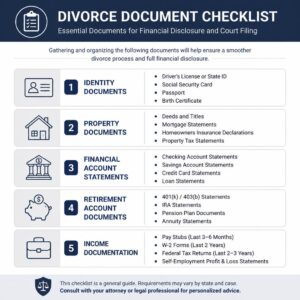
One of the most common reasons online divorce filings stall or get rejected is incomplete documentation. The court needs specific information to process your filing, and in virtually every U.S. jurisdiction, both spouses are required to make mandatory financial disclosures as part of the divorce process.
Financial disclosures are not optional even in an uncontested divorce. They are a legal requirement designed to ensure that both spouses are making informed decisions about property division and support based on complete, accurate information. Attempting to proceed without completing them, or completing them inaccurately, can expose you to claims of fraud and put your final decree at risk of being vacated, meaning undone by the court, after the fact.
Here is a comprehensive document checklist organized by category:
Identity and Marriage Documents
You will need your original marriage certificate or a certified copy. Most states require the official certificate with the registrar’s seal, not a church copy or a photocopy. If you don’t have your original marriage certificate, contact the vital records office in the state or county where you were married. Processing times vary, so request this document early in your preparation.
You will also need government-issued identification for both spouses, including your Social Security numbers, which are required for certain court forms and for calculating child support. If you have a prenuptial or postnuptial agreement, locate that document as well. It will directly affect how you structure your property settlement.
Real Property Documents
For any real estate you own jointly or separately, you will need the deed showing how title is held, a recent mortgage statement showing the current balance, a recent property tax statement, and if available, a current appraisal or recent comparable sales data that supports your agreed-upon property value.
If you’re agreeing that one spouse keeps the home and will refinance the mortgage to remove the other spouse’s name, you need to address this explicitly in your settlement agreement with a clear timeline. Courts have seen too many cases where one spouse “was going to refinance” after the divorce and never did, leaving the other spouse legally liable on a mortgage for a home they no longer own. Your agreement must specify what happens if the refinance doesn’t occur within a defined period.
Financial Account Documents
Gather the most recent statements for every financial account that existed during the marriage: bank accounts (checking, savings, money market), investment accounts (brokerage accounts, mutual funds), and any cash value in life insurance policies. You need the account number, the institution name, and the current balance.
For retirement accounts, this is where careful documentation becomes especially important. You need statements showing the current balance and, critically, the value of the account as of the date of marriage if either spouse brought retirement savings into the marriage. The portion of a retirement account that was accumulated before the marriage may be treated as separate property in your state, and establishing that value accurately affects how the account is divided.
Retirement Account Specific Requirements
Dividing a retirement account in divorce requires a special court order called a Qualified Domestic Relations Order, commonly abbreviated as QDRO. This is one of the most commonly mishandled aspects of an online divorce.
A QDRO is a separate legal document from your divorce decree. It is sent directly to the retirement plan administrator and tells them how to divide the account between the spouses. Without a properly drafted and approved QDRO, the retirement account cannot be divided. You cannot simply write in your settlement agreement that “Wife gets 40% of Husband’s 401(k)” and consider it handled. That language in your decree creates the legal right to the account division. The QDRO is what actually effectuates it.
Many online divorce platforms do not include QDRO preparation in their basic packages. This is a genuine legal gap that I want you to be aware of before you finalize anything. If your divorce involves a 401(k), a 403(b), a pension, or any other employer-sponsored retirement plan, you need a QDRO in addition to your divorce decree. QDRO preparation requires specific legal expertise and is not a document you should attempt to draft yourself from a template.
Debt Documentation
Compile statements for every marital debt: credit card accounts (all of them, not just the ones in your name), car loans, personal loans, student loans (noting which were taken before or during the marriage), a HELOC or second mortgage if applicable, and any other outstanding obligations. For each debt, you need the current balance, the account number, and the name or names on the account.
Your divorce agreement will specify who is responsible for each debt. This is legally binding between you and your spouse. What your divorce agreement cannot do is bind your creditors. A credit card company does not become bound by your divorce decree. If the decree says your spouse is responsible for a joint credit card and your spouse doesn’t pay, the credit card company can still come after you. This is a legal reality that catches many online divorce filers completely off guard.
The practical implication is this: wherever possible, pay off and close joint accounts before or during the divorce process rather than assigning them in your agreement. Where that’s not possible, your agreement should include indemnification language requiring the responsible spouse to hold the other harmless from any liability arising from nonpayment, and specifying consequences for default.
Income Documentation
You will need income documentation for both spouses. This typically includes the last two to three years of federal tax returns, the most recent two to three months of pay stubs for any employed spouse, and if either spouse is self-employed, profit and loss statements, business tax returns, and bank statements showing business income.
Income documentation is used to calculate child support according to your state’s formula and to assess the appropriateness of any spousal support agreement. Even in an uncontested divorce where both spouses are agreeing to a specific child support amount, many states require that the agreed amount be at or above the guideline calculation or that the court approve a deviation. You cannot simply agree to a child support amount without knowing what your state’s guideline would produce and addressing any deviation explicitly.
Child-Related Documents (For Cases Involving Minor Children)
If you have minor children, you will need school enrollment records showing the children’s current addresses and schools, healthcare information including the names of the children’s doctors, the cost of health insurance and who currently provides it, documentation of any childcare costs, and if applicable, documentation of any special needs, disability-related expenses, or educational costs that need to be addressed in your agreement.
Some states also require a completed Parenting Plan document as a separate exhibit to your divorce decree. This is a detailed, written schedule and set of protocols governing everything from the regular week-to-week custody schedule to holiday and vacation allocation, decision-making authority, communication between parents, and protocols for resolving future disagreements. Courts in many states will not approve a custody agreement that does not include a detailed parenting plan.
Step 5: Complete the Divorce Petition (and Understand What You’re Signing)
The divorce petition, sometimes called a complaint for divorce or a petition for dissolution of marriage depending on your state, is the legal document that formally initiates your case. One spouse files it. That spouse becomes the Petitioner, or Plaintiff in some jurisdictions. The other spouse is the Respondent, or Defendant.
The choice of who files first in an uncontested divorce is largely procedural rather than strategic. The Petitioner bears the responsibility of serving the Respondent with the filed documents, pays the initial filing fee, and names the case first. In a contested divorce, there can occasionally be strategic advantages to filing first, but in a genuinely uncontested proceeding, the distinction is minor.
The petition typically asks for the following information: identifying information for both spouses (full legal names, current addresses, dates of birth, Social Security numbers), the date and place of your marriage, the date of separation, the grounds for divorce (you’ll select the no-fault ground), a general description of any children of the marriage including their names and dates of birth, a general statement about property and debts, and the specific relief you are asking the court to grant.
Reading What You’re Signing
This sounds obvious, but I want to say it directly: read every word of your petition before you sign it. Not the headers. Every word.
Divorce petitions include legal representations, meaning you are certifying under penalty of perjury that the information you’re submitting is accurate and complete. Signing a petition with inaccurate information about your residence, your children’s residence, or your financial circumstances is not a paperwork technicality. It is a legal misrepresentation that can be used against you at any point in the proceedings and beyond.
If your online platform has auto-populated your petition from your questionnaire answers, verify every field against your actual documents. Platform questionnaires occasionally generate forms with data entry errors, particularly with dates, addresses, and financial figures. You are the last check before the document becomes a court filing.
Step 6: Complete the Marital Settlement Agreement
The Marital Settlement Agreement, sometimes called a Property Settlement Agreement or Separation Agreement depending on your state, is the most legally consequential document in your entire online divorce. It is the written, signed contract between you and your spouse that resolves every material issue of your marriage dissolution.
This is not a form in the sense that a petition is a form. A settlement agreement is a contract, and it needs to be drafted, reviewed, and signed with the same care you would give to any binding legal contract, because that is exactly what it is. Once incorporated into your divorce decree, your settlement agreement becomes a court order. Its terms are enforceable through the court system. Violating its terms has legal consequences.
What Your Settlement Agreement Must Cover
A comprehensive marital settlement agreement addresses the following with specificity, not general language:
Real property: For every piece of real estate, state who receives the property, what happens to the mortgage and by what deadline, what happens if the property needs to be sold (and how proceeds are divided), and who is responsible for carrying costs including mortgage payments, taxes, insurance, and maintenance during any transition period.
Personal property: List major items specifically. “Husband retains all furniture currently in the marital home and Wife retains all furniture currently in her apartment” is clear. “The parties will divide personal property equitably” is an agreement waiting to become a dispute.
Financial accounts: For each account, state the account holder, the institution, the account number, the approximate balance at the time of agreement, and what happens to it. Accounts that will be closed and divided need specific instructions about how the division is accomplished.
Retirement accounts: State the percentage or dollar amount each spouse receives from any retirement account to be divided. Remember that a separate QDRO will be required for any employer-sponsored plan. Note in your agreement that the parties agree to cooperate in executing any documents required to effectuate the retirement account division.
Debts: For each marital debt, name who is responsible, confirm they will hold the other harmless from liability on that debt, and include a consequence provision for nonpayment (for example, the responsible spouse will pay all attorney’s fees incurred by the other spouse in enforcing this provision).
Spousal support: If alimony is being paid, specify the amount, the payment frequency, the duration, the method of payment, the conditions under which it terminates early (such as the recipient’s remarriage or cohabitation), and whether and under what circumstances the amount can be modified.
Child custody and parenting time: Specify the legal custody arrangement (joint or sole), the physical custody arrangement, and the complete parenting time schedule. A complete schedule means a regular weekly schedule, a holiday schedule that addresses every major holiday and specifies which parent has the children in even versus odd years for alternating holidays, a vacation schedule, provisions for school breaks, and a first right of refusal clause if you want one (meaning if one parent needs childcare for more than a specified number of hours, they must first offer that time to the other parent before using a third party).
Child support: State the monthly amount, the payment start date, the payment method, how adjustments will be handled as income changes, and how the cost of uninsured medical expenses will be shared. Many states use a formula that addresses these issues, and your agreement should be consistent with or explicitly deviate from that formula with the court’s approval.
Health insurance: Specify which parent maintains health insurance for the children, what happens if that parent loses coverage, and how out-of-pocket medical expenses are allocated.
Education expenses: Address whether and how college or post-secondary education expenses will be shared, if applicable.
Tax provisions: Specify who will claim the children as dependents for tax purposes, how the dependency exemption will be handled in alternating years, and whether either spouse will have obligations related to prior joint tax filings.
The Language Precision Problem
The most common source of post-divorce litigation in cases that were filed as uncontested is ambiguous language in the settlement agreement. Disputes don’t usually arise over things the parties forgot to address entirely. They arise over terms that were addressed, but vaguely.
“The parties will share equally in the children’s extracurricular activities” sounds reasonable. It resolves nothing. Does it mean each parent pays 50% of all extracurricular costs? Does it mean each parent can enroll the child in activities without the other’s consent as long as the cost is split? What if one parent enrolls the child in a $3,000 travel soccer program the other parent can’t afford? What if they disagree about whether an activity is appropriate?
“Husband will retain the marital home and refinance the mortgage within a reasonable time” sounds agreeable. “Reasonable time” has been argued about in family courts for decades. Your agreement should specify 90 days, 120 days, 180 days. A specific deadline.
Write your settlement agreement as if the person reading it doesn’t know you or your spouse, has no context for your relationship, and will be asked to enforce specific terms based only on the words on the page. Because someday, that may be exactly what happens.
Step 7: Serve Your Spouse with the Filed Documents
After you’ve filed your petition with the court and paid your filing fee, you are legally required to formally notify your spouse that a divorce case has been opened. This legal notification process is called service of process.
Service of process is not simply texting your spouse to let them know you filed. It is a formal legal procedure with specific requirements that vary by state. Failure to properly serve your spouse can result in any subsequent orders being void, because the court lacks jurisdiction over a party who was never properly notified.
H3: Methods of Service in Uncontested Online Divorces
In a cooperative uncontested divorce, service is usually accomplished in one of three ways:
Acceptance of Service / Waiver of Service: Your spouse signs a document (sometimes called an Acceptance of Service, Waiver of Service, or Entry of Appearance depending on your state) confirming that they have received the divorce documents and are voluntarily entering the proceeding without formal service. This is the simplest and most common method in genuinely uncontested cases. Many online platforms provide this form as part of their document package.
Certified Mail: Some states allow service by certified mail, with the return receipt card (the green card if you’re familiar with the postal system) serving as proof of delivery. Requirements about who can send the mail and what documentation the court requires vary by state.
Personal Service: A process server or sheriff’s deputy personally delivers the documents to your spouse. This is more commonly required in contested divorces or in states that don’t accept waiver of service for initial filing. It is the most formal and most expensive service method, typically costing $50 to $200 depending on your location.
After service is completed, you file a Proof of Service or Certificate of Service with the court confirming that service was accomplished. This document triggers the response deadline for your spouse.
Step 8: Your Spouse’s Response (and the Significance of What Happens Next)
Once your spouse has been served, they typically have 20 to 30 days to file a formal response. The exact deadline varies by state, and the clock usually starts from the date of personal service or the date they sign the waiver of service.
In a genuinely uncontested divorce, your spouse will file one of two things: an Answer agreeing to the terms of the petition, or a Joinder in Petition (used in some states) indicating that they consent to the divorce and its terms. In many online uncontested divorce situations, the parties file jointly, meaning both sign the petition together, and formal service and response are handled simultaneously through the court’s joint petition process.
The legal moment to pay close attention to is what happens if your spouse doesn’t respond within the deadline.
H3: Default Divorce: What It Is and What It Isn’t
If your spouse is served with divorce papers and fails to file any response within the statutory deadline, you can typically request a Default from the court. A Default is a legal ruling that the non-responding spouse has forfeited their right to contest the proceedings, and the court may then proceed to grant the divorce based on your petition and proposed terms alone.
Default divorce sounds like an easy outcome if you’re dealing with an uncooperative spouse. And in some situations, it is the appropriate legal mechanism. But it comes with important caveats.
A default entered because your spouse genuinely couldn’t be located, received improper service, or was never actually notified of the proceedings is vulnerable to being set aside (legally reversed) later if the absent spouse comes forward and demonstrates they didn’t have proper notice. A divorce decree obtained through a defective service process is a decree that could be challenged.
Moreover, a default divorce is not the same as an agreed divorce. If your spouse defaults rather than agreeing, you lose the negotiated settlement agreement and must ask the court to award you what you’ve requested in your petition. The court is not obligated to grant everything you asked for. Judges have discretion, and in some states, certain terms like spousal support require specific evidence even in a default proceeding.
If you are heading toward a default because your spouse is avoiding service or refusing to engage, consult a family law attorney before proceeding. The procedural requirements for a legally sound default are more complex than the standard uncontested pathway, and the long-term stability of your decree depends on getting those procedures right.
Step 9: Complete Your Financial Disclosures
As mentioned in Step 4, financial disclosures are mandatory in virtually every U.S. jurisdiction regardless of how cooperative your divorce is. Most states require both spouses to complete and exchange formal financial disclosure documents early in the process, often within 30 to 60 days of the petition being filed.
The specific form varies by state. California calls it the Declaration of Disclosure. Florida uses a Financial Affidavit. Texas uses a Sworn Inventory and Appraisement. New York requires a Statement of Net Worth. The name differs. The legal purpose is the same: both parties must disclose their complete financial picture so that the settlement they’re agreeing to is based on informed consent.
H3: The Legal Consequence of Incomplete Disclosures
Failing to complete financial disclosures, or completing them inaccurately, is one of the most legally consequential errors in an online divorce. A spouse who later discovers that the other spouse concealed assets during the disclosure process can return to court to reopen the property settlement, even years after the divorce is finalized. Courts take financial fraud in divorce proceedings seriously, and the remedies available to the non-disclosing spouse can include an award of the entire concealed asset plus attorney’s fees.
This is not an area where cutting corners is worth the risk. Complete your disclosures honestly and thoroughly. If your spouse’s disclosures look incomplete to you, this is one of the specific situations where consulting an attorney before you finalize your agreement is worth every dollar of the consultation fee.
Step 10: Submit Your Completed Agreement and Proposed Final Decree to the Court
Once both parties have completed their financial disclosures and signed the settlement agreement, you submit your complete package of documents to the court. The exact documents required vary by state, but a typical submission package for an uncontested online divorce includes:
The filed and served Petition for Divorce (already in the court’s file), the Respondent’s Answer or Waiver of Service, the signed Marital Settlement Agreement, both parties’ completed financial disclosure forms, a Proposed Final Decree of Divorce or Proposed Judgment of Dissolution, any required parenting plan if you have children, any required child support calculation worksheets, and any additional local court forms required in your specific county or jurisdiction.
H3: The Proposed Final Decree: Draft It Carefully
The proposed final decree is the document you are asking the judge to sign. It becomes your divorce decree when approved. In some online divorce systems, particularly those with direct court e-filing, the platform generates this document from your completed questionnaire. In others, you draft it separately or it is generated from your settlement agreement.
Review your proposed decree against your settlement agreement line by line. Every term in your settlement agreement that needs to be enforceable by the court should be incorporated into the decree itself or expressly incorporated by reference. A settlement agreement that is referenced but not incorporated may be enforceable as a contract between the parties, but it may not be directly enforceable through the court’s contempt power, which is the most powerful enforcement tool available in family law.
In most states, incorporating your settlement agreement means the decree states something like: “The Marital Settlement Agreement of the parties dated [date] is hereby incorporated into and made a part of this decree and has the full force and effect of a court order.” That language transforms your negotiated agreement into a court order, giving either party the right to file for contempt of court if the other party violates its terms.
Step 11: Attend Your Final Hearing (If Your State Requires One)
Many states do not require a court appearance in an uncontested divorce. The judge reviews the submitted paperwork, confirms it is legally complete and compliant, and signs the decree. Other states require at least one brief court appearance, sometimes called a prove-up hearing, default hearing, or final hearing, even in uncontested matters.
If your state requires a hearing, it is typically brief. In many jurisdictions, it lasts five to fifteen minutes. The judge or a court clerk will ask you a series of standard questions confirming the essential facts: your identity, the date of marriage, the period of residency, that the marriage has irretrievably broken down, that you’ve reviewed and understood the settlement agreement, and that you’re entering into it freely and voluntarily.
In 2026, many courts that require final hearings in uncontested cases allow these hearings to be conducted remotely via video conference. Check your specific court’s current procedures, as this varies by county even within the same state.
H3: What to Bring to Your Final Hearing
If you have a final hearing, bring your government-issued photo identification, a copy of your marriage certificate, copies of all filed documents in your case, and your signed settlement agreement. If children are involved, bring a copy of your parenting plan. If you’re appearing remotely, test your technology connection at least 30 minutes before the scheduled time and have all documents available digitally.
Answer the judge’s questions directly and clearly. Do not volunteer information beyond what is asked. Do not use the hearing as an opportunity to describe your grievances about the marriage or your concerns about your spouse’s conduct. A final prove-up hearing is administrative, not adversarial. Keep it that way.
Step 12: Receive Your Final Decree and Take These Post-Divorce Steps Immediately
When the judge signs your final decree, your divorce is legally complete. You are legally divorced as of the date stated in the decree, which in most states is the date the judge signs it, though in a small number of states it may be a different date specified in the order.
Get certified copies of your final decree from the court. Not photocopies. Certified copies with the court seal. Get at least three to five certified copies. You will need them for changing your name on your Social Security card and driver’s license, updating beneficiary designations on life insurance and retirement accounts, refinancing a mortgage, transferring vehicle titles, and various other post-divorce administrative steps.
H3: The Post-Divorce Legal Steps You Cannot Skip
The issuance of your divorce decree does not automatically change your name on your Social Security records, update your beneficiary designations, or transfer property into the appropriate names. These are separate legal and administrative steps that you must take proactively. Many people complete their online divorce and then fail to take these steps, creating serious legal and financial complications later.
Update your beneficiary designations on every life insurance policy, retirement account, bank account, and any other account that has a named beneficiary. This is genuinely urgent. Beneficiary designations override what your will says. If you die with your former spouse still named as the beneficiary of your 401(k) and you haven’t changed the designation, they may receive that money regardless of your divorce decree or your intentions.
In most states, divorce automatically revokes any testamentary gifts to a former spouse in a will executed before the divorce. But this automatic revocation doesn’t apply to beneficiary designations. Change them immediately.
Transfer titles for vehicles according to your settlement agreement. Record any deed transferring real property in the county recorder’s office where the property is located. Closing any joint accounts that should be closed and opening individual accounts are steps to complete as soon as your decree is issued.
If your settlement agreement requires your spouse to take action (refinancing a mortgage, paying off a debt, transferring a retirement account balance), set calendar reminders for the deadlines specified in your agreement. If those deadlines pass without compliance, you have a legal right to enforce your decree, but you need to act within the limitations period applicable in your state.
10 Critical Legal Mistakes That Derail Online Divorce Filings
This section addresses the non-obvious errors that show up repeatedly in cases that looked simple at the outset and became complicated through preventable missteps.
Mistake 1: Treating a DIY Settlement Agreement as a Simple Form
The most common substantive error in online divorce filings is treating the marital settlement agreement as a fill-in-the-blank form rather than a legal contract that will govern your life for years or decades. Online platforms provide templates, and templates have gaps.
The legal mechanism at work here is straightforward: courts interpret ambiguous contract language against the interests of the drafter when the agreement was negotiated at arm’s length, or try to determine the parties’ intent using extrinsic evidence when the language is unclear. Either approach means that an ambiguous term in your settlement agreement will be resolved by a judge who doesn’t know your history, doesn’t know what you meant, and is constrained by the four corners of the document you signed.
Investing in attorney review of your settlement agreement, even if you’ve done everything else yourself, is the highest-leverage single expenditure in an online divorce.
Mistake 2: Not Addressing Future Modifications in Your Agreement
Life changes. Incomes change. Children’s needs change. Circumstances that seemed permanent when you divorced can shift significantly within two to five years. Many online divorce filers draft agreements that address current circumstances perfectly but fail to address what happens when circumstances change.
The legal implication is that if your agreement is silent on modification, either party must return to court to request a modification through a formal post-decree proceeding, pay new filing fees, potentially hire an attorney, and litigate the question of whether the change in circumstances is sufficient to warrant modifying the order. Including change-of-circumstances provisions in your original agreement, such as an automatic adjustment clause tied to a percentage change in income or a specific provision about what triggers a review of the parenting schedule, can prevent expensive future litigation.
Mistake 3: Ignoring the Tax Implications of Property Division
The marital home worth $400,000 is not equivalent to a retirement account worth $400,000, and those are not equivalent to cash worth $400,000. The after-tax value of different asset types varies significantly, and dividing assets based on their face value without considering tax treatment can leave one spouse with a disproportionately lower economic outcome.
Capital gains exposure on investment assets, the pre-tax nature of traditional retirement accounts (meaning you will owe income tax when you withdraw), the stepped-up basis rules for inherited property, the tax treatment of alimony (under current law, alimony is no longer deductible by the payer or includable as income for the recipient for divorces finalized after December 31, 2018), and the mortgage interest deduction and property tax deductions are all tax issues that a forensic accountant or CPA with divorce experience can model before you finalize your agreement.
Understanding the after-tax economic reality of your proposed division protects you from agreeing to a split that looks fair on paper but leaves you economically disadvantaged in practice.
Mistake 4: Using a Third-Party Service Designed for a Different State
Divorce law is state law. Forms, procedural requirements, filing deadlines, residency requirements, child support formulas, property division frameworks (community property versus equitable distribution), and alimony standards all vary by state. A platform designed primarily for California divorces that offers a “nationwide” service may generate forms that are technically not the right forms for your state’s court, use legal language inconsistent with your state’s statutory framework, or omit forms your state requires.
Before using any online service, confirm explicitly that it generates jurisdiction-specific forms for your state and your county. Some county courts have local forms that must be used in addition to state-level forms. A platform that doesn’t account for local court requirements can produce a filing that the clerk rejects on the first review.
Mistake 5: Filing Online When Your Case Is Actually Contested
This mistake is deceptively common because the contested nature of a divorce isn’t always obvious at the outset. Many couples believe they’re in agreement until the paperwork forces them to be specific, and specificity reveals the disagreements that general conversation obscured.
“We’ll split everything down the middle” sounds like agreement until one spouse learns that their pension earned before the marriage is separate property and objects to dividing it. “We’ll work out custody” sounds cooperative until one parent wants to move to another state and the other objects.
If you begin an online divorce process and your spouse begins objecting to specific terms, withdraws their agreement on any material issue, or stops cooperating with the process entirely, stop the online process and consult a family law attorney before you take another step. Continuing to try to push an online filing through when the case has become contested creates a procedural mess that is harder and more expensive to untangle than if you had sought legal representation from the moment the dispute became clear.
Mistake 6: Failing to Account for Business Interests
If either spouse owns all or part of a business, a professional practice, an LLC, a partnership interest, or any other business asset, that interest is a marital asset in most states to the extent it was acquired or increased in value during the marriage. Valuing a business interest and dividing it fairly requires a business valuation, which is a specialized financial analysis performed by a credentialed professional.
An online divorce that divides a business interest based on an informal estimate, a tax return figure, or a guess is an agreement that may not reflect the actual economic reality of the asset. If one spouse knows the real value of the business and the other doesn’t, there’s a risk that the agreement will be challenged as fraudulent or unconscionable.
Standard online divorce platforms have no mechanism for identifying or properly addressing business valuation issues. If either spouse has any business ownership interest, consult a family law attorney before finalizing your agreement.
Mistake 7: Not Including a Dispute Resolution Clause
Disputes about the interpretation or enforcement of divorce decrees are common. Adding a dispute resolution clause to your settlement agreement, specifying that future disagreements will first go to mediation before either party can file a court motion, can save thousands of dollars and months of stress in post-divorce conflict.
Courts in many jurisdictions now strongly encourage or even require mediation before hearing post-decree modification motions. Building that expectation into your original agreement, with a specific mediator selection process, cost allocation, and timeline, gives both parties a clear and less adversarial first step when disagreements arise rather than an immediate return to litigation.
Mistake 8: Not Understanding Your State’s Property Division Framework
The United States uses two fundamentally different legal frameworks for dividing marital property in divorce, and which one applies to you depends entirely on the state where your divorce is filed.
Nine states are community property states: Arizona, California, Idaho, Louisiana, Nevada, New Mexico, Texas, Washington, and Wisconsin. In these states, all property and debts acquired during the marriage are generally considered equally owned by both spouses and divided 50-50 in divorce. Separate property, meaning assets owned before the marriage or received as individual gifts or inheritance during the marriage, is generally not subject to division.
The remaining 41 states use equitable distribution, which does not mean equal. Equitable distribution means fair under the circumstances, and courts in these states have discretion to divide marital property in a way that may or may not be a 50-50 split depending on factors like the length of the marriage, each spouse’s economic contribution, each spouse’s earning capacity, and others. “Equitable” can mean 60-40 or even 70-30 depending on the specific circumstances the court finds relevant.
Understanding which framework applies in your state affects how you should think about and negotiate your property division. In a community property state, dividing everything equally is the legal baseline. In an equitable distribution state, the equitable share may be negotiated based on specific circumstances, and knowing the relevant factors gives you a stronger basis for negotiation.
Mistake 9: Neglecting the International Dimension
If either spouse is not a U.S. citizen or holds a visa status tied to the marriage, divorce has immigration implications that go completely unaddressed by standard online divorce platforms. A foreign national spouse may face visa status changes after the marriage ends. The sponsoring spouse may have ongoing financial obligations to the government under an affidavit of support. Child custody disputes involving a foreign national parent raise Hague Convention considerations if international child abduction is a concern.
These are not peripheral issues. They are legally significant in ways that an online divorce process is fundamentally not equipped to address. If immigration is a factor in your situation, add an immigration attorney to your team alongside a family law attorney before you file anything.
Mistake 10: Confusing Legal Separation with Divorce
Some people pursuing an online filing don’t actually want a divorce. They want a legal separation, which is a court-recognized arrangement where the parties live separately and have their financial affairs legally divided but remain legally married.
Legal separation is not available in all states. Some states have no legal mechanism for formal separation. Others offer it but with different legal consequences than divorce, including different rules about property acquired after separation, continued eligibility for certain spousal benefits, and the ability to reconcile without any formal legal proceedings.
If you have religious objections to divorce, if you want to remain on a spouse’s health insurance that you’d lose upon divorce, if you’re approaching a significant marriage anniversary that affects retirement or Social Security benefits, or if you’re not yet certain you want the marriage permanently dissolved, legal separation may be a better fit than divorce. But filing for one when you want the other is a legal mistake with real consequences.
In My 19 Years of Family Law Practice, What I’ve Seen Most Often Is…
In my 19 years of family law practice, what I’ve seen most often is couples who do 95% of their online divorce perfectly and then stumble at the finish line because of one provision they didn’t think through carefully enough. It’s rarely the big, obvious issues. It’s the sentence in the parenting plan that doesn’t account for school breaks. It’s the retirement account that got addressed in the agreement but not with a QDRO. It’s the house that “the husband is going to keep” with no timeline attached and no consequence if the refinance never happens.
The gap in standard online divorce advice is this: most platforms and most guides frame online divorce as a document-completion exercise. Fill out these forms, submit them here, done. What they underemphasize is that the documents you’re completing are legal instruments, and legal instruments need to be precise in ways that generic templates often aren’t.
As I’ve seen with many clients, the people who fare best in online divorce are those who treat it like the legal transaction it is. They gather their documents methodically. They read every form before they sign it. They run their settlement agreement past a family law attorney for a flat-fee review even when the case is uncontested. They know the difference between what their agreement says and what they intended, and they make sure those things are the same. That extra layer of diligence, which might cost a few hundred dollars in attorney review time, can prevent years of post-decree litigation over ambiguous terms.
The online divorce process, done right, is not a shortcut. It’s an efficient, legitimate legal pathway for cases that genuinely fit its parameters. Respect the process. Protect yourself within it.
When to Consult a Family Law Specialist: Specific Legal Red Flags
Online divorce is not appropriate for every situation, and even cases that begin as appropriate candidates for online filing can develop complications that require professional legal intervention. Here are the specific triggers that require you to stop and seek specialist help before continuing.
Real property with complex title issues. If your real estate has title issues including liens, disputed ownership claims, encumbrances from a previous marriage, or ownership interests held by a business entity, consult a family law attorney and a real estate attorney together before finalizing your settlement agreement. Property title disputes can complicate your divorce significantly and may require separate legal proceedings to resolve.
Retirement accounts without QDRO preparation. If your divorce involves any employer-sponsored retirement plan, including a 401(k), 403(b), defined benefit pension, or government retirement plan, and your online platform does not offer QDRO preparation, consult a family law attorney or a dedicated QDRO specialist immediately after your decree is finalized. QDROs must be submitted to the plan administrator and approved before the division can be effectuated, and errors in QDRO drafting can result in significant tax penalties and loss of retirement assets.
If you receive a motion from your spouse’s attorney within 30 days of filing. If your spouse, after agreeing to an uncontested divorce, retains an attorney who files any motion challenging your filing, questioning your financial disclosures, requesting discovery (the legal process of formal information exchange), or seeking to modify any proposed terms, contact a family law attorney within 48 hours. Your case has shifted from uncontested to contested, and you need representation.
If your spouse is hiding assets. If your spouse’s financial disclosures appear incomplete, if income that you know existed is missing from their disclosure, or if assets you know about are not appearing in their statements, consult a family law attorney and potentially a forensic accountant before signing any settlement agreement. Forensic accountants are credentialed financial professionals who specialize in identifying concealed assets and tracing financial irregularities.
If domestic violence is or has been present in your relationship. Online divorce is not designed for situations involving domestic violence, coercive control, or power imbalances that affect your ability to negotiate freely. If your safety or your children’s safety is a concern, contact the National Domestic Violence Hotline and a family law attorney who specializes in domestic violence cases before initiating any divorce process. Courts have specific protections available for survivors of domestic violence, including expedited proceedings and protective orders, and you deserve legal support that accounts for your full situation.
If you have been married for more than 10 years. Marriages of 10 years or longer may carry significant spousal support implications and affect Social Security benefits in ways that deserve specific legal analysis before you finalize your agreement. An attorney consultation before you sign any settlement agreement is worth the investment.
If either spouse has more than $250,000 in total assets or complex financial holdings. Business interests, investment portfolios, multiple real estate holdings, offshore accounts, stock options, equity compensation, or cryptocurrency holdings create valuation and division complexities that go beyond what online divorce templates can reliably address. A family law attorney and a financial advisor or forensic accountant working together will protect your economic interests far better than any document preparation platform.
If you have children and cannot agree on any aspect of custody or support. If your negotiations about parenting time, legal custody, or child support have stalled, reached an impasse, or produced an agreement that either of you isn’t fully comfortable with, consult a family law attorney or a family mediator immediately. A custody arrangement that doesn’t work for one parent will eventually fail for both, and the children bear the consequences. Getting the parenting plan right the first time is immeasurably important.
You Have More Power in This Process Than You Think
By the time most people finish reading a guide this comprehensive, they feel one of two things: empowered, or overwhelmed. If you’re somewhere in between, that’s exactly right. Online divorce is a manageable process when you understand it, and this guide has given you the understanding you need to move through it with your eyes open.
Here is the single most important legal takeaway from everything you’ve just read: your divorce decree is a legal instrument that will govern your life, potentially for years. The goal of an online divorce is not to complete forms and get it done. The goal is to reach a final decree that accurately reflects what you’ve agreed to, protects your legal and financial interests, and is enforceable if your circumstances change. Every step in this guide is in service of that goal.
Your one concrete next step is this: before you choose a platform, before you create an account or answer a questionnaire, sit down with a blank piece of paper and write out every asset, every debt, every child-related issue, and every agreement you and your spouse have reached. If there are gaps, address them. If there are disagreements, name them honestly. That document becomes your roadmap, and starting with clarity always produces a better outcome than discovering complications halfway through a filing.
You’re not just ending a marriage. You’re laying the legal foundation for the next chapter of your life. Do it carefully, and do it right.
Read Next: The Complete Guide to Marital Settlement Agreements: What to Include, What to Avoid, and How to Protect Yourself
Share this guide with someone who’s been putting off taking this step. It might be exactly what they needed to feel ready.
Frequently Asked Questions About Filing for Divorce Online in 2026
How long does an online divorce take?
The timeline for an uncontested online divorce depends primarily on your state’s mandatory waiting period, how quickly both parties complete their paperwork, and court processing times in your county. In states with short or no waiting periods, a fully cooperative uncontested online divorce can be finalized in as few as 30 to 60 days. In states with longer waiting periods, like California’s six-month minimum, the minimum timeline is dictated by that statutory requirement regardless of how quickly your paperwork is ready. Most uncontested online divorces in the United States are finalized within three to six months of the initial filing, assuming both parties cooperate and documents are completed correctly the first time.
How much does it cost to file for divorce online?
The cost of filing for divorce online in 2026 varies by state and by the method you choose. State court filing fees, which you pay regardless of method, range from approximately $75 in states like Wyoming to $435 in California. Third-party document preparation services charge between $150 and $500 for a basic package. If you add attorney review of your settlement agreement, expect to pay $300 to $800 for a flat-fee review depending on your market and the complexity of your agreement. QDRO preparation adds $500 to $1,500 per retirement account. A fully online uncontested divorce with no children and minimal assets can cost as little as $300 to $500 all-in. A more complex uncontested case with children, real estate, and retirement accounts might cost $2,000 to $4,000 total including professional review services. Both of these figures are still dramatically lower than a contested litigated divorce, which in most U.S. metropolitan areas costs $15,000 to $50,000 or more per spouse.
Can you file for divorce online if you have children?
Yes, you can file for divorce online if you have minor children, provided your case is genuinely uncontested and you and your spouse have agreed on all child-related issues. Online divorce with children requires additional documentation including a parenting plan and child support calculation, and most states require judicial review of any custody arrangement to confirm it is in the children’s best interests. Courts are permitted to reject or modify custody arrangements they find inconsistent with the children’s welfare even in an uncontested case. The “best interests of the child” standard is the governing legal framework in every U.S. jurisdiction for custody determinations, and your agreement needs to satisfy that standard to be approved.
What is the difference between an online divorce and a DIY divorce?
The terms are often used interchangeably, but there is a meaningful distinction worth understanding. Online divorce typically refers to using an internet-based platform or court e-filing system as the delivery mechanism for your filing. DIY divorce, or Do-It-Yourself divorce, refers more broadly to any divorce in which the parties represent themselves without an attorney, regardless of whether they file online or in person. An online divorce is almost always a DIY divorce in the sense that you’re not paying for full attorney representation. A DIY divorce may be filed in person at the courthouse rather than online. The key legal distinction is between represented and self-represented, not between in-person and online.
Can I change my name during an online divorce?
Yes. If you want to restore a prior legal name (typically your pre-marriage surname) as part of your divorce, you request that relief in your divorce petition and your final decree will include a name restoration order. This is the most legally efficient way to change your name after a divorce, and it is available in every U.S. jurisdiction. After your decree is issued with the name restoration order, you use that order to update your Social Security card first, then your driver’s license, then your financial accounts and other records. Note that a name restoration order in a divorce only authorizes restoring a name you previously held. Changing to an entirely new name requires a separate legal name change proceeding.
What if my spouse refuses to sign the online divorce papers?
If your spouse refuses to sign any divorce documents, your case cannot proceed as an uncontested online divorce. You have two practical options. First, attempt mediation with a licensed family mediator, who can help you and your spouse reach agreement on disputed terms. Mediation is typically faster and far less expensive than litigation. Second, proceed with a contested divorce filing, which requires formal service on your spouse and potentially a period of waiting for their response, after which you can request a default if they continue to refuse to participate, or proceed to litigation if they engage but remain in disagreement. A contested divorce requires a licensed family law attorney. At this point, you are beyond the scope of any online filing platform.
Is an online divorce legally valid in all 50 states?
Yes, a divorce completed through an online process is legally valid in all 50 U.S. states provided it meets the substantive and procedural requirements of the state in which it is filed. The method of completing and submitting paperwork (online versus in person) does not affect the legal validity of the resulting divorce decree. What affects legal validity is compliance with your state’s specific requirements: proper residency, correct grounds, proper service, complete financial disclosures, and a decree that meets the court’s formal requirements. A legally proper online divorce produces a decree with the same binding force as any other.
Can I file for divorce online without my spouse knowing?
No. U.S. law requires that your spouse be formally notified of any divorce proceeding through proper service of process. You cannot obtain a valid divorce decree without your spouse being served. Attempting to proceed without service, or using a fraudulent proof of service, would result in any decree being void. In situations where a spouse’s location is genuinely unknown and all reasonable efforts to locate them have been exhausted, courts may permit service by publication, meaning notice published in a local newspaper or posted at the courthouse. Service by publication is a last resort with specific procedural requirements, and the resulting default divorce may be more vulnerable to being set aside if the spouse later appears. If you are attempting to end your marriage while concealing your whereabouts for safety reasons, consult a domestic violence attorney immediately.
Understanding State-Specific Variations That Affect Your Online Divorce
Because family law is state law, the online divorce process varies significantly across U.S. jurisdictions. The following overview addresses the most commonly asked state-specific questions and the variations most likely to affect your filing strategy.
Community Property States vs. Equitable Distribution States
As discussed earlier in this guide, the fundamental property division framework in your state determines how marital property is divided and therefore how you should structure your settlement agreement.
In the nine community property states (Arizona, California, Idaho, Louisiana, Nevada, New Mexico, Texas, Washington, and Wisconsin), marital property is generally divided equally. If you’re dividing a community property estate, your agreement should specify how each asset is allocated and confirm that the overall division reflects an equal split or document a mutually agreed-upon deviation.
In the 41 equitable distribution states, courts have discretion to divide marital property in a manner that is fair but not necessarily equal. Factors courts commonly consider include the length of the marriage, each spouse’s economic and non-economic contribution to the marital estate, each spouse’s earning capacity and financial need, the age and health of each spouse, and whether one spouse interrupted their career for the benefit of the family. In an uncontested equitable distribution state divorce, you have significant latitude to agree to a division that reflects your specific circumstances, including divisions that aren’t 50-50, provided the court finds the agreement voluntary and not unconscionable.
States With Mandatory Waiting Periods
The following is a representative overview of mandatory waiting periods in selected states. Always verify current requirements on your state court’s official website, as these can change through legislation.
California: six months minimum from the date of service of the petition. This is one of the longest waiting periods in the country and is non-waivable. Florida: 20 days minimum, though judges often finalize sooner if all documents are complete. Texas: 60 days from filing. New York: no mandatory waiting period, but the process of completing required documents typically takes 60 to 90 days or longer. Illinois: no mandatory waiting period in an uncontested divorce, though the court’s scheduling availability determines actual processing time. North Carolina: one-year separation period required before filing (not a waiting period after filing, but a prerequisite to filing). Virginia: six months for couples without minor children, one year for couples with minor children (also a separation period rather than a post-filing waiting period).
No-Fault Divorce State Variations
While all 50 states offer no-fault divorce, the specific language and requirements vary. Some states use “irreconcilable differences” as the ground, which requires no specific waiting period or separation. Other states that use “irretrievable breakdown” may require that the couple demonstrate the breakdown by having lived separately for a specified period. In these states, simply asserting irreconcilable differences is not sufficient without the underlying factual basis of demonstrated separation.
Certain states also retain the option to object to a no-fault divorce petition under specific circumstances. The available grounds for objection vary, but generally courts have moved away from permitting such objections in recognition that marriage is a voluntary union and cannot be forced to continue against the will of both parties. In my legal experience, objections to no-fault grounds are rare in 2026 and rarely successful, but they do represent a procedural complication that could delay your case.
Online Divorce and Child Support: A Deeper Legal Analysis
Child support is one of the most legally regulated aspects of divorce in the United States, and it is an area where the flexibility of an online divorce has meaningful limits. Understanding those limits protects your children and protects you.
The State Guideline Framework
Every U.S. state has a statutory formula for calculating child support. These formulas are designed to produce a presumptively correct support amount based on specific financial inputs, and courts are required to follow them unless there is a valid reason to deviate. The formula and the inputs it uses vary by state, but the two dominant models are the Income Shares model and the Percentage of Income model.
The Income Shares model is used in approximately 40 states. It calculates child support based on the combined income of both parents, allocates a portion of the children’s estimated cost of living proportionally to each parent, and adjusts for factors like parenting time and the cost of health insurance and childcare. The underlying logic is that children should receive the same proportion of parental income they would have received if the family remained intact.
The Percentage of Income model, used in some variation in the remaining states, bases child support primarily on the income of the paying parent and applies a percentage of that income depending on the number of children. Some states using this model consider only the paying parent’s income (the “flat percentage” variation), while others consider both parents’ incomes.
You need to know which model your state uses and run the guideline calculation before you finalize any child support agreement. Most state court websites offer a child support calculator, and online divorce platforms typically include a calculator specific to your state. Use it. Then compare the guideline amount to the amount you and your spouse are proposing to agree to.
Agreeing to a Non-Guideline Child Support Amount
Courts in all states will approve a deviation from the guideline amount if both parents agree and the court finds the deviation is in the children’s best interests. Courts will not approve a deviation simply because the parents prefer it, particularly if it results in an amount significantly below the guideline.
If you are agreeing to an amount below the guideline, you need to articulate in your agreement or in a separate statement to the court why the deviation serves the children’s interests. Common justifications include one parent having extraordinary costs related to caring for the children, a shared custody arrangement that results in substantially equal parenting time (which some states treat as a deviation basis), or a structured agreement that provides non-monetary benefits to the children that offset the reduced cash support amount.
An agreement that proposes a significantly below-guideline child support amount without a documented rationale is likely to be rejected by the court, requiring revision and resubmission. Think through this issue before you finalize your numbers.
Modifying Child Support After Divorce
Child support is modifiable throughout the children’s minority if there is a substantial change in circumstances. The definition of “substantial” varies by state, but typically includes a significant change in either parent’s income, a change in the children’s living situation, a change in health insurance costs, or a change in childcare expenses.
Your divorce decree will not lock in child support permanently. This is a feature of the system, not a flaw. It ensures that children’s support adjusts to reflect changing economic realities. What it means practically is that both parents should maintain accurate records of their income and the costs associated with the children’s care throughout the years following the divorce.
Many online divorce agreements include an automatic review provision, specifying that either parent may request a child support review every two to three years without being required to demonstrate a specific substantial change. This is a reasonable approach that reduces conflict by building in an expected review process rather than requiring a formal legal proceeding every time a modification is sought.
Protecting Your Retirement in an Online Divorce: A Comprehensive Guide
Retirement assets are often the most significant financial asset a couple accumulates during a marriage, and they are consistently the most poorly handled category in online divorces. The complexity is real, the stakes are high, and the errors are avoidable with the right information.
The Types of Retirement Accounts and How They’re Treated in Divorce
Different types of retirement accounts have different legal frameworks for division in divorce, and understanding those frameworks affects how your settlement agreement should be structured.
Defined Contribution Plans (401(k), 403(b), 457(b), Thrift Savings Plan): These are workplace retirement plans where the account balance represents accumulated contributions plus investment returns. The marital portion of a defined contribution plan is generally the amount contributed during the marriage plus the investment returns attributable to those contributions. The pre-marital balance and its investment returns may be treated as separate property in many states.
Division of defined contribution plans requires a Qualified Domestic Relations Order (QDRO), which is submitted to the plan administrator for approval and then implemented. The receiving spouse has several options for how to receive the allocated funds: rolling them into their own IRA (which defers taxes and avoids early withdrawal penalties), rolling them into their own workplace plan if their employer accepts transfers, or in certain limited circumstances, taking a direct distribution (which is taxable as income in the year received).
Defined Benefit Pensions: Traditional pension plans that promise a monthly payment in retirement are more complex to value and divide than defined contribution plans. Because the ultimate benefit depends on factors like final salary, years of service, and actuarial assumptions about life expectancy, valuing the marital portion requires either a present value calculation (converting the future benefit stream to a current dollar amount) or an agreement to divide the benefit when it is actually paid (called the “if, as, and when” method).
Pension division also requires a QDRO, though pension QDROs are more complex than defined contribution QDROs and must comply with the specific terms of the pension plan. Government pensions, including military retirement, federal civilian retirement under FERS or CSRS, and state employee pension systems, are divided through separate orders that function like QDROs but have different names and requirements depending on the specific plan.
Individual Retirement Accounts (IRAs): Traditional and Roth IRAs do not require a QDRO to divide. They are divided through a different mechanism called a Transfer Incident to Divorce, which is a direct transfer of a specified portion of the IRA from one account to a new IRA in the receiving spouse’s name. This transfer is not a taxable event and does not trigger early withdrawal penalties when done correctly.
To accomplish a transfer incident to divorce, you need a copy of your divorce decree specifying the transfer and written instructions from both parties to the IRA custodian. The custodian then moves the specified amount directly to the new account. Attempting to withdraw IRA funds and then give them to your spouse, rather than doing a direct transfer, will trigger taxes and potentially a 10% early withdrawal penalty. Do it the right way.
Stock Options and Equity Compensation: Unvested stock options, restricted stock units, and other equity compensation are among the most difficult retirement-adjacent assets to value and divide in divorce. The marital portion depends on the grant date, the vesting schedule, and the formula used to allocate the marital and separate portions. If either spouse has equity compensation as part of their employment, a forensic accountant or financial professional with divorce experience should be involved in determining the value and appropriate treatment of those assets.
The QDRO Process: Step by Step
Because QDRO errors are so common and so costly, here is a step-by-step overview of the QDRO process for defined contribution plans.
First, your divorce decree must include language authorizing the QDRO. Your settlement agreement should state that the parties agree to divide the specified retirement account and will cooperate in executing any orders required. The decree should specify the percentage or dollar amount being transferred, the valuation date (the specific date as of which the account balance is measured for division purposes), and whether the receiving spouse will share in investment gains and losses between the valuation date and the date of actual transfer.
Second, a QDRO document must be drafted. This is a separate legal document from your divorce decree. It contains specific plan information and the terms of the division, and it must comply with the requirements of both ERISA (the federal law governing employer-sponsored retirement plans) and the specific terms of your spouse’s plan.
Third, the draft QDRO should be sent to the plan administrator for pre-approval before it is submitted to the court. Plan administrators have specific requirements, and getting pre-approval before finalization avoids the delay of having a submitted order rejected and requiring redrafting.
Fourth, once the plan administrator confirms the draft is acceptable, the QDRO is submitted to the family court for entry. The judge signs it as a court order.
Fifth, the signed QDRO is submitted to the plan administrator, who implements the division. The receiving spouse’s share is segregated into a separate account or transferred as directed.
The timing of this process matters. Delays in QDRO processing can expose the receiving spouse to risk if the plan-holding spouse experiences a job change, plan dissolution, or death before the QDRO is implemented. Prioritize QDRO completion immediately after your divorce is finalized.
Parenting Plans in Online Divorce: What Courts Actually Require
A parenting plan is not optional window-dressing in a divorce with children. It is a legally required document in most U.S. states, and courts take it seriously as the operative document that will govern your children’s lives for years.
Here is what a legally comprehensive parenting plan must address, and what courts look for when reviewing it.
Legal Custody: The Decision-Making Framework
Legal custody refers to the right and responsibility to make major decisions affecting the children’s upbringing: educational decisions (school choice, special education, tutoring), medical decisions (treatment choices, specialists, therapy, medication), religious upbringing, and extracurricular activity choices.
Joint legal custody is the most common arrangement in 2026 and means both parents share decision-making authority. Practically, this means both parents must agree on major decisions. Joint legal custody works well when parents can communicate respectfully and reach consensus. It creates conflict when communication is poor.
Sole legal custody gives one parent exclusive decision-making authority. Courts are less likely to award sole legal custody than they were in previous decades, as research consistently supports the importance of both parents’ involvement in children’s lives. Courts typically award sole legal custody only when there is documented evidence that joint decision-making is genuinely impossible due to domestic violence, substance abuse, extreme parental conflict, or one parent’s persistent failure to participate in the process.
Your parenting plan should specify the legal custody arrangement and include a dispute resolution mechanism for situations where joint legal custodians cannot reach agreement on a major decision. Common mechanisms include a tie-breaking provision (designating one parent as the tie-breaker on specific categories of decisions), a requirement to mediate before any court action, or a requirement to consult a specific professional such as the children’s pediatrician before finalizing a disputed medical decision.
Physical Custody: The Parenting Schedule
Physical custody determines where the children live and the schedule for each parent’s parenting time. Your parenting plan must include a complete, specific schedule that leaves no significant gaps.
The Regular Weekly Schedule: Your plan must specify exactly where the children are on every day of a typical week. A schedule that says “the children will alternate weeks with each parent” is complete for a 50-50 arrangement, though it should specify the transition day and time. A schedule that says “the children will primarily reside with Mother” is not complete. What does “primarily” mean? What is the other parent’s parenting time? When does it occur? When are transitions?
Common physical custody arrangements in 2026 include alternating weeks (sometimes called 2-2-3 or 7-7 schedules), schedules where children spend weekdays with one parent and alternating weekends with the other, and schedules designed around specific parental work schedules. The specific arrangement matters less than whether it is clearly defined and genuinely workable for your children’s ages and needs.
Holiday and School Break Schedules: Your plan must specify the holiday schedule separately from the regular weekly schedule because holiday time typically overrides the regular schedule. For each major holiday (Thanksgiving, Christmas/Hanukkah/Kwanzaa, New Year’s, Mother’s Day, Father’s Day, Memorial Day, Labor Day, Independence Day, spring break, summer break, and any other holiday of significance to your family), your plan should specify which parent has the children, whether the allocation alternates in odd and even years, the exact start and end times of the holiday period, and whether holiday travel is allowed and under what conditions.
Failing to specify holiday allocations in sufficient detail is the single most common drafting gap in parenting plans that leads to post-decree conflicts. Don’t leave anything to interpretation.
Transition Logistics: Where do transitions happen? Who is responsible for transportation? What time? What if a parent is consistently late? What if a parent needs to cancel? Your plan should address these practical realities specifically.
Communication Between Parents: Many parenting plans include provisions governing how parents will communicate about the children: through a specific co-parenting app (such as OurFamilyWizard, TalkingParents, or Custody X Change), through email only, within specified response timeframes. This is especially valuable in high-conflict situations where unstructured communication creates conflict.
Communication Between Parents and Children: Your plan should specify that each parent may communicate freely with the children during the other parent’s parenting time within reasonable parameters (not during school hours, not excessively late at night), and that neither parent will interfere with the children’s relationship with the other parent.
Out-of-State and International Travel: Specify the notification requirements when either parent travels out of state with the children (many plans require 14 to 30 days advance notice), whether written consent from the other parent is required for international travel, and how passports are maintained (often each parent holds the passport during their own international trips, or passports are held by a neutral third party).
Relocation: Address what happens if either parent wishes to move more than a specified distance away (50 miles, 100 miles, or out of state are common thresholds). Many states have specific relocation statutes that govern this issue, requiring advance notice and potentially court approval before a custodial parent can relocate. Your parenting plan should reference your state’s relocation law and specify the notice requirements applicable in your situation.
Spousal Support in an Online Divorce: Negotiating Alimony Intelligently
Spousal support, also called alimony or maintenance depending on your state, is one of the most negotiated and most misunderstood elements of divorce settlements. In an uncontested online divorce, you have the opportunity to reach a spousal support agreement that reflects your specific circumstances rather than what a judge would order, which gives you creative flexibility that litigation does not.
The Legal Basis for Spousal Support
Spousal support is designed to address the economic disparities that can result from divorce, particularly in marriages where one spouse sacrificed career advancement to support the family or where a significant income gap exists between the parties. It is not punishment for marital misconduct in most states (though a small number of states still permit marital fault to affect alimony in limited circumstances).
Courts that award alimony consider factors including the length of the marriage, the standard of living established during the marriage, each spouse’s income and earning capacity, the education and job skills of each spouse, the contributions of each spouse to the other’s career or education, the age and health of each spouse, and the time needed for the supported spouse to become self-sufficient.
Types of Spousal Support You Might Agree To
Temporary support (pendente lite alimony): Support paid during the divorce proceedings before the decree is final. In an online uncontested divorce, this may be addressed in your separation agreement before filing or may not be necessary if the divorce proceeds quickly.
Rehabilitative alimony: Support intended to enable the recipient to obtain education, training, or work experience to become self-supporting. It is time-limited and often tied to a specific goal, such as completing a degree program or obtaining a professional license.
Durational alimony: Support paid for a specified period, not necessarily tied to the recipient becoming self-sufficient. Common in medium-length marriages where some economic equalization is appropriate but lifetime support is not.
Permanent alimony: Support with no specified end date, available in some states primarily after very long marriages or when the recipient has a permanent disability that prevents self-support. “Permanent” doesn’t necessarily mean forever; it typically terminates on the recipient’s remarriage, the cohabitation of the recipient with a romantic partner (in states with cohabitation provisions), or the death of either party.
Lump sum alimony: A one-time payment rather than periodic installments. This has the advantage of finality and eliminates the enforcement risk of periodic payments, but requires access to sufficient liquid assets.
Structuring Your Alimony Agreement
Your spousal support agreement should specify the exact monthly amount, the payment method and schedule, the duration or the specific terminating conditions, the conditions under which the amount can be modified (or whether the amount is non-modifiable, which some states permit), the conditions under which support terminates early (remarriage, cohabitation, death), and how disputes about modification or termination will be resolved.
A critically important provision is the tax treatment of your alimony. Under the Tax Cuts and Jobs Act of 2017, for divorces finalized after December 31, 2018, alimony payments are no longer deductible by the payer or includable as income by the recipient. This is a significant change from prior law and affects the economic analysis of any alimony arrangement. If your divorce was pending before 2019 and you are looking at very old legal advice, be aware that the tax treatment has changed.
After the Divorce: Rebuilding Your Legal Foundation
The day your divorce decree is signed is not the end of your legal journey. It is the beginning of a new legal chapter. Understanding your post-divorce rights and obligations sets you up for stability rather than recurring conflict.
Enforcement of Your Divorce Decree
Your divorce decree is a court order. Violating it carries legal consequences including contempt of court, which can result in fines, payment of the other party’s attorney’s fees, and in serious cases, incarceration. If your former spouse fails to comply with any term of your decree, including property transfers, debt payments, or parenting time, you have the right to seek enforcement through the court.
Enforcement actions begin by filing a Motion for Contempt or a Motion to Enforce, depending on your state’s terminology. The moving party (you) must demonstrate that there is a valid court order, the other party knew about it, and the other party has failed to comply without a legally sufficient justification. If the court finds contempt, it can order the non-complying party to cure the violation, pay the complying party’s attorney’s fees, and pay sanctions.
Keeping careful records of all decree-related communications and compliance is essential. Text messages, emails, payment records, and documentation of missed parenting time are all potentially relevant in enforcement proceedings.
Post-Decree Modifications
Beyond child support and parenting time, other aspects of your decree can potentially be modified if there is a substantial change in circumstances. Spousal support may be modifiable if your state allows it and if the terms of your agreement permit it. Parenting arrangements can be modified if a change serves the children’s best interests and is supported by changed circumstances.
The standard for modification varies by issue. Child custody modifications are typically subject to a “substantial change in circumstances” standard, meaning you cannot return to court every time you’re unhappy with a minor aspect of how the parenting arrangement is working. There must be a meaningful change in circumstances affecting the children’s welfare. Courts are particularly cautious about frequent custody modifications, recognizing that stability is itself a component of children’s best interests.
Spousal support modifications depend entirely on the language of your original agreement and your state’s law. If your agreement specifies that the amount is non-modifiable, courts in most states will honor that agreement. If the agreement is silent, your state’s law determines the standard for modification.
The Long-Term Legal Maintenance of Your Divorce
Several legal documents that existed before your divorce need to be updated to reflect your post-divorce status. Estate planning documents including your will, any existing trusts, powers of attorney, and healthcare directives should all be reviewed and updated. Beneficiary designations, as mentioned earlier, must be changed immediately. Your credit report should be monitored to confirm that joint accounts are being closed and managed as agreed.
If you changed your name as part of your divorce, the name change process involves updating your Social Security card first (this is the master identity document), then your driver’s license or state ID, then your passport, then your financial accounts, professional licenses, and other official documents. Keep a checklist and work through it systematically.
If children are involved, the ongoing management of your co-parenting relationship is itself a long-term legal endeavor. Communication, documentation, adherence to the parenting plan, and proactive management of co-parenting conflicts through mediation or co-parenting counseling before they escalate to court motions are investments in your children’s wellbeing and your own peace of mind.
The Emotional Dimension of an Online Divorce: What the Process Asks of You
This guide has focused primarily on the legal and procedural dimensions of online divorce, and deliberately so. Accurate legal information is the foundation of a good outcome. But the process of divorce also makes emotional and cognitive demands that affect your ability to make good legal decisions, and acknowledging that is part of giving you complete guidance.
Decision Fatigue Is a Real Legal Risk
Divorce requires you to make dozens of significant decisions in a compressed period of time, often while you’re also managing the grief of the relationship ending, the practical disruptions of separation, potential financial stress, and if children are involved, the complexity of their emotional needs. Decision fatigue, the cognitive phenomenon where the quality of decisions deteriorates after a sustained period of decision-making, is a real risk in divorce negotiations.
Research in behavioral economics has consistently found that people make worse decisions when they are tired, overwhelmed, or emotionally distressed. In a negotiation context, this can manifest as agreeing to terms that are less favorable than you would have accepted if you’d had more time to think clearly, failing to raise important issues because you’re focused on managing the immediate emotional landscape, or accepting an unfair proposal simply because the prospect of continued negotiation feels unbearable.
Protecting yourself against decision fatigue means building deliberate recovery time into your divorce process. Don’t make financial decisions during or immediately after high-conflict conversations with your spouse. Review important documents when you are rested and in a calm environment, not at midnight or immediately following an upsetting phone call. Ask for time to review any proposal before agreeing to it, even if the agreement seems fine in the moment.
The Role of Grief in Legal Decision-Making
Grief is not linear, and it is not limited to mourning a person. Divorce involves grieving the marriage, the shared future that was planned, the family structure that is changing, and often the version of yourself that existed within the relationship. Grief affects cognitive function, and it can affect the legal decisions you make.
In my direct experience with clients across 19 years of family law practice, the people who most often came to regret specific terms of their settlement were those who had agreed to provisions during a period of acute grief or emotional crisis rather than from a position of clarity and self-knowledge. Some made concessions because they felt guilty. Some agreed to unfavorable terms because they desperately wanted the process to be over. Some undersold their contribution to the marriage because their confidence had been eroded by the relationship itself.
Your legal rights are not diminished by your emotional state. The asset you’re entitled to doesn’t become less valuable because you’re grieving. The parenting time you deserve doesn’t shrink because you’re exhausted. Give yourself the grace of time when major legal decisions are involved, and surround yourself with people who can help you think clearly, including a therapist if that support would help you.
What Self-Advocacy Looks Like in a Legal Process
Self-advocacy in the context of an online divorce means knowing your rights, reading what you sign, asking questions when something is unclear, seeking professional review when complexity warrants it, and refusing to agree to terms that don’t serve your interests even when the pressure to “just finish this” feels intense.
It means recognizing that being cooperative and being a pushover are not the same thing. An uncontested divorce requires agreement, and genuine agreement means both people are actually agreeing, not one person conceding because the other is more assertive. Your willingness to be reasonable in negotiation is a strength. Allowing that reasonableness to become a pattern of chronic concession is a risk.
You came to this process wanting to do it right. That instinct, the one that brought you to a comprehensive legal guide rather than the first cheap platform you found, is exactly the right instinct. Trust it through the entire process.
Technology Tools for Online Divorce in 2026
The landscape of legal technology supporting online divorce has evolved significantly in recent years, and understanding the tools available helps you use them strategically rather than just conveniently.
Document Management and Organization
The paperwork of divorce is substantial, and disorganized records create delays, errors, and missed information. Before you begin any filing process, create a dedicated digital folder system for your divorce documentation. Separate folders for financial records, property documents, child-related records, court filings, and correspondence will allow you to find any document quickly and share it accurately with any professional you consult.
Scanning all physical documents to PDF and naming them descriptively (not “document1.pdf” but “Chase_Checking_Statement_2025-12.pdf”) creates a searchable, shareable record that supports every step of your filing process.
Co-Parenting Apps
If you have children and are managing a co-parenting relationship, dedicated co-parenting communication apps provide a documented record of all parenting-related communication that is preserved and court-admissible if needed. Apps like OurFamilyWizard, TalkingParents, and Talking Parents are widely used and are specifically designed to provide time-stamped, unalterable records of communication. Some courts in high-conflict custody cases specifically order the parties to use these apps for all co-parenting communication.
Even in cooperative co-parenting relationships, having a documented record of agreements, schedule changes, and communications about the children protects both parents from future misunderstandings and provides clarity about what was actually said and agreed to.
Financial Tracking and Disclosure Tools
Several financial tools can help you compile the financial disclosures required in your divorce. Mint, YNAB, and similar budgeting apps can help you track income and expenses in the months leading up to and during your divorce, providing documentation of your financial reality. Many banks and investment platforms now offer downloadable account history in PDF or spreadsheet format, which simplifies the compilation of your required financial statement.
If your marital estate includes complex investments, cryptocurrency holdings, or business assets, financial aggregation tools that consolidate all account information in one view can help ensure that nothing is accidentally omitted from your disclosures.
E-Signature and Document Sharing
E-signature platforms like DocuSign and Adobe Sign are now accepted in most family court proceedings for signing settlement agreements and other divorce-related documents (though some courts require wet signatures, meaning physical ink signatures, for specific documents including the final decree). Confirm your court’s specific requirements before relying on e-signatures for any document.
Secure file sharing through platforms like ShareFile or even encrypted email services ensures that sensitive financial information is transmitted safely between you and your spouse or any professionals involved in your case.
A Final Word on Legal Representation Within an Online Divorce
This guide has provided comprehensive guidance on how to file for divorce online independently, and I stand behind every step as a legitimate, legally sound process for appropriate cases. But I want to close with one more honest observation about the relationship between online divorce and legal representation, because it’s important.
“Online divorce” and “no attorney involvement” are not the same thing. The two are frequently confused, and that confusion leads people to make a binary choice between full attorney representation (expensive) and complete DIY filing (potentially risky) when there’s a genuinely valuable middle ground.
Unbundled legal services allow you to hire an attorney for specific, limited tasks within your online divorce. The most valuable such task, in my professional assessment, is a flat-fee review of your completed settlement agreement before you sign it. This is typically a one-to-two-hour service that costs $300 to $800 depending on your market and the complexity of your agreement. An experienced family law attorney reviewing your settlement agreement will identify ambiguous language, flag provisions that don’t protect you, note missing provisions you didn’t know to include, and flag legal issues in your specific situation that require attention.
For the vast majority of online divorce clients, this is the single most valuable professional investment they can make. It takes full advantage of the cost savings of an online process while providing the professional oversight that protects you from the most consequential errors.
You don’t have to choose between professional guidance and a cost-effective process. Use both strategically, and you’ll have the best of what both approaches offer.
Legal Disclaimer
This article is for informational purposes only and does not constitute legal advice. Laws vary by state and jurisdiction. Always consult a licensed family law attorney before making any decisions about your divorce, separation, or custody matter.
Attorney Sarah Mitchell is a licensed family law attorney with 19 years of litigation and mediation experience. She writes exclusively for divorceprolaw.com to help individuals navigate divorce, separation, and family court with clarity, confidence, and legal protection. Nothing in her writing constitutes an attorney-client relationship.