6 Dangerous Divorce Settlement Errors That Could Cost You Millions
By Attorney Sarah Mitchell | Asset Division & Financial Rights | divorceprolaw.com
Opening Hook
The pen is in your hand.
The settlement agreement is three inches thick on the table in front of you. Your attorney is nodding. Your spouse’s attorney is waiting with the patience of someone who has done this a thousand times before. Everyone in the room is telling you, in the professionally measured tones of people who want this meeting to be over, that this is a fair deal. That you should sign. That it is time to move forward.
And something in you pauses.
You are not sure if it is the legal language you cannot quite parse on page 47. Or the retirement account figure that seems lower than you expected. Or the way your spouse’s attorney glossed over the business valuation question when you raised it three weeks ago. Maybe it is the provision about the family home that your attorney described as “standard” but that you have never seen explained in plain English.
That pause you feel? That quiet, persistent sense that something has not been fully explained? That is not anxiety getting the better of you. That is instinct built from months of living inside this process, and it deserves to be taken seriously.
The truth about divorce settlement errors is that most of them do not happen because someone was dishonest or because a process was broken. They happen because good, reasonable, exhausted people signed agreements they did not fully understand at a moment when they desperately wanted to be finished. The financial consequences of those moments can persist for decades.
You still have time to get this right. Let us talk about the six errors that matter most.
What It Is: The Legal Foundation of Divorce Settlement Errors
A divorce settlement agreement, sometimes called a marital settlement agreement or MSA depending on your jurisdiction, is a binding legal contract between two divorcing spouses that resolves all or most of the outstanding issues in their divorce. It covers property division, debt allocation, spousal support, and if children are involved, a parenting plan and child support arrangement. Once it is signed by both parties and approved and incorporated by the court into a final divorce decree, it carries the full legal force of a court order.
That last sentence is the one most people underestimate. Think of a divorce settlement agreement the way you would think of buying a house. When you sign a real estate purchase contract, you are bound by its terms. You cannot unwind it because you later wish you had negotiated differently. You cannot reclaim the money you left on the table because you did not have the inspection report reviewed by an engineer. The signed contract is the signed contract. The same principle governs your divorce settlement with one additional layer: the court itself has approved and adopted it as a judicial order, which makes reopening it procedurally demanding and sometimes legally impossible.
Divorce settlement errors are commonly misunderstood because most legal advice focuses on what to ask for, rather than on the legal mechanisms that govern what you sign. The distinction matters enormously, because you can advocate effectively for the right outcome and still sign a document that undermines it.
The most important thing to understand about divorce settlement errors is this: a settlement agreement that appears reasonable on its surface can contain provisions that are financially harmful in ways that only become visible months or years later, when tax consequences materialize, when asset valuations prove inaccurate, or when a waiver you signed prevents you from seeking a remedy you did not know you needed. Knowing which provisions carry the highest risk, and why, is the difference between a settlement that serves your future and one that quietly depletes it.
For a foundational understanding of how marital settlement agreements function within the legal framework of divorce, the Nolo complete guide to divorce settlements and agreements provides a reliable plain-language overview of the principles involved.
6 Dangerous Divorce Settlement Errors That Could Cost You Millions
Error #1: Ignoring the Tax Consequences of Asset Division Until It Is Too Late
The first and arguably most financially consequential error in divorce settlement negotiations is treating all assets as if they are worth the same dollar amount, when the tax treatment of different assets makes their actual after-tax value dramatically different.
Here is the legal mechanism at work. When you and your spouse divide marital assets, you are not simply dividing a pile of money. You are dividing assets that carry different tax characteristics, including cost basis (the original purchase price of an asset, which determines how much gain will be taxed when the asset is eventually sold), deferred tax liability (taxes that have been accumulating inside retirement accounts and that will be owed when funds are withdrawn), and capital gains exposure (the tax owed on the appreciation of an asset above its original purchase price). A settlement that divides assets equally on paper can be deeply unequal in after-tax terms.
Consider a concrete illustration. Your settlement gives you the family home worth $500,000, and your spouse receives a brokerage account also worth $500,000. On paper, you each received the same amount. But if the home has a cost basis of $450,000, your capital gains exposure on a future sale is modest. If the brokerage account has a cost basis of $100,000, your spouse received an account carrying $400,000 of embedded taxable gain. Whoever receives that account will eventually owe capital gains tax on that $400,000 when they sell. At current federal long-term capital gains rates of 15 to 20 percent, plus applicable state taxes, that tax liability could represent $60,000 to $80,000 or more. A fifty-fifty split on paper becomes a sixty-forty split in reality.
The procedural consequence of missing this analysis during settlement negotiations is that once the agreement is signed and incorporated into a final decree, you cannot reopen it to adjust for a tax consequence you failed to anticipate. The settlement is binding. The tax liability follows the asset to whoever received it.
Legal consensus holds that courts are not required to equalize the after-tax value of assets in a divorce, only their face value. Tax consequences are considered a collateral matter in most jurisdictions, meaning they are the responsibility of the parties and their advisors to evaluate, not the court’s to correct after the fact. This means the burden of identifying and accounting for tax consequences falls entirely on you and your legal team during the negotiation phase.
This error extends beyond investment accounts. The tax treatment of spousal support, legally known as alimony, changed significantly under the Tax Cuts and Jobs Act of 2017. For divorce agreements executed after December 31, 2018, spousal support payments are no longer deductible by the paying spouse, and no longer taxable income for the receiving spouse. This change altered the economic calculus of support negotiations significantly. If your divorce agreement was drafted before 2019, or if you are comparing notes with a friend who divorced before that date, the tax rules that applied to their situation may not apply to yours. Verify the current treatment of every financially significant provision with your attorney and a tax advisor before you sign.
Retirement account distributions present their own layer of tax complexity. If you receive funds from a 401(k) or similar pre-tax retirement account through a QDRO and then take a distribution rather than rolling those funds into your own IRA, the distribution is taxable as ordinary income in the year received, and if you are under 59 and a half, it may also be subject to a 10 percent early withdrawal penalty. Rolling the funds into an IRA avoids both consequences, but you must take that step correctly and promptly. Many people discover this rule only after they have already triggered a tax bill they were not expecting.
Your implementation step: Before signing any settlement agreement, engage a certified divorce financial analyst (CDFA) or a CPA with specific experience in divorce taxation to review every asset in the proposed settlement for its after-tax value. The cost of that review is a fraction of the tax liability you could avoid by completing it.
Error #2: Accepting a Business Valuation Without Scrutinizing the Methodology
If either you or your spouse owns a business, a professional practice, or a closely-held entity of any kind, the valuation of that business may be the single most contested and most consequential financial determination in your entire divorce. And the error most people make is accepting a valuation, even one prepared by a credentialed expert, without understanding how it was calculated or whether the methodology is appropriate for the type of business involved.
Business valuation in divorce is not a precise science. It is a professionally disciplined exercise in judgment, and different valuation methodologies can produce dramatically different results for the same business. The three primary approaches used in divorce proceedings are the income approach (which values the business based on its expected future earnings), the market approach (which values the business by comparing it to similar businesses that have recently sold), and the asset approach (which values the business based on the fair market value of its assets minus its liabilities). Each approach is legitimate. Each produces a different number. And the choice of methodology, combined with the specific assumptions embedded within it, can shift the final valuation by hundreds of thousands or even millions of dollars.
The legal mechanism that makes this error so costly is straightforward: once you accept a valuation as part of your settlement, you have implicitly agreed that the number is accurate. If the business is later sold for significantly more than the divorce valuation suggested, you have no legal recourse to claim a share of the difference, because you settled based on that number. Courts have consistently found that parties are bound by the valuations incorporated into their settlements absent evidence of fraud or material nondisclosure, both of which are difficult and expensive to prove after the fact.
There are specific red flags that should prompt you to challenge a business valuation before accepting it. If the valuation was prepared by a single expert retained by your spouse’s attorney without any independent review, that is a concern. If the valuation was calculated using only the income approach for a business that holds significant real property or equipment, the methodology may be understating the asset value. If the valuation fails to address goodwill, which is the economic value attributable to a business’s reputation, customer relationships, and market position, you may be looking at an incomplete picture.
Goodwill deserves particular attention. Many professional practices, including medical practices, law firms, dental practices, and consulting firms, carry significant goodwill value. However, courts in different states treat goodwill differently. Most jurisdictions distinguish between “enterprise goodwill,” which is attached to the business itself and is generally considered a marital asset subject to division, and “personal goodwill,” which is attached to the individual owner’s reputation and skills and is generally treated as separate property not subject to division. The distinction between these two types of goodwill, and how courts in your jurisdiction characterize them, can affect the marital value of the business by a substantial amount.
Legal consensus holds that in contested divorce cases involving business ownership, both parties are entitled to retain their own independent business valuation expert, and that courts will often hear testimony from both experts before making a determination. In an uncontested or mediated divorce, however, the parties may agree to use a single neutral expert, which reduces cost but also reduces the likelihood that methodology questions will be fully examined.
Your implementation step: If your settlement involves a business, retain a certified valuation analyst (CVA) or a certified public accountant with credentials in business valuation to review the methodology and assumptions in any valuation report before you accept it. Ask specifically how goodwill was characterized, which valuation approach was used and why, and what assumptions were made about future earnings growth. These are not adversarial questions. They are the questions any well-advised party should ask.
Error #3: Agreeing to Keep the Marital Home Without a Realistic Financial Analysis of Whether You Can Sustain It
The family home is frequently the most emotionally significant asset in a divorce and one of the most financially complicated. The error of agreeing to keep the marital home without completing a thorough and honest financial analysis of its long-term affordability is one of the most common mistakes I see in settlement negotiations, and one of the most painful to watch unfold over the following years.
Here is the legal mechanism behind the complication. When one spouse agrees to keep the family home in a divorce settlement, the standard arrangement involves three parallel financial transactions: a buyout of the other spouse’s equity interest, a refinance of the existing mortgage into the keeping spouse’s name alone, and a transfer of the title through a quitclaim deed. Each of these steps carries its own legal and financial requirements, and the failure of any one of them can create problems that neither the settlement agreement nor the court anticipated.
The buyout of the other spouse’s equity is typically accomplished either through a cash payment at closing or through an offset, meaning the keeping spouse accepts a smaller share of other marital assets in exchange for the full equity in the home. This offset arrangement is where the first financial mistake often occurs: the equity figure used in the offset calculation must be accurate, which means the home needs a current, credible appraisal, not an estimate based on online valuation tools or a casual walk-through by a real estate agent.
The refinance requirement is where the arrangement most often breaks down in practice. When a divorce settlement awards the home to one spouse, the agreement typically includes a provision requiring that spouse to refinance the mortgage within a specified period, often 90 to 180 days after the divorce is finalized. The purpose of this provision is to remove the other spouse’s name from the mortgage, protecting their credit and their debt-to-income ratio. But refinancing requires qualification, and qualification depends on your individual income, credit score, and the current interest rate environment.
If you agreed to keep the home during a period of historically low interest rates, and you now need to refinance at a rate that is two or three points higher, your monthly mortgage payment may increase substantially. If your income has been reduced by the divorce, particularly if you were previously a non-working or lower-earning spouse whose household budget depended on your combined marital income, you may find that you do not qualify for the refinance at all. And if you cannot refinance, your spouse’s name remains on the mortgage indefinitely, creating legal exposure for them and a potential violation of your settlement agreement for you.
Courts have consistently found that a party who agrees to refinance within a specified period and then fails to do so has breached the settlement agreement, and the non-refinancing spouse can return to court seeking enforcement. In some cases, this results in a court-ordered sale of the home, which means you end up losing the asset you fought to keep anyway, after having offset other assets to keep it. That is one of the more painful financial sequences in family law.
Beyond the mortgage, there is the question of ongoing carrying costs. Many people negotiate to keep the family home while focusing primarily on the mortgage payment, without fully accounting for property taxes, homeowner’s insurance, maintenance and repair costs, homeowners association fees if applicable, and utility costs on a single income. A home that was affordable on two incomes may be genuinely stressful on one, particularly in the first years after divorce when legal fees and adjustment costs have already strained the budget.
Legal consensus holds that courts do not police the financial wisdom of property division decisions made by the parties themselves. If you agree to keep a home you cannot sustain, the court will not intervene after the fact to renegotiate your settlement. The responsibility for assessing financial sustainability rests with you and your advisors before the settlement is signed.
Your implementation step: Before agreeing to keep the marital home, run a complete post-divorce budget that includes your projected individual income, the anticipated refinanced mortgage payment at current rates, property taxes, insurance, maintenance reserves, and all other carrying costs. Have a mortgage professional pre-qualify you for the refinance before you agree to it as a settlement term, not after. Knowing you can actually qualify for the loan before committing to the arrangement is not just prudent. It is essential.
Error #4: Failing to Address Marital Debt Allocation with the Same Rigor as Asset Division
Most people going through a divorce spend the majority of their negotiating energy on the asset side of the ledger: the house, the retirement accounts, the investment portfolio, the business. What they frequently give insufficient attention to is the debt side, and that imbalance can produce settlement agreements that look favorable on paper but leave one spouse carrying a debt burden that erodes the value of the assets they received.
The legal mechanism at work here involves a distinction that most people do not know exists: the difference between internal debt allocation (which spouse is responsible for paying a given debt under the divorce settlement) and external liability (which spouse the creditor can legally pursue if the debt goes unpaid). These are not the same thing, and the gap between them is where the financial harm occurs.
When your divorce settlement assigns a particular debt to your spouse, the agreement binds the two of you. It does not bind the creditor. If that debt is a joint credit card, a joint personal loan, or a joint line of credit, the creditor has a contract with both of you and is under no legal obligation to remove either party from that obligation simply because your divorce decree says your spouse is now responsible for it. If your spouse fails to make the required payments, the creditor can and will pursue you, damage your credit, and potentially obtain a judgment against you. Your remedy at that point is to take your spouse back to family court for contempt or breach of the settlement agreement, which is a time-consuming and expensive process that does not undo the credit damage already done.
The only legally reliable way to protect yourself from a jointly-held debt that your settlement assigns to your spouse is to have that debt paid off at or before closing, refinanced into your spouse’s name alone, or discharged through some other mechanism that actually removes your name from the creditor’s records. A settlement agreement provision saying “spouse B shall be responsible for the joint Mastercard balance” is not sufficient to protect spouse A if spouse B defaults.
This error is particularly common with mortgage debt when the non-keeping spouse agrees to leave their name on the mortgage while the keeping spouse “takes over” the payments. As discussed in the preceding section, the refinance requirement exists precisely to address this risk, but if it is not completed within the agreed timeframe or at all, the non-keeping spouse remains legally exposed to the mortgage lender indefinitely.
Student loan debt presents its own layer of complexity. Private student loans taken out jointly during the marriage are generally subject to division in the same way as other joint debt. Federal student loan debt, however, is held only in the name of the borrowing spouse and cannot be transferred to the other spouse through a divorce settlement. Courts can order one spouse to pay toward the other’s student loans as a marital debt obligation, but the underlying loan contract remains with the borrower, and the federal servicer will continue to hold only the original borrower responsible.
Legal consensus holds that in equitable distribution states, marital debt is subject to the same analysis as marital property: courts consider the nature of the debt, which spouse benefited from it, and which spouse is better positioned to repay it. In community property states, joint marital debt is generally divided equally as a matter of statute, though parties can negotiate different arrangements within a settlement. The critical point in either framework is that the settlement’s internal allocation must be backed by a realistic plan for actually eliminating or transferring the debt obligation, not merely shifting the responsibility on paper.
Your implementation step: Create a complete marital debt inventory before finalizing any settlement. For every jointly-held debt, identify the creditor, the current balance, the minimum monthly payment, and whether the debt can be refinanced, paid off, or otherwise resolved in a way that removes both names from the creditor’s records. Where that is not immediately possible, negotiate specific timeframes and enforcement mechanisms into the settlement agreement, and consider whether the debt risk warrants an adjustment to the asset allocation to compensate.
Error #5: Signing a Comprehensive Waiver of Future Claims Without Understanding Its Full Legal Scope
Settlement agreements in divorce almost universally contain some version of a mutual release clause, a provision in which both spouses agree to waive all claims against each other arising from the marriage. This clause is entirely standard, and in its basic form it is both appropriate and necessary to achieve finality in the divorce. The error occurs when that clause is drafted broadly enough, intentionally or otherwise, to waive claims that you did not intend to give up and that could be financially significant.
The legal mechanism is one of contract interpretation. Broadly drafted release clauses can be interpreted to bar claims that were not explicitly contemplated at the time of signing. This includes claims arising from facts that were not yet fully known at the time of settlement, which is precisely the scenario that creates the greatest financial risk.
Consider the most common version of this problem. You and your spouse settle your divorce based on mutually disclosed financial information. Six months after the divorce is finalized, you discover that your spouse owned a cryptocurrency account, a real estate investment, or a financial interest in a business that they did not disclose during the proceedings. You want to reopen the settlement to claim your share of that undisclosed asset. But the settlement agreement contains a comprehensive waiver clause that purports to release all claims of any nature arising from the marriage. Your spouse’s attorney argues that this waiver bars your claim, even though the asset was not disclosed.
Most courts will not give a release clause that sweeping an interpretation when the failure to disclose was intentional or constituted fraud. Courts have consistently found that a release of claims obtained through fraudulent concealment is voidable, meaning it can be set aside, precisely because the defrauded party’s consent was not fully informed. However, the procedural burden of pursuing a fraud-based motion to set aside a final judgment is substantial, the timeframe within which you can bring that motion is limited by state law, and the outcome is not guaranteed.
The broader risk involves claims you might not have thought about at the time of settlement, including undiscovered claims related to jointly-filed tax returns. If you and your spouse filed joint tax returns during the marriage and those returns are later audited, you could face liability for tax deficiencies related to income you did not earn and did not know was underreported. The IRS recognizes this risk through the innocent spouse relief provision, which provides a mechanism for one spouse to seek relief from liability for the other’s tax underreporting. However, innocent spouse relief has specific requirements and limitations, and it is a federal tax remedy, not a family court remedy. Your divorce settlement’s release clause does not bind the IRS, but it may affect your ability to seek indemnification from your former spouse if a joint tax liability arises after the divorce.
Another dimension of this error involves estate claims. If your spouse had a will or trust during the marriage that named you as a beneficiary, the divorce may automatically revoke those provisions under your state’s law, a concept known as revocation-upon-divorce. Conversely, if your settlement agreement does not explicitly address the disposition of life insurance policies, retirement account beneficiary designations, and estate planning documents, those may not update automatically, and your former spouse could remain the beneficiary of significant assets through an oversight, long after the divorce is final.
Legal consensus holds that release clauses in divorce settlement agreements should be reviewed carefully for scope, and that parties should ensure the clause contains explicit carve-outs for claims arising from non-disclosed assets, post-divorce tax liabilities, and any other category of potential claim that has not yet been fully resolved. An attorney reviewing your settlement agreement before you sign should flag any release language that appears disproportionately broad.
In my legal experience, the release clause is the provision that receives the least scrutiny during settlement review and has the greatest potential for unexpected consequences. Read it carefully. Ask your attorney exactly what claims it covers and whether there are any you should specifically exclude.
Your implementation step: Ask your attorney to walk you through the precise scope of the release clause in your settlement agreement before you sign. Ask specifically: “Does this clause prevent me from making any future claim if I discover assets that were not disclosed?” and “Does this clause affect my rights with respect to joint tax returns filed during the marriage?” The answers to those questions will tell you whether the clause needs to be modified.
Error #6: Treating the Settlement as the Finish Line When the Implementation Phase Is Where Things Fall Apart
This is the error that catches people most completely by surprise, because it comes after the relief of reaching an agreement. You have negotiated. You have signed. The judge has entered the final decree. You feel, for the first time in months or years, like you can breathe. The case is over.
Except in a very meaningful legal sense, it is not.
A divorce settlement agreement is a blueprint. A final divorce decree is a court order. But neither document automatically implements itself. Every provision in your settlement that requires a transfer of property, a change of title, a retirement account division, a beneficiary designation update, a refinance, or a debt payoff requires a subsequent legal or financial action to actually take effect. And the failure to complete those subsequent actions is where a settlement that was carefully negotiated falls apart in practice.
The legal mechanism behind this error is the distinction between the contractual obligation (what the settlement says you or your spouse must do) and the completed transaction (the actual transfer, filing, or execution that makes the obligation real). Courts have consistently found that a final divorce decree obligates the parties to take the required actions, but it does not automatically accomplish them. A decree saying “spouse B shall transfer their interest in the family home to spouse A within 30 days” does not actually transfer the property. A properly executed and recorded deed does. If the deed is never executed and recorded, the decree sits in a court file while the title record shows both spouses still own the property.
The practical consequences of implementation failures can be severe and genuinely unexpected. If a QDRO is never drafted and submitted to the retirement plan administrator, your share of your spouse’s retirement account is not protected. If a refinance is required but never completed, your credit remains tied to a property you no longer occupy. If beneficiary designations on life insurance policies, retirement accounts, and annuities are not updated, your former spouse may receive those assets upon your death regardless of what your will says. In most states, a beneficiary designation on a financial account supersedes a conflicting provision in a will, meaning estate planning intent does not override a stale beneficiary form.
Title transfer failures on real estate are particularly common. A divorce decree that awards the family home to one spouse must be followed by an executed quitclaim deed, recorded with the county recorder’s office, to legally transfer title. If this step is not completed, both spouses remain on the title record, which creates complications for any future sale, refinance, or estate proceeding. The spouse who was supposed to transfer their interest retains a legal ownership stake in the property simply because the paperwork was never completed, even though the settlement clearly addressed the issue.
The timing of implementation matters too. Some post-divorce actions have legal deadlines. QDRO preparation and submission should begin immediately after the divorce is finalized, not months later. Refinance requirements typically have contractual deadlines built into the settlement agreement. Debt payoff obligations may have their own timelines. Missing these deadlines can constitute a breach of the settlement agreement and expose the breaching party to contempt proceedings.
As I’ve seen with many clients, the implementation phase of a divorce is treated as an afterthought when it should be treated as a project with a specific checklist, a clear timeline, and accountable parties for every item. The best settlement agreement in the world produces no protection if its provisions are never executed.
Legal consensus holds that parties are legally responsible for completing the post-decree actions assigned to them under the settlement, and that failure to do so constitutes a breach that the other party can enforce through a motion for contempt, specific performance, or other post-decree relief in family court. These enforcement proceedings are costly and time-consuming and should be unnecessary if both parties approach the implementation phase with the same diligence they brought to the negotiation.
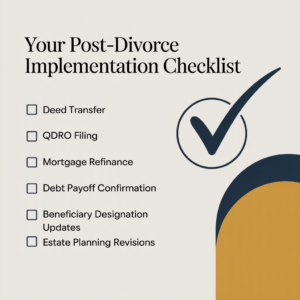
Your implementation step: Before your divorce is finalized, create a written post-decree implementation checklist with your attorney that identifies every action required by your settlement, the party responsible for each action, and the applicable deadline. Items on the list should include deed transfers, QDRO preparation and submission, mortgage refinancing, debt payoffs, insurance beneficiary updates, retirement account beneficiary designation changes, title transfers for vehicles, and estate planning document revisions. Review the checklist at 30, 60, and 90 days post-decree to confirm every item has been completed.
The Legal Insight Paragraph
In my 19 years of family law practice, what I’ve seen most often is that the most costly divorce settlement errors are not made by people who were careless or uninformed in a general sense. They are made by people who were very focused on the negotiation itself and simply did not have a clear mental model of the life cycle of a divorce settlement: the negotiation phase, the drafting phase, the court approval phase, and then the implementation phase, which is where the real financial work begins. People who understand that a settlement agreement is a legal blueprint rather than a completed transaction approach the post-decree period completely differently. They follow up on the QDRO. They confirm the deed was recorded. They check that the refinance closed on time. They update their beneficiary designations within the week. And the people who treat the signed settlement as the finish line, who assume that because the decree was entered, everything is now handled, are frequently the ones sitting across from me two years later, asking what can be done about the retirement account that was never divided or the house that is still in both names. The answer to those questions is almost always that something can be done, but it takes longer, costs more, and produces more uncertainty than simply doing it right immediately after the decree was entered.
When to Consult a Specialist
These are not general cautions. These are specific legal and financial triggers that require specific professional responses within defined timeframes.
If your divorce settlement includes a business owned by either spouse, and a valuation report has been prepared by a single expert retained by your spouse’s attorney, contact a certified valuation analyst (CVA) or a forensic accountant with divorce business valuation experience within 30 days of receiving that report. You are entitled to an independent valuation, and the deadline for contesting the opposing expert’s methodology may be set by your court’s scheduling order.
If your settlement agreement includes a comprehensive release of claims clause and you have reason to believe financial assets may not have been fully disclosed, contact your family law litigation attorney immediately, before you sign, to review the scope of the release and whether carve-out language for undisclosed asset claims should be added. Do not sign a release you do not fully understand.
If you are the spouse agreeing to keep the family home and you have not yet been pre-qualified for a refinance at current interest rates, contact a mortgage lender for a formal pre-qualification before your settlement is finalized. If you cannot qualify, that fact must be addressed in the settlement negotiations before you agree to a provision you cannot execute.
If your divorce decree has been entered and a QDRO has not yet been submitted to the retirement plan administrator, contact a QDRO specialist attorney within the first 30 days post-decree. Delays in QDRO filing create risk, particularly if the account holder dies, retires, or changes plan providers before the order is processed.
If joint tax returns were filed during the marriage and those years are potentially subject to audit, contact a CPA or enrolled agent with experience in innocent spouse relief under Internal Revenue Code Section 6015 before finalizing any release of indemnification claims in your settlement. The interaction between your settlement agreement and your potential federal tax liability requires specialized tax counsel.
If you discover, after your divorce is finalized, that your former spouse failed to disclose a significant asset during the proceedings, contact a family law appellate attorney or post-decree modification specialist within the limitation period for motions to set aside judgment in your state, which in many jurisdictions is between one and two years from the entry of the decree. Time is a legal constraint in these matters, and delay compounds it.
If your settlement assigned joint debt to your spouse and you have not received confirmation that the debt has been refinanced, paid off, or otherwise resolved in a way that removes your name from the creditor’s records, contact your family law attorney to initiate enforcement proceedings if the settlement’s deadline has passed. Each month of inaction is a month of credit exposure you do not need to carry.
Empowering Close / Call to Action
You have worked hard to get to the settlement phase of your divorce. That effort deserves to be protected by the same level of care and legal precision that you brought to every other part of this process.
The single most important legal takeaway from everything in this article is this: a divorce settlement agreement is a legal document with a life cycle, and the negotiation phase is only the beginning of it. The tax analysis, the business valuation review, the post-decree implementation checklist, the QDRO filing, the refinance confirmation, and the beneficiary designation updates are not administrative details. They are the substance of what you actually receive from your settlement. They are where your financial future is built or quietly undermined.
You have the information now. You know what to look for, what to ask, and when to bring in the right specialist to fill the gaps your attorney cannot cover alone.
That knowledge changes everything about how you approach the next conversation at that settlement table.
Or share this article with a friend or family member who is in the middle of settlement negotiations right now. The best thing you can do for someone you care about going through a divorce is give them the legal framework they did not know they were missing.
Legal Disclaimer
This article is for informational purposes only and does not constitute legal advice. Laws vary by state and jurisdiction. Always consult a licensed family law attorney before making any decisions about your divorce, separation, or custody matter.