11 Urgent Steps to Protect Your 401(k), Pension, and Assets Before Filing for Divorce
By Attorney Sarah Mitchell | Family Law | Asset Division & Financial Rights | divorceprolaw.com
You Stayed Up Until 2 A.M. Running the Numbers. Here Is What You Need to Know.
You have been sitting at your kitchen table, laptop open, bank statements spread across the counter, trying to figure out what you actually own. Maybe the conversation happened weeks ago, maybe months ago, maybe it happened in that quiet, devastating way where both of you just knew without saying the words out loud. But now you are here, at some hour that no longer feels like night or morning, searching for answers because the stakes are too high to get this wrong.
Your 401(k). Your pension. The house you refinanced together. The savings account you built dollar by dollar over fifteen years of overtime shifts and careful budgeting. Everything you worked for is suddenly sitting in the middle of a legal process you did not choose and do not fully understand.
Here is the truth no one tells you at the beginning: the financial decisions you make, or fail to make, in the weeks and months before you file for divorce can permanently shape what you walk away with. Not the decisions your attorney makes in the courtroom. The decisions you make right now, sitting at that table, before a single document has been filed.
This article will not scare you. It will prepare you.
What Asset Protection in Divorce Actually Means: The Legal Foundation
When people hear the phrase “protect your assets before divorce,” they often picture someone hiding money in a mattress or secretly transferring property to a cousin. That is not what this is, and it is not what any responsible attorney should ever advise.
Asset protection in the context of divorce is a legitimate, well-established legal concept. It means understanding which assets are legally vulnerable in your divorce proceeding, which are legally protected, and how to document, preserve, and advocate for your rightful share before the process begins. Think of it like reading the rules before a board game that you cannot leave halfway through. Knowing the rules does not give you an unfair advantage. It simply prevents you from losing pieces you were always entitled to keep.
Here is the foundational legal concept you must understand first: Marital property, which is generally any asset acquired by either spouse during the marriage, is subject to equitable distribution or community property division depending on your state. Separate property, meaning assets you owned before the marriage or received as a personal inheritance or gift, is typically not subject to division. The problem is that the line between these two categories blurs dramatically over the course of a long marriage, and courts do not automatically protect your separate property. You must prove it.
The reason this topic is so consistently misunderstood in mainstream legal advice is that most general financial guides treat divorce as a single event rather than a process. Asset protection begins before you file, not after.
Featured Snippet Target: Protecting your 401(k) and assets before divorce means documenting ownership, understanding what qualifies as marital versus separate property under your state’s laws, and taking legally permissible steps to preserve your financial position before proceedings begin. Courts divide marital assets based on the information available at the time of filing, so failing to act early often means giving up rights you legally hold.
For a comprehensive overview of how equitable distribution works across U.S. jurisdictions, the Cornell Law School Legal Information Institute provides a complete guide to property division principles that every divorcing spouse should review before their first attorney consultation
11 Proven Steps to Protect Your 401(k), Pension, and Assets Before Filing for Divorce
Step 1: Understand the Difference Between Marital and Separate Property Before You Do Anything Else
This is not a step you can skip or come back to later. Every other step on this list builds on whether you correctly understand what belongs to the marital estate and what does not.
Marital property is generally everything acquired by either spouse during the marriage, regardless of whose name is on the account, whose paycheck funded it, or who managed it day to day. Your 401(k) contributions made during the marriage, the appreciation on your pension during the marriage, the joint savings account, and often the family home all fall into this category.
Separate property is what you brought into the marriage, inherited solely in your name, or received as a personal gift during the marriage, provided it was never commingled with marital funds. Commingling, which is the legal term for mixing separate property with marital property, is one of the most common and costly mistakes divorcing spouses make.
Here is where it gets complicated. Many people assume that the 401(k) they had before they got married is entirely their separate property. It is not. Only the portion that existed at the time of the marriage and can be traced through documentation, known as the premarital balance, is typically considered separate. Every dollar contributed after the wedding day, and often the investment growth on the entire account, may be subject to division.
The legal standard varies significantly by jurisdiction. States operating under community property laws, including California, Texas, Arizona, Nevada, Washington, Idaho, Louisiana, New Mexico, and Wisconsin, generally treat all marital earnings and accumulations as a 50/50 split. The remaining states use equitable distribution, which means a fair division based on factors like the length of the marriage, each spouse’s earning capacity, and contributions to the household economy. Equitable does not mean equal, and understanding which standard applies in your state shapes every financial decision you will make in this process.
Your first concrete action: pull your 401(k) and pension statements from the month you got married. If you do not have them, contact your plan administrator and request historical account statements going back to your marriage date. This documentation will be the foundation of your separate property claim if you have a premarital balance worth protecting.
Courts do not assume you have separate property. They start with a presumption of marital property and expect you to prove otherwise with paper trail evidence. The spouse who walks in with documentation wins more often than the spouse who walks in with a good memory.
Step 2: Take a Complete Financial Inventory Before Your Spouse Does
In divorce proceedings, information is leverage. Not the manipulative kind, the legal kind. The spouse who has a thorough, organized picture of the marital estate’s full financial picture is far better positioned in discovery, negotiation, and if necessary, litigation.
A complete financial inventory means gathering documentation on every asset and liability that exists in your marriage, regardless of whose name is attached to it.
Assets to document:
- All retirement accounts: 401(k), 403(b), IRA, Roth IRA, pension plans, profit-sharing plans, stock option plans, deferred compensation arrangements
- Bank accounts: checking, savings, money market, certificates of deposit
- Investment accounts: brokerage accounts, mutual funds, bonds, stock portfolios
- Real property: the marital home, rental properties, vacation properties, undeveloped land
- Business interests: sole proprietorships, partnerships, LLC membership interests, closely held corporate shares
- Personal property with significant value: vehicles, boats, jewelry, art, antiques, collectibles
- Life insurance policies with cash value
- Intellectual property: patents, copyrights, royalties
- Cryptocurrency holdings
- Structured settlements or pending legal claims
Liabilities to document:
- Mortgage balances and home equity lines of credit
- Auto loans
- Credit card debt (individual and joint)
- Student loans (note: student loans taken before marriage are typically separate debt)
- Business debts
- Tax liabilities
Why does this matter before you file? Because once litigation begins, some spouses begin moving assets, withdrawing from accounts, or transferring property in ways that make the marital estate suddenly look smaller than it is. Courts call this dissipation or fraudulent transfer, and it is illegal. But by the time you discover it and file a motion, the money may be gone for months.
Documenting everything now gives you a baseline. If assets disappear after you file, you have evidence of what existed before.
Gather the most recent statements for every account. Take photographs of high-value personal property. Save tax returns for the last five years. Note any business valuations or recent appraisals. Store digital copies securely in an account your spouse cannot access, such as a new personal email account or a secure cloud storage service in your name only.
Step 3: Understand Exactly How Your 401(k) Will Be Divided and What a QDRO Actually Does
Your 401(k) is likely one of the most significant assets in your marital estate, and it is also one of the most misunderstood when it comes to how divorce law actually handles it.
Here is the core legal reality: a 401(k) cannot simply be withdrawn and split like a bank account. Unauthorized early withdrawal triggers federal income taxes plus a 10 percent early withdrawal penalty, and it violates IRS rules governing qualified retirement plans. To divide a 401(k) in divorce, courts use a specific legal instrument called a Qualified Domestic Relations Order, commonly known as a QDRO.
A QDRO is a court order that instructs the 401(k) plan administrator to transfer a specified portion of the account directly to the other spouse, who becomes what the law calls an alternate payee. When the transfer is processed correctly through a QDRO, the receiving spouse can roll the funds into their own IRA without triggering the 10 percent early withdrawal penalty. The receiving spouse will eventually pay income taxes on those funds when they withdraw them in retirement, but the immediate penalty is avoided.
Here is what you must understand before you file: the QDRO is a separate legal document from your divorce decree. Many divorcing spouses, and even some family law attorneys who do not specialize in retirement assets, finalize the divorce without ever completing the QDRO. When this happens, the divorce decree may say “wife receives 40 percent of husband’s 401(k),” but the money never actually moves. The plan administrator cannot act on a divorce decree alone. They need the QDRO. And if the QDRO is never completed, the account holder, often years later, can cash out the entire account, claim it as their own, and the other spouse has almost no recourse.
Your pre-filing action here: Ask your 401(k) plan administrator for their QDRO procedures document before your divorce begins. Every plan has specific requirements for what language the QDRO must contain in order for the plan to accept it. Some plans have model QDRO language they prefer. Getting this document early ensures your attorney drafts a QDRO the plan will actually honor.
Also understand that 401(k) plans and pension plans are governed by different legal frameworks. 401(k) plans are covered by a federal law called ERISA, the Employee Retirement Income Security Act. Pension plans, also called defined benefit plans, require their own version of a QDRO, which some plans call a DRO or a separate interest order. The mechanics are different, and the timeline for processing is often much longer for pensions, sometimes several months.
Government pension plans, including military pensions, federal employee pensions under FERS or CSRS, and state or local government pensions, have their own division procedures entirely and are not subject to standard QDRO rules. If your spouse is a military veteran, a federal employee, or a public school teacher with a state pension, flag this for your attorney immediately. The division process for these plans requires specialized knowledge and specific court orders that differ from private sector retirement plans.
SUGGESTED CONTENT IMAGE / INFOGRAPHIC:
A clean, two-column infographic titled “Marital vs. Separate Property: What Courts Actually Divide.”
Left column: “Marital Property” with examples like 401(k) contributions during marriage, joint bank accounts, appreciation on shared investments.
Right column: “Separate Property” with examples like premarital 401(k) balance (if documented), inheritance in one spouse’s name, gifts from third parties.
Bottom note: “Commingling can convert separate property into marital property.”
Alt text: “Infographic showing the difference between marital property and separate property in divorce asset division”
Step 4: Place a Hold on Any Retirement Account Beneficiary Designations Before You File
This is one of the most critical and consistently overlooked pre-filing steps. And it is one that can cost you nothing to take and everything to ignore.
Most people set their beneficiary designations once, when they first open a retirement account or start a new job, and never think about them again. The problem in divorce is this: beneficiary designations on retirement accounts operate outside of your will and outside of your divorce decree. In most cases, the beneficiary designation on file with the plan administrator controls what happens to the account at death, regardless of what your divorce settlement says.
Here is a scenario I have seen play out in real life. The divorce is finalized. The decree says the 401(k) was divided by QDRO. But the account holder dies before the QDRO is processed. Or the account holder has a separate IRA that was not addressed in the decree. If the ex-spouse is still listed as beneficiary on that account, they will inherit it. The new spouse or the children of the account holder have no claim.
Before you file for divorce, do not change your beneficiary designations. I want to be very clear about this. Courts in many jurisdictions issue automatic temporary restraining orders, called ATROs, at the time divorce is filed. These orders typically prohibit either party from changing beneficiary designations, transferring assets, or taking on new debt without the other party’s consent. If you change your beneficiary designation before the ATRO is in effect and it looks retaliatory or financially motivated, it can create legal complications for your case.
What you should do before filing: take note of every beneficiary designation on every retirement account, life insurance policy, and financial account you hold. Write down who is listed, when the designation was made, and what percentage each person receives. This documentation becomes important during settlement negotiations because your attorney can ensure that beneficiary designation changes are specifically addressed and ordered as part of the final decree.
After the divorce is finalized and the court-ordered asset division is complete, updating your beneficiary designations becomes one of the single most important steps in your post-divorce financial recovery.
Step 5: Document the Premarital Value of Every Retirement Account You Owned Before the Wedding
If you walked into your marriage with a 401(k), an IRA, a pension, or any other retirement savings already in place, you potentially have a separate property claim worth fighting for. But that claim is only as strong as your documentation.
Courts do not take your word for it. They require traceable evidence showing the account balance as it existed on or before the date of your marriage. This evidence is called a “separate property tracing,” and it is an area where divorcing spouses either win or lose significant money based entirely on whether they did their homework before litigation began.
Here is how separate property tracing works for retirement accounts. You identify the account balance on your marriage date. That premarital balance, plus any separate contributions you can trace directly, is your separate property claim. The contributions made after the marriage date are marital property. The investment growth during the marriage is often, though not always, marital property depending on your jurisdiction.
To build your separate property tracing file, you need:
- Account statements from the month you got married (or as close as possible)
- Historical statements showing contribution history
- Any documentation of rollover funds that came from a pre-marital employer plan
- If the account grew from a pre-marital inheritance or gift, documentation of that original deposit
Some pension plans will provide you with a pension benefit statement that shows what your benefit would be if you had left the company on your marriage date. This is called a coverture fraction analysis, and your attorney or a forensic accountant can use it to calculate the premarital versus marital portion of your pension.
If you cannot find statements from your marriage date, contact your plan administrator or investment firm and request historical records. Under ERISA, retirement plan administrators are required to maintain records, and most financial institutions can pull account history going back many years.
The spouse who comes to the negotiating table with a documented premarital balance of $85,000 in their 401(k) is in a fundamentally different legal position than the spouse who simply says, “I had money in that account before we got married.” Documentation is the difference between a claim and a proven right.
Step 6: Understand the Role of a Forensic Accountant and Know When You Need One
A forensic accountant is not just for fraud cases or multimillion-dollar divorces. In any marriage where retirement assets are substantial, where one spouse ran a business, where income is irregular or commission-based, or where you suspect assets may have been hidden or undervalued, a forensic accountant can be the most valuable member of your divorce team.
Forensic accountants specialize in financial analysis within legal proceedings. In divorce cases, they perform functions that most family law attorneys are not trained to do.
Business valuation. If your spouse owns a business, that business likely has marital value. A forensic accountant can determine the fair market value of the business using established valuation methods: the income approach, the market approach, or the asset-based approach. Business owners often undervalue their companies in divorce proceedings. A forensic accountant provides an independent, court-defensible valuation.
Hidden income analysis. In cases involving self-employed spouses or business owners, forensic accountants analyze tax returns, bank statements, profit and loss statements, and expense reports to determine whether income has been artificially suppressed or whether lifestyle spending significantly exceeds reported income. This is particularly relevant for calculating spousal support and child support.
Tracing separate property. As discussed in Step 5, tracing the premarital portion of a retirement account requires meticulous financial analysis. A forensic accountant can prepare a formal separate property tracing report that is admissible in court.
Lifestyle analysis. Forensic accountants can analyze credit card statements, bank records, and spending patterns to establish the marital standard of living, which courts use to determine appropriate support levels.
Retirement account valuation. Pension plans, especially defined benefit plans, require actuarial analysis to determine their present value for equitable distribution purposes. A forensic accountant working with an actuary can calculate what a future pension stream is worth in today’s dollars, allowing you and your attorney to negotiate a fair offset using other marital assets.
The cost of a forensic accountant is typically considered a marital expense and can sometimes be ordered by the court to be paid from marital funds. Your attorney can advise you on whether to request this relief in your jurisdiction.
Consider engaging a forensic accountant before you file if any of the following apply to your situation: your spouse controls the marital finances, your spouse is self-employed or owns a business, your household’s lifestyle significantly exceeds the income shown on tax returns, you have substantial retirement assets with complicated pre-marital history, or you have received any credible indication that assets have been transferred or hidden in anticipation of divorce.
Step 7: Freeze or Protect Joint Accounts and Credit Lines Within Legal Limits
This step requires careful, attorney-guided action because the line between protecting your financial interests and violating a court order or engaging in dissipation is one you cannot afford to cross carelessly.
Before divorce proceedings begin, both spouses typically have equal legal access to joint bank accounts and joint credit lines. This access is a double-edged sword. It protects you if your spouse tries to drain an account. It also means your spouse’s attorney may argue that any withdrawal you made was marital waste if the timing looks suspicious.
Here is what the law generally permits before you file and before any automatic restraining order is in effect.
What you can typically do legally:
- Withdraw your share of a joint account for legitimate living expenses and attorney fees. A commonly cited guideline, though not a universal legal rule, is withdrawing up to 50 percent of a joint account for your own expenses. Document every withdrawal and the purpose it served.
- Open a separate bank account in your name only for future income deposits and expenses. This is not hiding assets. It is creating a separate financial identity, which is a reasonable step when separation is imminent.
- Freeze a joint credit card so no new charges can be made by either party. Most major banks allow one party to freeze a joint card. This prevents your spouse from running up debt that you may be held jointly responsible for.
- Contact a credit bureau and place an alert on your credit report so you are notified of any new accounts opened in your name or jointly.
What you cannot do:
- Transfer marital property to a third party to shield it from division.
- Withdraw the full balance of a joint account without notice or legitimate purpose.
- Liquidate retirement accounts to prevent division.
- Secretly open new credit accounts and run up debt with the intent of claiming it as marital debt.
Once divorce is filed and an automatic temporary restraining order or preliminary injunction is in place, both parties are typically prohibited from taking any of the above actions without court approval or written consent from the other spouse. The specific terms of any ATRO vary by jurisdiction, so review these with your attorney immediately after filing.
The American Bar Association provides guidance on domestic relations law and procedural protections that vary by state, and their family law resources offer a complete overview of automatic temporary restraining orders and financial injunctions in divorce proceedings.
Your goal in this step is to protect access to funds you need to live and to fund your divorce, not to strip the marital estate. Courts are sophisticated enough to distinguish between the two, and so is your attorney.
Step 8: Secure Copies of All Critical Financial Documents Before Access Becomes Complicated
Once divorce proceedings begin, document access can become complicated, contested, and expensive. Spouses who previously had open access to shared financial records sometimes find that access restricted once the legal process starts, particularly if the primary account holder closes access, changes passwords, or retains documents through their attorney.
Your goal before filing is to secure copies of every relevant financial document you can lawfully access as a spouse.
The documents you need to gather and store securely:
Tax returns: Collect the last five years of federal and state tax returns. These documents are gold in divorce proceedings. They reveal income, business revenue, investment gains, deductions claimed for assets you may not have known about, and sometimes unreported income sources that appear in lifestyle spending but not on the return itself.
Pay stubs and income documentation: Gather the last 12 months of pay stubs for both yourself and your spouse if accessible. Self-employed spouses: gather profit and loss statements, business bank statements, invoices, and contractor payment records.
Retirement account statements: All 401(k), 403(b), IRA, Roth IRA, pension benefit statements, and stock option plan statements for the last three to five years. Pay particular attention to statements from the year of your marriage for separate property tracing purposes.
Bank and investment account statements: Last 12 to 24 months for all accounts, including any accounts held solely in your spouse’s name that you have lawful access to review as a married couple.
Mortgage documents: Your current mortgage statement, the original loan documents, any home equity line of credit documents, and the most recent property tax assessment.
Insurance policies: Life insurance policies (particularly whole or universal life policies with cash value), homeowners insurance, and any disability insurance policies.
Vehicle titles and loan documents: Include boats, RVs, motorcycles, and any other titled vehicles.
Business documents: If either spouse owns a business, gather articles of incorporation or organization, recent financial statements, tax filings for the business, buy-sell agreements, and any partnership or operating agreements.
Estate planning documents: Wills, trusts, and power of attorney documents, particularly if any family trusts contain assets that may be relevant to the marital estate.
Recent appraisals: Any professional appraisals of real estate, jewelry, art, antiques, or other high-value personal property completed in recent years.
Store these documents in a secure location your spouse cannot access. A private cloud storage account, a USB drive stored outside the home, or a personal safety deposit box at a bank where you hold an individual account are all reasonable options.
Do not remove original documents from the family home if those documents are joint property or business records. Make copies. Courts have little patience for spouses who remove original business records or shared legal documents from the marital home, as this can be characterized as evidence tampering or obstruction.
Step 9: Know How Long-Term Marriage, Career Sacrifice, and Homemaking Contributions Affect Your Retirement Rights
This step matters most for spouses who stepped back from their careers, reduced their working hours, or left the workforce entirely to raise children or support the other spouse’s professional advancement. And it matters in ways that are genuinely counterintuitive.
If you sacrificed career advancement for the marriage, your legal position in dividing retirement assets may be stronger than you think. Courts increasingly recognize what legal scholars and family law practitioners call the “career sacrifice factor” in asset division and spousal support determinations.
Here is the core legal principle: equitable distribution is not just about counting who contributed more dollars to a retirement account. Courts are required to consider the non-economic contributions of each spouse to the marital estate. This includes homemaking, child-rearing, supporting a spouse’s education or career advancement, relocating for a spouse’s job, and making lifestyle decisions that reduced one spouse’s earning capacity in favor of the other’s.
If you were the primary caregiver during a long marriage, you likely have diminished Social Security benefits compared to your working spouse. Under current Social Security rules, however, if your marriage lasted at least 10 years and you do not remarry before applying for benefits, you are entitled to claim Social Security benefits based on your ex-spouse’s earnings record, up to 50 percent of their benefit amount, without reducing their benefit at all. This is a federally guaranteed right, not a marital asset subject to negotiation, but it is one that many divorcing spouses do not know they hold.
Military spouses may be entitled to direct payment of military pension benefits from the Defense Finance and Accounting Service if the marriage lasted at least 10 years during the service member’s qualifying military service. This is known as the 10/10 rule. It does not determine how much of the pension you receive. That is determined by your divorce settlement or court order. But it does determine whether you receive your share directly from the government rather than through your ex-spouse.
For homemaker spouses who have little or no retirement savings of their own after a long marriage, the division of the working spouse’s 401(k) and pension may represent the most significant financial asset in the entire settlement. Do not let anyone, including a well-meaning friend or a quick internet search, tell you that you are entitled to nothing simply because your name is not on the account. Contributions made from marital income to any retirement account during the marriage are marital property regardless of who earned the paycheck.
Step 10: Establish Your Own Credit Identity and Financial Infrastructure Before You File
Many divorcing spouses, particularly those who were not the primary financial managers in the marriage, discover a painful reality once proceedings begin: they have no independent credit history, no accounts in their own name, and no financial infrastructure to support themselves through a potentially lengthy divorce process.
Rebuilding credit and establishing financial independence before filing is not an act of bad faith. It is a necessary act of self-preservation that courts understand and respect.
Assess your current credit position. Pull your own credit report from all three major bureaus through the federally authorized annualcreditreport.com. Review every account listed. Note which accounts are joint, which are solely in your name, and which are solely in your spouse’s name. This baseline is essential because joint debt remains your responsibility regardless of what a divorce decree says to the contrary if the creditor was not a party to the divorce proceeding.
Open a checking account in your name only. If you do not already have one, open a personal checking account at a bank where you do not share joint accounts with your spouse. Begin directing any income or funds you are entitled to use for personal expenses into this account.
Apply for a credit card in your name only. If you have limited independent credit history, start with a secured credit card, which requires a small deposit as collateral. Use it for small, regular purchases and pay the balance in full each month. This begins establishing your independent credit history immediately.
Do not close joint accounts unilaterally. Closing a joint credit card before the divorce is finalized can actually damage your credit score, particularly if the card has a long history and a high credit limit. Instead, freeze new charges and monitor the account. Your attorney can address the disposition of joint accounts formally in your divorce settlement.
Notify your bank of your upcoming separation. You do not need to disclose the legal details, but informing your bank that you are going through a separation allows them to flag your account for additional verification on transactions, which can protect you if your spouse attempts unauthorized activity.
Establish your own income documentation. If you are currently not working or working part-time, consider whether this is the right time to return to the workforce, update your resume, or consult with a career advisor. Your earning capacity is a factor courts consider in spousal support determinations, and demonstrating active steps toward financial self-sufficiency can be relevant to your case.
Consider a post-office box or alternate mailing address. If you anticipate that communication with your bank, attorney, or court may be sensitive, routing important mail through a P.O. box or a trusted family member’s address can prevent your spouse from inadvertently or intentionally intercepting important financial or legal correspondence.
Step 11: Consult a Family Law Attorney Before Your Spouse Does, and Do It Now
This is not a strategic manipulation. It is a legal reality.
Once a family law attorney has an initial consultation with one spouse in your divorce, they are typically ethically prohibited from representing the other spouse due to the conflict of interest created by that consultation. This is called a conflict check, and it is a standard part of every intake process in a family law practice.
In some smaller cities and towns where the pool of experienced family law attorneys is limited, your spouse consulting multiple attorneys before you act can narrow your options for representation. This is a practical concern, not a fear-based tactic.
More importantly, consulting an attorney before you file gives you several concrete legal advantages.
You learn the law that applies to your specific situation. Your jurisdiction’s marital property rules, your state’s equitable distribution factors, the local court’s approach to spousal support, the practical timelines and costs of divorce proceedings in your county. This is not information you can reliably get from a general internet search. Laws vary dramatically by state, and even within states, judicial temperament and local court practice differ significantly by county.
You get a realistic assessment of your financial position. A good family law attorney will review your financial picture, identify your strongest arguments for separate property claims, flag any vulnerabilities in your position, and advise you on what pre-filing steps are legally appropriate in your jurisdiction.
You establish attorney-client privilege immediately. Everything you share with your attorney in consultation is protected by attorney-client privilege, meaning your spouse’s attorney cannot compel your attorney to disclose it. This protection begins with your first consultation.
You understand your filing options. Contested divorce, uncontested divorce, collaborative divorce, and mediated divorce all have different financial and procedural implications. Your attorney can help you assess which path is most likely to serve your financial and personal interests.
You avoid costly mistakes. The clients I have seen lose the most in divorce proceedings are not those who were outspent or outwitted. They are those who took significant financial actions, withdrew money, transferred property, signed agreements, or made verbal commitments, before consulting an attorney. Some of those actions were irreversible.
When you search for a family law attorney, look for someone with specific experience in asset division, retirement account division, and QDRO preparation. Ask specifically whether they handle QDRO drafting in-house or outsource it. Ask whether they have experience with your type of retirement plan. And ask for a clear explanation of their fee structure before the first consultation ends.
The Legal Insight Paragraph
In my 19 years of family law practice, what I have seen most often is a spouse who has spent months, sometimes years, emotionally preparing for divorce but has done almost no legal or financial preparation at all. They know the marriage is over. They have grieved it privately. They have made peace with it. And then they walk into my office having already signed a separation agreement drafted by their spouse’s attorney, withdrawn money from a joint account in a way that looks like dissipation, or quietly changed their 401(k) beneficiary without understanding that this action may be prohibited once a QDRO is sought. The emotional preparation happened long before the legal preparation, and that gap cost them. The single most important shift I can offer any client reading this is this: your legal preparation does not need to come after your emotional readiness. You can begin gathering documents, understanding your rights, and consulting an attorney while you are still in the middle of the grief. The law will not wait for you to feel ready. But it will protect you if you understand it in time.
When to Consult a Specialist
The following situations require you to contact a specific legal or financial professional immediately, not eventually.
If you receive a formal divorce petition or summons from your spouse’s attorney, you have a limited window, typically 20 to 30 days depending on your state, to file a formal legal response. Contact a licensed family law attorney within 72 hours of receiving service. Failing to respond may result in a default judgment against you, which can affect asset division, spousal support, and custody arrangements.
If you discover that retirement account funds have been withdrawn without your knowledge or consent, contact a family law attorney and a forensic accountant within one week. Document the withdrawal with account statements and request an emergency court order to freeze remaining assets. Courts can issue injunctions to prevent further dissipation, but timing is critical.
If your spouse is self-employed, owns a business, or has a compensation structure that includes bonuses, commissions, deferred compensation, or stock options, engage a forensic accountant before or during your initial attorney consultation. Business income is frequently understated in divorce proceedings, and the financial analysis required to identify the true marital income and business value is beyond the scope of standard legal representation.
If you are the spouse of a military service member, a federal employee, or a state or local government employee with a defined benefit pension plan, consult a family law attorney with specific experience in government and military retirement division before any settlement discussions begin. These plans operate under completely different legal frameworks, with strict procedural requirements and deadlines that do not apply to private sector retirement accounts.
If your divorce involves assets held in another country, offshore accounts, or real property located in a foreign jurisdiction, contact a family law attorney with international divorce experience. Standard domestic asset tracing methods may not apply, and coordination with foreign legal counsel may be required.
If you believe your spouse has hidden assets, transferred property to family members or business entities, or significantly changed their financial behavior in the months before filing, request an emergency asset freeze order through your attorney and engage a forensic accountant immediately. Courts can compel financial disclosure through a formal discovery process, but the earlier forensic analysis begins, the more complete the picture your attorney can present.
If you signed any financial agreement, prenuptial agreement, postnuptial agreement, or business partnership document during your marriage and you are uncertain what it says or whether it is enforceable, bring those documents to an attorney consultation before any settlement discussions begin. Some of these agreements are legally binding. Others are not, depending on how they were executed, whether full financial disclosure occurred, and whether duress was involved.
As I have seen with many clients, the situations that cause the most financial harm in divorce are not the ones where the law was unclear. They are the ones where a client did not know the law applied to them at all until it was too late to act.
You Have More Control Than You Think
If you have read this far, you are not the person who will be caught off guard. You are the person who shows up prepared.
The most important legal takeaway from everything in this article is this: your financial rights in divorce are determined largely by documentation, timing, and informed action taken before the process accelerates. Courts work with the information they are given. Your job, your one concrete next step, is to begin building that information now.
Pull one document today. One retirement account statement from your marriage date, one tax return, one bank statement that tells the story of what you built together and what portion of it belongs to you.
Then share this article with someone in your life who is navigating a separation right now and does not yet know that the choices made before filing often matter more than the arguments made in the courtroom.
Read Next: “How Courts Divide Retirement Accounts in Divorce: A Complete Guide to QDROs, Pensions, and Your Financial Future”
Or drop a comment below with your question. I read every one.
Legal Disclaimer
This article is for informational purposes only and does not constitute legal advice. Laws vary by state and jurisdiction. Always consult a licensed family law attorney before making any decisions about your divorce, separation, or custody matter.
EXPANDED DEEP-DIVE SECTIONS
The following sections provide extended analysis, jurisdiction-specific guidance, and practical implementation detail on each of the 11 steps above. These sections are designed to serve the comprehensive research needs of readers who are in the early stages of separation and need thorough legal grounding before their first attorney consultation.
Section A: The Legal Architecture of Retirement Account Division, A Complete Framework
Understanding how courts approach retirement account division requires understanding that these assets do not fit neatly into the standard marital property framework. They exist at the intersection of federal law, state family law, contract law between you and the plan, and equitable principles that courts apply with significant discretion.
Federal Law Versus State Law: Why Both Matter for Your 401(k)
Most people think of divorce as exclusively a state law matter. And in terms of the grounds for divorce, the property division standards, and the support frameworks, that is largely correct. Family law is state law.
But retirement accounts are different. Private sector retirement plans, including 401(k) plans, 403(b) plans, and pension plans sponsored by private employers, are governed by a federal statute called the Employee Retirement Income Security Act of 1974, commonly known as ERISA. ERISA was designed to protect retirement savings from being drained before workers retire, and one of its key features is a rule called the anti-alienation provision, which generally prohibits retirement plan benefits from being transferred, assigned, or pledged to another person.
A QDRO is the federally authorized exception to this rule. Congress specifically built the QDRO mechanism into ERISA to allow divorce courts to divide retirement plan assets without triggering the anti-alienation prohibition and without triggering early withdrawal taxes and penalties.
Here is why this matters practically: the state family court has the authority to tell you that your ex-spouse is entitled to a portion of your 401(k). But that court order, your divorce decree, cannot by itself transfer the money. For the money to actually move from your 401(k) account to your ex-spouse’s hands, a QDRO must be drafted in compliance with ERISA, submitted to the plan administrator, reviewed by the plan, and accepted. The plan administrator has the right, and the legal obligation, to reject a QDRO that does not meet ERISA’s requirements or that conflicts with the plan’s terms.
Plans typically take 30 to 90 days to review and accept or reject a QDRO. During this review period, most plans will honor a “hold” on the account, meaning they will not process any withdrawals or loans that might affect the amount available for the alternate payee. This is called a QDRO hold, and you or your attorney can request it from the plan administrator as soon as divorce proceedings are initiated.
The practical takeaway: do not wait until after your divorce is finalized to begin the QDRO process. Many family law attorneys recommend having the QDRO drafted and submitted to the plan administrator for pre-approval review before the divorce is even finalized. Pre-approval means the plan reviews the draft QDRO and confirms it will accept the language as written, so that once the judge signs the divorce decree, the QDRO can be immediately submitted and processed.
IRAs Are Different: No QDRO Required, But Mistakes Still Happen
Individual Retirement Accounts, including traditional IRAs and Roth IRAs, are not governed by ERISA. They are individual accounts established under the Internal Revenue Code, and they follow different rules for divorce-related division.
For IRAs, the mechanism for tax-free division in divorce is not a QDRO but rather a direct transfer incident to divorce, authorized by IRS rules under Internal Revenue Code Section 408(d)(6). Under this provision, a transfer of an IRA to a spouse or former spouse pursuant to a divorce decree or separation instrument is not treated as a taxable distribution. The receiving spouse simply takes ownership of the transferred portion in their own IRA account.
The key requirements are: the transfer must be directly between IRAs, the transfer must be described or ordered in the divorce decree or written separation agreement, and the receiving spouse must retitle the account in their own name.
If these requirements are not followed precisely, what looks like a “division” of an IRA becomes a taxable distribution. A spouse who simply withdraws funds from their IRA and hands cash to their ex-spouse has just created a taxable event, and the receiving spouse cannot deposit that cash into their own IRA as a rollover if they have already received it as a distribution.
Always work with your attorney and your financial advisor to ensure IRA transfers in divorce are structured as direct trustee-to-trustee transfers with the proper language in your divorce agreement. Never take an IRA withdrawal and hand cash to your spouse as a division of retirement assets. The tax consequences are immediate and avoidable.
Roth IRAs: The Post-Tax Wrinkle That Changes the Math
Roth IRA funds are contributed after-tax, meaning the money in a Roth IRA has already been taxed and will grow and be withdrawn tax-free in retirement under current law. This creates a valuation complication in divorce asset division that is frequently overlooked.
When you and your spouse are dividing retirement assets, comparing a traditional 401(k) with a Roth IRA dollar for dollar is not an apples-to-apples comparison. A dollar in a traditional 401(k) will be taxed when withdrawn. A dollar in a Roth IRA will not. So a traditional 401(k) with a balance of $200,000 is not worth the same after-tax value as a Roth IRA with a balance of $200,000.
In settlement negotiations, sophisticated parties and their attorneys adjust for this difference by calculating the after-tax value of each retirement account before agreeing to any division. For example, if your marginal tax rate at retirement is expected to be 22 percent, a traditional 401(k) balance of $200,000 has an estimated after-tax value of approximately $156,000. A Roth IRA balance of $200,000 is worth its full face value after tax.
If you are receiving the Roth IRA as part of your settlement while your spouse receives the traditional 401(k) of equal face value, you are actually receiving the more valuable asset in after-tax terms. Conversely, if you are the spouse giving up the Roth IRA, ensure that this difference in after-tax value is accounted for in the overall settlement.
Your attorney and a financial advisor should review the tax-adjusted value of all retirement assets before you agree to any division. This analysis belongs in your pre-filing preparation, not after you have already signed off on a proposed settlement.
Section B: State-by-State Considerations, What Changes Depending on Where You Live
The differences between state divorce laws are not minor variations on a single theme. In some cases, they represent fundamentally different legal frameworks that produce dramatically different outcomes for divorcing spouses.
Community Property States: The 50/50 Starting Point
Nine states operate under community property law: California, Texas, Arizona, Nevada, Washington, Idaho, Louisiana, New Mexico, and Wisconsin. In these states, the default rule is that all property acquired during the marriage is owned equally by both spouses, regardless of who earned it, whose name is on the account, or how it was managed.
This means that in a community property state, your spouse is already a 50 percent owner of your 401(k) contributions made during the marriage, the salary deposited into your individual checking account, the appreciation on investments purchased with marital income, and the goodwill value of a business built during the marriage.
The community property framework has significant implications for your pre-filing financial planning. In a community property state, removing marital funds from joint accounts or placing marital assets in solely owned accounts does not change their character as community property. Courts can, and do, order those assets returned to the community estate for division.
However, community property states also give clear protection to separate property. Assets you owned before the marriage, or received as a separate inheritance or gift during the marriage, remain your separate property as long as they are not commingled with community property. The tracing rules in community property states are well-developed and courts are experienced in hearing separate property claims supported by documentation.
California is worth noting specifically because it applies strict community property rules, has significant judicial experience with complex asset division, and has specific statutory protections for spouses who discover that the other spouse has breached their fiduciary duty with respect to community assets. Under California Family Code Section 1101, if a spouse has deliberately misappropriated community assets, the harmed spouse may be entitled to 100 percent of the misappropriated asset as a penalty. This is not a national rule, but it reflects the kind of powerful statutory protection that exists in community property states for spouses who act in good faith.
Equitable Distribution States: The Fair Share Framework
The remaining 41 states and the District of Columbia use an equitable distribution framework. In these states, courts divide marital property in a manner that is fair and equitable, which courts interpret based on a list of statutory factors that typically include:
- The length of the marriage
- Each spouse’s income and earning capacity
- The age and health of each spouse
- The contributions of each spouse to the acquisition, preservation, and improvement of marital assets
- The non-economic contributions of each spouse, including homemaking and child-rearing
- The tax consequences of the proposed division
- Any premarital or postnuptial agreements
- The standard of living established during the marriage
- Whether either spouse depleted marital assets
Equitable distribution does not mean equal distribution. Courts have broad discretion, and outcomes can vary significantly based on the facts of a specific case, the quality of legal representation, and the local judicial culture.
In some equitable distribution states, courts have a strong presumption in favor of equal division as the starting point for equitable analysis. In others, the analysis begins with all factors equally weighted, and either spouse can argue for a greater or lesser share based on the relevant equitable factors.
Your attorney’s familiarity with how your specific county’s judges apply equitable distribution factors is itself a valuable asset in your case preparation.
What Happens When Spouses Live in Different States?
In cases where spouses have recently relocated, own property in multiple states, or maintain legal domiciles in different states, jurisdiction questions can complicate asset division. Generally, the court in the state where divorce is filed has authority over the divorce itself and over personal property held in that state. Real property located in another state is subject to the laws of that state, even if the divorce is filed elsewhere.
If you own real property in a community property state but your divorce is filed in an equitable distribution state, the property in the community property state may retain its community property character for purposes of division. Courts in equitable distribution states typically apply “quasi-community property” analysis to determine how to handle property acquired in community property states.
This is an area where the specific facts of your case matter enormously, and where a family law attorney with interstate divorce experience can make a significant difference in your outcome.
Section C: Hidden Assets in Divorce, What They Are, How Spouses Hide Them, and How Courts Find Them
One of the most painful discoveries in divorce is learning that a spouse has deliberately concealed assets from both you and the court. Courts take this seriously. Judges who discover that a spouse has hidden assets during divorce proceedings have broad discretion to sanction that behavior, sometimes dramatically.
But hidden assets are often not discovered unless someone looks for them. Forensic accountants and experienced divorce attorneys look for them systematically. Trusting spouses who assume full disclosure has occurred often lose significant marital wealth without ever knowing it existed.
Common Methods Spouses Use to Conceal Assets
Overpaying taxes and requesting a refund post-divorce. A spouse who files a tax return showing a large overpayment is essentially depositing marital money with the IRS to be returned as a separate refund after the divorce is finalized. A forensic accountant reviewing withholding patterns can identify this anomaly.
Deferring income or bonuses until after divorce. A self-employed spouse or business owner may ask clients to delay payment, defer invoicing, or structure deals to close after the divorce is final. A forensic accountant can analyze historical billing cycles and client payment patterns to identify artificial deferrals.
Overpaying fictional debts to friends or family members. A spouse may write checks to family members or friends characterized as repayment of personal loans that never actually existed. These payments reduce the marital estate and place cash outside the reach of division, to be returned informally after the divorce is complete. Bank records and witness testimony can expose this pattern.
Creating fictitious business expenses. A self-employed spouse may run personal expenses through the business as deductions, artificially reducing the business income and therefore the support obligation calculated in the divorce. Forensic accountants trained in business expense analysis can identify expenses that do not match the business’s operational profile.
Transferring assets to cryptocurrency wallets. Cryptocurrency presents a newer challenge in asset tracing because transactions on many blockchain networks are pseudonymous. However, the movement of funds into cryptocurrency exchanges leaves a trace in bank records, and forensic accountants with cryptocurrency tracing expertise can often reconstruct the flow of funds.
Undervaluing business interests. A business owner may arrange for an informal valuation by a friendly business appraiser who produces a low estimate, or may claim the business has significant liabilities that reduce its net value. Independent business valuation by a neutral forensic accountant hired by your legal team provides a counterpoint.
Hiding cash businesses. Businesses with heavy cash flow, including restaurants, retail stores, salons, and contractors, can be particularly susceptible to underreported income. Lifestyle analysis comparing reported income with actual spending can reveal significant discrepancies.
How Courts Respond to Hidden Assets
When a court finds that a spouse has deliberately hidden, concealed, or dissipated marital assets, the consequences can include:
Adverse inference. The court may instruct the jury or itself to assume that the hidden assets exist in an amount favorable to the innocent spouse.
Enhanced share. Many courts will award the innocent spouse a larger share of the remaining marital estate as a sanction for the concealing spouse’s misconduct.
Attorney fees. Courts routinely order the concealing spouse to pay the innocent spouse’s attorney fees incurred in discovering and proving the concealment.
Contempt of court. If a spouse violates a court order to disclose assets or continues to hide assets after being ordered to produce them, they may be held in contempt, which can result in fines or, in extreme cases, jail time.
Setting aside the decree. If hidden assets are discovered after the divorce is finalized, courts may reopen the case, set aside the prior settlement, and re-divide assets. This remedy requires a showing of fraud upon the court, which is a high legal standard, but it is available in egregious cases.
The legal message is clear: hiding assets is not only morally wrong, it is legally catastrophic for the spouse who does it. The discovery mechanisms available in family law, including formal interrogatories, document subpoenas, depositions under oath, and forensic accounting analysis, are powerful enough to find most attempts at concealment. The risk-reward calculation for hiding assets in divorce is profoundly unfavorable.
Section D: The Intersection of Divorce and Estate Planning, Protecting Your Future Beyond the Settlement
Many divorcing individuals focus exclusively on the immediate financial settlement without considering how the divorce interacts with their existing estate plan. This oversight can create serious problems in the months and years following the divorce.
Your Will May Not Reflect Your New Intentions
In many states, divorce automatically revokes any bequest to a former spouse in your will, but the timing of this revocation varies. In some jurisdictions, the revocation takes effect at the time the divorce is filed. In others, it does not occur until the divorce is final. And in some states, the revocation applies only to direct bequests, not to assets held in trust or accounts with beneficiary designations.
The safe practice is to review and update your will immediately upon separation, subject to any court-ordered restrictions on asset transfers in your jurisdiction, and to complete a full estate plan review within 90 days of your divorce being finalized.
Your Trust May Still Name Your Spouse
Revocable living trusts, which are commonly used in estate planning, typically name your spouse as the primary beneficiary and successor trustee. Divorce does not automatically remove your spouse from these roles in all jurisdictions. Without an amendment or restatement of the trust, your ex-spouse may retain legal authority over the trust assets after your death.
Consult with an estate planning attorney alongside your family law attorney to coordinate the updates needed to your trust documents. In some cases, trust amendments can be made before the divorce is final. In others, particularly where a marital asset sits within the trust, you may need court approval or your spouse’s consent.
Powers of Attorney and Health Care Directives
Your existing durable power of attorney, which gives your designated agent authority to make financial decisions on your behalf if you are incapacitated, likely names your spouse. Your health care proxy or medical power of attorney, which governs medical decision-making if you cannot speak for yourself, similarly may name your spouse.
Separating from your spouse without updating these documents means your soon-to-be-ex-spouse may retain legal authority over your finances and medical decisions if you are ever incapacitated during the divorce process. This is a serious risk that is easily addressed by executing new power of attorney and health care directive documents through your estate planning attorney.
Life Insurance as a Marital Asset and As a Post-Divorce Tool
Term life insurance generally has no cash value and is not a marital asset subject to division. However, permanent life insurance, including whole life and universal life policies, builds cash value over time. That cash value, accumulated during the marriage, is typically a marital asset subject to division.
Whole life policies also often have loan provisions that allow the policy owner to borrow against the cash value. Be aware that if your spouse has borrowed against a joint or marital life insurance policy, those loan balances may reduce the cash value available for division. Your financial inventory should include the current death benefit, the current cash value, and any outstanding loans on every life insurance policy.
Post-divorce, life insurance takes on a different but equally important role. If you have minor children, your divorce decree may require that you maintain life insurance coverage naming your children as beneficiaries for the duration of the child support obligation. Some courts also order a life insurance policy naming the supported spouse as beneficiary to secure a spousal support obligation. These requirements should be specifically addressed in your settlement negotiations with precise coverage amounts and policy duration requirements.
Section E: Protecting Your Pension, The Often-Forgotten Retirement Asset
While 401(k) accounts receive most of the attention in divorce financial planning, pensions, also known as defined benefit plans, are often larger and more complicated assets that require specialized handling.
Understanding How Pension Value Is Calculated for Divorce Purposes
A defined benefit pension does not work like a 401(k). There is no account balance you can look up on a statement. Instead, the pension promises to pay you a specific monthly benefit at retirement, based on a formula that typically considers your years of service and your final average salary.
Because there is no account balance, courts cannot simply divide the pension the way they divide a 401(k). Instead, attorneys and financial experts must determine the present value of the pension’s future benefit stream, which requires actuarial calculation.
The present value of a pension is what that stream of future payments is worth in today’s dollars, accounting for the probability that the pension holder will actually reach retirement, the time value of money, and the specific terms of the pension plan. A pension that will pay $3,000 per month starting at age 65 may have a present value of $400,000 or more in today’s dollars, making it a substantial marital asset that deserves careful attention.
Two approaches to pension division in divorce:
The offset method. Under this approach, the pension is valued using actuarial analysis, and the pensioned spouse keeps the entire pension. Their spouse receives other marital assets of equivalent value, such as a larger share of the home equity or investment accounts. This approach avoids the complexity of a pension QDRO and gives both parties a clean break.
The deferred distribution method. Under this approach, the non-pensioned spouse receives a share of the pension payments when they begin, through a domestic relations order. This method is more complex and requires waiting until the pension holder reaches retirement age, but it may be the only option if there are not enough other assets to offset the pension’s full value.
The right approach for your case depends on the size of the pension relative to other marital assets, the ages of both parties, the specific terms of the pension plan, and the preferences of both spouses regarding a clean financial break versus a long-term financial connection through shared pension payments.
Government and Military Pensions: The Specialized Rules
Military pensions are divided under the Uniformed Services Former Spouses’ Protection Act (USFSPA), a federal statute that permits state courts to treat military retirement pay as marital property. The 10/10 rule, mentioned earlier, determines whether the former spouse receives direct payment from the Defense Finance and Accounting Service or must collect their share from the service member directly.
Under the 10/10 rule: if the marriage lasted at least 10 years during at least 10 years of the service member’s qualifying military service, the former spouse can receive their court-ordered share of retirement pay directly from DFAS. If the marriage does not meet this threshold, the division can still be ordered by the court, but the former spouse must collect their share from the service member individually.
Military divorce involves additional complexities including Survivor Benefit Plan coverage, which provides a continuing annuity to a former spouse if the service member dies before the former spouse. SBP coverage must be specifically addressed in your divorce decree and the court order implementing it. Courts can order the service member to maintain SBP coverage for the former spouse, but this must be done in writing with specific language in the divorce order.
Federal employee pensions under the Federal Employees Retirement System (FERS) or the older Civil Service Retirement System (CSRS) are divided using a court order often called a Court Order Acceptable for Processing (COAP). These orders are submitted to the Office of Personnel Management, which administers federal retirement benefits. COAP requirements differ from QDRO requirements and must be specifically drafted by someone familiar with federal retirement law.
State and local government pensions vary enormously in their division rules, as each plan is governed by its own enabling statute and administrative rules. Teachers’ pension plans, police and firefighter pension plans, and other state or local government retirement plans each have their own QDRO equivalent, their own review procedures, and their own timeline for processing. If your spouse is a state or local government employee, obtain the plan’s division procedures document from the plan administrator as early as possible in the divorce process.
Section F: The Timeline of Pre-Filing Financial Preparation, A Practical Week-by-Week Guide
Understanding what to do is essential. Understanding when to do it relative to your decision to file makes the difference between a prepared spouse and a reactive one.
In the Weeks Before You Make Any Decision:
Week 1-2: Internal Assessment
Begin by making a private, honest assessment of your financial situation without taking any action. Do not withdraw funds, do not move assets, and do not contact any financial institutions yet. Simply inventory what you know.
Make a private list of every bank account, investment account, retirement account, real property, business interest, and significant personal property you are aware of in the marriage. Note whose name is on each account and approximately what the balance or value might be.
Review your own credit report to understand your current credit standing and identify all accounts associated with your name.
If you have a journal or private document you use for personal notes, begin keeping a dated record of any financially relevant events, conversations, or observations. This contemporaneous record can be useful if disputes arise later about the timeline of events leading to the separation.
Week 3-4: Document Collection
Begin gathering copies of the documents described in Step 8 of this article. Work systematically and quietly. If you share a home filing system or a shared digital storage system, make copies of relevant documents and store them in a private location. Do not remove originals.
Request historical account statements from financial institutions for accounts you have access to. Most institutions provide access to statements through online portals, and you can download and save them to a personal device or private cloud storage.
If you have access to tax returns stored in a shared filing system, make copies of the last five years of federal and state returns.
Month 2: Consultation Phase
Schedule a consultation with a family law attorney. Most family law attorneys offer initial consultations ranging from free to $300-$500 depending on the market. Come prepared with your financial inventory list and any documents you have already gathered.
Use this consultation to understand the divorce laws in your jurisdiction, get a realistic assessment of your financial position, and understand what pre-filing steps are legally appropriate in your state.
If your situation involves significant business interests, pension assets, or suspected asset concealment, ask for a referral to a forensic accountant during this consultation.
Month 2-3: Pre-Filing Financial Organization
With attorney guidance, take any legally appropriate steps to establish your independent financial infrastructure, document your separate property claims, and secure necessary information about the marital estate.
Open independent financial accounts if you do not already have them.
Contact your 401(k) and pension plan administrators to request plan documents and QDRO procedures.
Gather beneficiary designation information for all retirement accounts and insurance policies.
If applicable, consult with an estate planning attorney to review whether any immediate updates to your estate planning documents are appropriate before filing.
Month 3+: Filing Decision
Make the decision to file, or not to file, with full legal and financial information. Your attorney will advise you on the timing of filing relative to your state’s laws, any pending financial events such as bonuses, expected inheritances, or business transactions, and any procedural considerations in your jurisdiction.
Section G: Tax Consequences of Divorce Asset Division, What You Need to Know Before You Agree to Anything
Divorce settlements are not immune to taxes. In fact, tax considerations can dramatically affect the real-dollar value of any proposed settlement, and failing to analyze them before agreeing to terms is one of the costliest mistakes divorcing spouses make.
Transferring Assets Between Spouses in Divorce: Generally Tax-Free, With Important Exceptions
Under Internal Revenue Code Section 1041, transfers of property between spouses, or between former spouses if the transfer is incident to divorce, are generally not taxable events. The receiving spouse takes the property at its original tax basis, meaning the taxable gain or loss is deferred until the receiving spouse sells or otherwise disposes of the property.
This is sometimes called “carryover basis,” and it has significant tax implications. If you receive the family home in the divorce, you do not pay tax on the transfer itself. But when you sell the house years later, you will recognize a taxable gain based on the original purchase price, not the value at the time of the divorce transfer. If the house has appreciated significantly during a long marriage, the embedded capital gain you are inheriting may be substantial.
For investment accounts, the same principle applies. A brokerage account with $200,000 in current value and a cost basis of $50,000 contains $150,000 in embedded capital gain. If you receive that account in a settlement and your spouse receives a different $200,000 account with a cost basis of $195,000, you have not received equivalent value after tax. Your account will trigger a large tax bill when you sell. Your spouse’s account will not.
Always analyze the after-tax value of investment assets, not just their face value, before agreeing to a proposed settlement.
Spousal Support and Taxes: The Post-2018 Reality
Prior to 2019, spousal support, also called alimony, was deductible by the paying spouse and taxable as income to the receiving spouse under federal tax law. This tax treatment made alimony negotiations somewhat more flexible because the tax deduction reduced the net cost to the payor.
The Tax Cuts and Jobs Act of 2017 fundamentally changed this for divorce agreements executed after December 31, 2018. Under current federal law, spousal support is no longer deductible by the paying spouse and is no longer taxable income to the receiving spouse for agreements finalized after that date.
This change affects the economics of alimony negotiations. For a high-income payor who previously received a significant tax deduction on alimony payments, the elimination of that deduction effectively increases the after-tax cost of the same payment amount. This may be a factor in negotiations if your divorce involves substantial spousal support.
Agreements executed before January 1, 2019 were grandfathered under the old rules, but if those agreements are subsequently modified, the modified agreement may be subject to the new rules depending on how the modification is structured and what it says about the parties’ intent with respect to the tax treatment.
Capital Gains Tax on the Family Home: The Exclusion Rules
When a married couple sells their primary residence, they may exclude up to $500,000 of capital gain from federal income tax under Internal Revenue Code Section 121, provided both spouses meet the ownership and use tests: they must have owned the home for at least two of the last five years and used it as their primary residence for at least two of the last five years.
In divorce, this exclusion becomes more complicated. If one spouse moves out of the family home during the divorce process but the home is not sold until later, that spouse may lose the two-year use test if they have been out of the home for more than three years when the sale occurs. In that case, they may only qualify for the single-filer exclusion of $250,000 rather than the married couple exclusion of $500,000.
There is an important exception: if a spouse has left the home under the terms of a divorce or separation instrument, and the other spouse continues to use the home as their principal residence, the departed spouse may be treated as having used the home as a principal residence for the period their spouse used it, under a special rule applicable to divorce situations. Your attorney and a tax advisor should review this rule as it applies to your specific timeline.
Timing the sale of the family home relative to the finalization of the divorce can significantly affect the tax consequences. This is a joint decision that may require coordinated advice from your family law attorney and a tax professional.
Section H: Post-Divorce Financial Checklist, Protecting What You Won
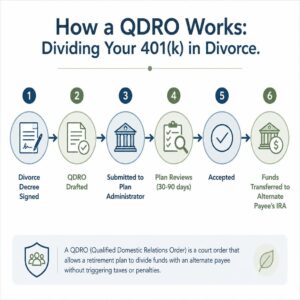
The work does not end when the judge signs the divorce decree. In some ways, the most critical period for protecting your financial future is the first 90 days after your divorce is finalized.
Immediate Post-Divorce Actions (Within 30 Days of Final Decree):
Confirm the QDRO has been submitted and accepted. If the QDRO for your 401(k) or pension was not completed before or simultaneously with the divorce, make this your first priority. Contact your attorney and confirm the status. Do not assume it has been filed. Ask for confirmation in writing that the plan administrator has received and accepted the QDRO.
Transfer IRA assets pursuant to the decree. If you are receiving a portion of an IRA, contact the financial institution and initiate the direct trustee-to-trustee transfer with documentation of the divorce decree. Do not take a distribution and re-deposit. Do it as a direct transfer.
Update all beneficiary designations. Every retirement account, life insurance policy, bank account with a payable-on-death designation, and investment account with a transfer-on-death designation must be reviewed and updated to reflect your post-divorce intentions. This is non-negotiable. Courts have seen countless cases where an ex-spouse inherited a retirement account because the account holder never updated the beneficiary designation after the divorce was final.
Refinance or remove your name from joint debt. If the divorce decree requires your ex-spouse to pay certain joint debts, contact the creditors and ask what process is required to remove your name from those accounts. Many creditors will not modify the account without refinancing, and a creditor who was not a party to your divorce is not bound by your decree. If your ex-spouse defaults on a joint debt, your credit suffers regardless of what the divorce decree says.
Close or segregate remaining joint accounts. If any joint bank accounts were not addressed in the decree or have remaining balances, work with your attorney to resolve them promptly. Leaving joint accounts open creates ongoing risk of unauthorized transactions.
Update your estate plan. Schedule an appointment with an estate planning attorney within 60 days of your divorce to update your will, trust, powers of attorney, and health care directive.
Longer-Term Post-Divorce Financial Health (Within 90 Days):
Establish your own retirement savings strategy. If you received a portion of marital retirement assets, consult with a financial advisor to develop a retirement savings plan for your post-divorce life. Consider maximizing your own 401(k) or IRA contributions, particularly if your divorce settlement gave you access to liquid assets you can deploy strategically.
Review your tax filing status. Your tax filing status changes at the end of the year in which your divorce is finalized. If your divorce is final on December 31, you file as a single taxpayer for that entire year. Consult with a tax advisor about the implications for your upcoming tax return, particularly if you received substantial assets that may trigger tax obligations.
Build an emergency fund. The financial disruption of divorce often depletes savings that were previously available as an emergency buffer. Establishing an emergency fund of three to six months of living expenses in a readily accessible account should be a priority in your post-divorce financial recovery plan.
Evaluate your housing situation. If you are retaining the family home, ensure you can carry the mortgage, property taxes, and maintenance costs on your post-divorce income. If the numbers are not comfortable, a thoughtful sale and rightsizing may be better for your long-term financial health than holding onto a home that strains your budget.
Monitor your credit. Set up regular credit monitoring after the divorce to ensure that no joint account activity is being reflected on your credit report, and to track your progress in building or rebuilding your independent credit score.
Section I: Special Circumstances in Asset Division, Scenarios That Require Unique Legal Attention
Divorce and Business Ownership: Valuing What Cannot Be Easily Priced
Business interests are among the most complex assets in divorce proceedings because they combine elements of income, property, and goodwill that are inherently subjective to value and often bitterly contested between the parties.
Types of business interests subject to division:
- Sole proprietorships operated by either spouse during the marriage
- Partnership interests in professional partnerships such as law firms, medical practices, and accounting firms
- LLC membership interests in companies formed during the marriage
- Closely held corporate stock in family businesses or small corporations
- Minority interests in larger private companies
- Franchise ownership interests
The marital estate typically includes the increase in value of a business during the marriage, even if the business was started before the marriage. The appreciation in value of a premarital business that is attributable to marital efforts, such as the working spouse’s time, talent, and energy invested in growing the business during the marriage, is generally a marital asset in most jurisdictions.
Professional goodwill: Personal vs. enterprise goodwill:
This distinction is one of the most hotly contested issues in business valuation for divorce purposes. Enterprise goodwill is the value of the business’s reputation, customer relationships, and brand that would survive the owner’s departure. Enterprise goodwill is generally a marital asset subject to division.
Personal goodwill is the value attributable specifically to the owner’s personal relationships, skills, and reputation, which cannot be sold or transferred because it would disappear if the owner left. Many jurisdictions treat personal goodwill as a non-marital asset because it is not independently transferable.
Distinguishing between enterprise and personal goodwill requires expert testimony from a qualified business valuator and often produces competing expert analyses from each side. This is an area where the quality of your forensic accountant’s work can have an enormous impact on the settlement outcome.
Divorce and Stock Options or Restricted Stock Units
Equity compensation is increasingly common in professional employment packages, and it presents unique challenges in divorce proceedings because it often has a complex vesting schedule that spans multiple years.
Vested stock options that were earned and exercisable during the marriage are generally marital property to the extent they were granted for marital-period services.
Unvested stock options and RSUs present a more complex analysis. Courts must determine what portion of the grant was for services rendered during the marriage versus services to be rendered after the divorce, using formulas that allocate the value of each grant between the marital and non-marital periods based on the grant date, the vesting schedule, and the date of separation.
The “coverture fraction” approach is commonly used: the numerator is the number of months from the grant date to the date of separation, and the denominator is the total vesting period. The resulting fraction represents the marital portion of the unvested grant.
Different courts and different jurisdictions apply varying approaches to the division of unvested equity compensation, and the law continues to evolve in this area as equity compensation becomes more prevalent. If your divorce involves significant unvested stock options or RSUs, this is an area requiring careful legal analysis.
Cryptocurrency and Digital Assets
Cryptocurrency holdings are a relatively new but increasingly significant category of marital asset. Bitcoin, Ethereum, and other digital currencies held in exchange accounts or digital wallets may constitute marital property if acquired with marital funds or during the marriage.
Tracing cryptocurrency holdings requires specialized forensic expertise. Blockchain transactions are publicly recorded, but matching wallet addresses to specific individuals requires analysis of exchange records, bank transfers used to fund purchases, and wallet metadata. Some cryptocurrency transactions are designed specifically for privacy, using mixing services or privacy coins, which can make tracing more difficult.
Courts have begun issuing subpoenas to cryptocurrency exchanges for account records in divorce proceedings, just as they subpoena traditional financial institutions. If you suspect your spouse holds undisclosed cryptocurrency, your attorney can request production of digital asset records in formal discovery.
Valuation of cryptocurrency holdings is also complicated by price volatility. Courts must determine the appropriate date of valuation: the date of separation, the date of trial, or another agreed-upon date. In periods of high volatility, the choice of valuation date can change the value of a cryptocurrency holding by tens or hundreds of thousands of dollars.
Final Reflection: What Every Divorcing Spouse Deserves to Know Before They Begin
You are navigating one of the most financially consequential experiences of your adult life. The legal system is not designed to make this easy or intuitive. It is designed to be fair, but fair outcomes require informed participation.
The eleven steps in this article are not tricks, tactics, or workarounds. They are the basic, legally sound actions that any competent family law attorney would recommend to a client who has the time and presence of mind to prepare before the process begins.
You have that time right now. Use it.
Gather your documents. Understand your accounts. Consult an attorney before you assume what you are entitled to and before you assume what you must give up. The financial future you protect through informed preparation is the foundation of the life you build after this chapter ends.
And it does end. Not tomorrow, perhaps not for months. But it ends. And when it does, you will want to have been the spouse who was prepared.
Legal Disclaimer
This article is for informational purposes only and does not constitute legal advice. Laws vary by state and jurisdiction. Always consult a licensed family law attorney before making any decisions about your divorce, separation, or custody matter.
Content Image 2 (Suggested Placement: After Section A on Federal vs. State Law):
A simple, text-based visual comparing “Community Property States” (list of 9 states) versus “Equitable Distribution States” with a brief descriptor of each approach. Clean design with a map of the United States color-coded to show the two categories.
Recommended alt text: “Map showing community property states versus equitable distribution states for divorce asset division in the United States”
Published by Attorney Sarah Mitchell | divorceprolaw.com | Asset Division & Financial Rights
Last updated for current U.S. family law standards and federal tax law