The Ultimate Relationship Red Flags List: 21 Warning Signs You Should Never Ignore
Opening: The Moment You Already Know
It’s 11:47 PM and the house is quiet. Your partner fell asleep an hour ago, and you’re sitting in the kitchen with a cup of tea that went cold twenty minutes ago, staring at nothing. You’re not sad, exactly. You’re not angry, exactly. You’re something harder to name: a hollow, aching awareness that something is deeply wrong, and has been for a long time.
Maybe it was the comment at dinner that landed like a slap, delivered so casually that you almost questioned whether you heard it correctly. Maybe it was the password change on the phone. Maybe it was the third time this month you cried in your car before walking back into your own house.
You’re not here because you’ve made a decision. You’re here because part of you is starting to wonder whether what you’re living with is normal. And the quiet, honest answer rising up through the fatigue is: no. It isn’t.
You don’t need me to tell you your marriage is over. What you need right now is someone who will name what you’re already seeing, validate what your instincts are already telling you, and help you understand what these patterns mean, not just emotionally, but legally. Because when a marriage begins to fracture along these fault lines, what happens next often has real legal consequences.
That’s exactly what this article is for.
What Relationship Red Flags Actually Mean in Legal Terms
Let’s start with something mainstream advice gets consistently wrong. Most articles about relationship red flags treat them as purely psychological territory, the domain of therapists and self-help books. But in family law, behavioral patterns in a marriage are not simply personal problems. They are legally relevant facts.
Think of your marriage as a legal contract, because that is precisely what it is. When you married, you entered a binding civil agreement governed by state law. That agreement comes with rights, obligations, and remedies. The behavior of both parties during that marriage, how finances were handled, how decisions were made, how conflict was conducted, and whether either party engaged in abuse, fraud, or concealment, can directly affect how a court divides your assets, awards custody, and determines support.
A relationship red flag, in legal terms, is any behavioral pattern that signals a breach of the marital partnership, potential harm to a vulnerable party, or conduct that a family court may consider relevant when making rulings. Courts in all fifty states consider factors like documented domestic violence, financial misconduct, parental fitness, and credibility of each party when issuing judgments in divorce and custody proceedings.
Here is the featured snippet answer you may be looking for: Relationship red flags are consistent behavioral patterns that signal emotional, financial, or physical harm within a partnership. In the context of marriage and family law, they matter because courts may consider a spouse’s conduct, including abuse, hidden assets, parental behavior, and financial deception, when making decisions about divorce settlements, custody arrangements, and spousal support.
What most people miss is the gap between recognizing a red flag emotionally and understanding its legal weight. You may have lived with financial control for years and called it “the way he manages money.” A family court attorney might call it economic abuse, a form of coercive control that affects a judge’s assessment of marital equity and support needs. The difference in framing matters enormously.
For a foundational understanding of how courts approach marital conduct in family law proceedings, the Cornell Law School Legal Information Institute’s guide to family law provides a comprehensive overview of the legal framework governing marriage, divorce, and separation across U.S. jurisdictions.
MAIN CONTENT SECTION: 21 Relationship Red Flags You Should Never Ignore
Format A: Warning Signs, organized by category with legal context woven throughout
Category One: Control, Power, and Financial Dominance
1. Your Partner Controls All Financial Access
You earn income, but you don’t know the passwords to joint accounts. You don’t know what’s in the retirement fund. You ask about the household finances and get dismissed, redirected, or made to feel foolish for asking. This is not a quirky budgetary preference. This is financial control, and in the language of family law, it may constitute economic abuse.
Economic abuse is a form of coercive control recognized by courts in a growing number of states. When one spouse deliberately restricts the other’s access to marital funds, controls all spending, or prevents the other from building independent financial resources, they create a power imbalance that family courts take seriously. If this is your reality, the legal implication is significant: you may have less financial knowledge than you realize going into any divorce proceeding, and a forensic accountant may become one of the most important professionals in your legal team.
Start documenting now. Even informal records, screenshots of what you can see, notes about what you’ve been told, copies of any financial statements you can access legally, begin to build a picture that your attorney can use.
2. Sudden Changes in Financial Behavior Before or During Separation
Your partner suddenly opens new accounts. Starts making large cash withdrawals. Pays off a “loan” to a family member you’ve never heard of. Purchases an expensive item and insists it’s for work. These are classic signs of financial dissipation or asset concealment, and they carry serious legal consequences.
Dissipation of marital assets refers to one spouse spending, hiding, or destroying marital property in anticipation of divorce. Courts across the country have consistently found that a spouse who engages in dissipation may face an unequal asset division as a remedy. The tricky part is that by the time most people notice these behaviors, assets have already moved.
If you see this pattern, your first call should not be to a mediator. Your first call should be to a family law attorney who can seek emergency financial orders or discovery to freeze assets before they disappear entirely.
3. You Are Required to Account for Every Dollar You Spend
Financial monitoring within a marriage can masquerade as “budgeting” or “being responsible.” But when one partner must justify every grocery receipt, explain every small purchase, or ask permission to spend money they legally earn, something more troubling is happening. This is financial surveillance, a behavior pattern associated with coercive control.
Legal consensus in family law increasingly recognizes coercive control as a form of domestic abuse, even in the absence of physical violence. Several states, including California, New York, and Hawaii, have introduced or passed legislation explicitly addressing coercive control in the context of domestic violence protections. Courts that operate under these frameworks consider financial surveillance as part of a broader abuse pattern, which can affect both custody determinations and spousal support awards.
4. Your Partner Has Hidden Debt or Financial Obligations You Didn’t Know About
You discover a credit card you didn’t know existed. A second mortgage on the home. A tax lien filed years ago that your spouse never mentioned. This is financial concealment, and in a marriage, it is both a relational betrayal and a legal problem.
In most states, marital debt, debt incurred during the marriage regardless of whose name it’s in, is divided upon divorce. But hidden debt complicates this calculation enormously. If your spouse ran up significant undisclosed debt, the question of who bears responsibility and in what proportion is one that courts must untangle, often with the help of forensic financial professionals.
More critically, if your spouse’s financial concealment caused harm to the marital estate, that conduct may be factored into the equitable distribution of assets. Document what you find. Do not confront your spouse if you suspect concealment. Consult an attorney first.
5. Your Partner Makes Unilateral Major Financial Decisions
They bought a car. Refinanced the house. Moved money into a new investment account. Sold stock without discussing it. All without consulting you, and often without even informing you until after the fact. In a healthy marital partnership, major financial decisions are made jointly. When one spouse consistently excludes the other from these decisions, it’s a behavioral signal of both disrespect and potential legal exposure.
Why this matters legally: in community property states, both spouses generally have equal rights to marital assets and equal responsibility for decisions affecting them. In equitable distribution states, the court considers each spouse’s contributions and the conduct of the parties. A pattern of unilateral financial decision-making, especially one that harmed the marital estate, is the kind of evidence a skilled attorney presents to argue for a more favorable distribution for the disadvantaged spouse.
Category Two: Emotional Abuse, Coercion, and Psychological Harm
6. You Walk on Eggshells in Your Own Home
You think carefully before every sentence. You rehearse conversations in your head before having them. You edit yourself constantly to avoid an explosion, a punishment, or days of silence. This is hypervigilance, and it is a textbook psychological response to living with an unpredictable, emotionally controlling partner.
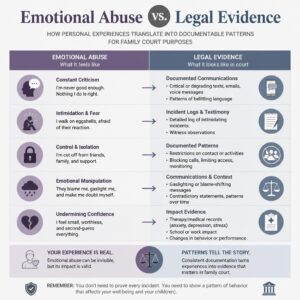
The legal relevance of emotional abuse is increasingly recognized across family courts, particularly in custody proceedings. Courts evaluating parental fitness consider the emotional environment each parent creates for the children. A parent who creates an atmosphere of fear and walking on eggshells for the other adult in the house is often creating the same environment for the children, whether they intend to or not.
If you recognize yourself in this description, start keeping a private record of incidents. Date, time, what was said or done, how you responded. These contemporaneous notes, created in real time rather than recalled months later, carry significant evidentiary weight.
7. Gaslighting: Your Reality Is Consistently Questioned or Denied
You raise a concern and are told you’re imagining it. You recall a conversation and your partner tells you it never happened, or that you’ve misunderstood. You express hurt and are told you’re too sensitive, crazy, or overreacting. Over time, you begin to doubt your own memory and perception. This is gaslighting, a form of psychological manipulation that erodes your ability to trust yourself.
In legal proceedings, gaslighting creates a specific challenge: the person who has been gaslit often struggles to present their experiences with confidence. They hedge. They second-guess. They apologize for what they know to be true. Defense attorneys and opposing counsel are trained to exploit this. Understanding that gaslighting is a deliberate manipulation tactic, not a reflection of your mental instability, is critical to your ability to testify clearly and credibly on your own behalf.
Therapy with a licensed mental health professional creates a contemporaneous record of your experience that can, with appropriate legal guidance, become part of your documented history.
8. Love-Bombing Followed by Withdrawal or Punishment
The pattern is cyclical: intense affection, gifts, declarations of love, overwhelming attention, followed by cold withdrawal, criticism, or punitive silence whenever you express a need or set a boundary. This cycle, often called intermittent reinforcement in psychology, is one of the most powerful and destructive dynamics in an abusive relationship.
The legal significance here lies in its effect on decision-making. People in love-bombing cycles often delay leaving because the “good periods” feel like evidence that things can improve. Courts and custody evaluators see this pattern clearly. As I’ve seen with many clients, the hardest cases to move forward are those where the abusive spouse presents beautifully during court appearances and mediation, because they know how to turn on the charm.
Documenting the cycle, including the good periods and the withdrawal periods, creates the kind of behavioral pattern evidence that credibly demonstrates a dynamic that can’t be captured in a single incident report.
9. Public Humiliation or Degradation
Contempt, defined in relationship research as a fundamental disrespect for the humanity of a partner, is one of the most reliable predictors of marital breakdown. It often manifests as public humiliation: mocking you in front of friends, correcting you dismissively, making jokes at your expense that cross from playful into cutting.
While public humiliation alone may not rise to the legal standard of domestic abuse in most states, its documentation forms part of a pattern of conduct that informs custody evaluations, character assessments, and credibility determinations. A parent who routinely demeans their co-parent in social settings raises questions for a custody evaluator about how they behave in private.
10. Threats, Intimidation, or Coercion Used to Control Your Decisions
These threats don’t always sound like threats. Sometimes they sound like: “If you ever leave me, I’ll make sure you get nothing.” “I’ll fight you for the kids and win.” “You’ll never survive financially without me.” “I know people. You don’t want this to get ugly.”
These statements are not just emotionally abusive. They may constitute witness intimidation or coercive control depending on context and state law. Courts take seriously any attempt by one spouse to manipulate or frighten the other into particular legal outcomes. If you have received communications like this via text, email, or voicemail, preserve them immediately. Screenshot, save to cloud, forward to a trusted person. This is potential evidence.
Category Three: Infidelity, Betrayal, and Broken Trust
11. Patterns of Secrecy Around Technology and Communication
A partner who has nothing to hide generally hides nothing. Sudden password changes, a phone that is never left unattended, private messaging apps you weren’t aware of, a computer screen that tilts away when you walk in: these behavioral shifts signal something is being concealed. They may not mean infidelity. But they mean something is wrong.
From a legal standpoint, if you suspect your spouse of infidelity, understand this: in most U.S. states, infidelity has a limited but real impact on divorce proceedings. In fault-based divorce states, adultery can affect alimony awards and, in some states, property division. In no-fault states, courts are generally less concerned with why the marriage ended and more focused on equitable resolution going forward.
What matters more legally is whether marital funds were used to support an affair. Taking a paramour on vacations funded by joint accounts, purchasing gifts, or maintaining a second household using marital assets is financial dissipation and is treated very differently from the emotional betrayal alone.
12. Repeated Lies, Even About Small Things
When someone lies habitually, even about things that seem inconsequential, they are demonstrating their relationship with honesty. Small lies, whether it’s where they were, who they were with, how much something cost, are not small. They are evidence of a character pattern.
In litigation, credibility is everything. A spouse who has been caught in multiple lies, even minor ones, loses credibility with the court. Judges are experienced at evaluating witness honesty, and a pattern of deception, documented and presented clearly, significantly undermines your spouse’s position on the issues where their testimony matters most, including financial disclosure and parenting capacity.
13. Emotional Infidelity and the “We’re Just Friends” Pattern
You’ve noticed the relationship with the colleague, the childhood friend, the fitness instructor. Your partner tells you you’re paranoid. But the relationship has qualities that feel more intimate than friendship: private jokes, late-night messages, your partner’s eyes lighting up when they mention this person’s name. Emotional infidelity, an intimate emotional connection outside the marriage that displaces the primary partnership, is a significant relational red flag even when it hasn’t become physical.
Legally, emotional infidelity without physical consummation has limited direct impact on divorce proceedings in most jurisdictions. However, the behavioral pattern around it matters. If your spouse has been redirecting emotional and practical energy outside the marriage, that pattern often correlates with other concerning behaviors, including financial redirection, gradual separation of assets, and parenting disengagement, all of which have legal relevance.
Category Four: Parenting Concerns and Children’s Wellbeing
14. Your Partner Uses the Children as Leverage or Weapons
“I’ll tell the kids what you did.” “Don’t think you’re taking them from me.” “They’ll choose me, you know that.” When a spouse begins deploying the children as instruments of control or threats in adult conflict, it is one of the most serious red flags in family law terms. Courts call this behavior parental alienation when it escalates to actively undermining the other parent’s relationship with the children.
Parental alienation, whether at the level of subtle commentary or outright campaign to turn children against the other parent, is a factor courts weigh heavily in custody determinations. A parent who demonstrates an inability to support the children’s relationship with the other parent is often viewed as the less suitable primary custodian. Document every incident: the exact words used, in front of which children, at what time.
15. Inconsistent or Absent Parenting When It’s Inconvenient
During the marriage, you handle nearly everything related to the children: school communications, medical appointments, homework, emotional support, discipline. Your partner is present when parenting is fun and absent when it’s work. Then, the moment separation becomes real, they suddenly become fiercely invested in custody.
Courts are not naive to this dynamic. Judges and custody evaluators look at the history of caregiving involvement, not just the stated intentions going forward. School records, medical records, extracurricular activity records, and testimony from teachers and pediatricians all paint a picture of who has functionally been the primary parent. This history is one of the most powerful tools available to the parent who has done the daily work of raising the children.
16. Exposing Children to Inappropriate Conflict or Adult Information
Children who are present during adult arguments, told details about financial disputes, used as messengers between parents, or asked to keep secrets from the other parent are being harmed. This is not just a parenting concern. It is a legal one.
Family courts apply a best interest of the child standard, a legal framework in which all custody and visitation decisions are made based on what arrangement best serves the child’s physical, emotional, and developmental needs. A parent who routinely places their own emotional needs above the child’s need for stability and protection from adult conflict is demonstrating poor judgment in a way that courts can, and do, consider in parenting plan decisions.
Category Five: Isolation, Dependency, and Boundary Violations
17. Systematic Isolation From Friends, Family, or Support Networks
It happened gradually. The comments about your friends being a bad influence. The subtle friction whenever you made plans without your spouse. The way spending time with your family became its own emotional ordeal. Now, years later, you realize your social world has contracted to almost nothing, and your partner is your primary source of emotional and practical support. This is manufactured dependency, a classic feature of coercive control.
Legally, isolation matters because it affects your ability to seek help and build the support network you’ll need to navigate a separation. It also matters evidentially: when a victim of coercive control has limited witnesses and limited corroboration of their experience, they face a heavier evidentiary burden. An attorney who understands coercive control dynamics can help you present a pattern of behavior that a single incident-based approach would miss.
18. Your Identity Has Been Systematically Diminished
You used to have opinions. Hobbies. A career. Friends. Plans. Over time, your identity has been subsumed into the marriage, often at your partner’s insistence or through their quiet, consistent dismissal of your independent self. Who you are has been replaced by your role in their life.
While this is primarily a psychological observation, it has legal implications in the context of spousal support. Courts in many jurisdictions consider factors including each party’s earning capacity, the length of the marriage, and the degree to which one spouse sacrificed career or personal development to support the other. A spouse who was systematically discouraged from career development or independent achievement may have a strong claim for rehabilitative alimony, support designed to help them return to financial self-sufficiency.
19. Physical Intimidation Without Physical Violence
He doesn’t hit you. But he stands too close when he’s angry. He punches walls. He drives recklessly when you’ve argued. He blocks doorways. He grabs your arm when you try to walk away. He throws things near you, not at you. This is physical intimidation, and the legal question is not whether it crosses a specific threshold of violence but whether it creates a climate of fear.
Many states’ domestic violence statutes include physical intimidation and threatening behavior in their definitions of domestic abuse, even in the absence of actual physical contact. A protective order, also called a restraining order in some states, may be available based on a pattern of intimidating behavior. These orders have immediate practical consequences, including living arrangements and temporary custody, making them one of the most powerful tools available to someone in this situation.
20. Substance Abuse That Is Denied, Minimized, or Hidden
The drinking is “just stress.” The pill use is “prescribed.” The behavior when they’re using is something you’ve learned to manage, work around, excuse. Substance abuse within a marriage affects every dimension of family life, and it carries specific legal weight in divorce and custody proceedings.
Courts evaluating parental fitness take substance abuse allegations seriously when supported by evidence. That evidence includes DUI records, medical records (when legally obtainable), witness testimony, and behavioral patterns documented by the sober spouse over time. If your co-parent has an untreated substance abuse problem, your family law attorney can seek provisions in a parenting plan for drug testing, supervised visitation, and graduated reunification, all aimed at protecting your children while recognizing the other parent’s potential for recovery.
21. Your Gut Has Been Telling You Something Is Wrong for Years
You’ve explained it away. Made excuses. Given the benefit of the doubt one more time. But underneath all of it, there has been a quiet, persistent signal. Not panic. Not drama. Just a steady, internal knowing that something in your relationship is not right, and that you are not the problem.
In my legal experience, the clients who waited the longest to seek legal advice were those who had the longest history of being told that their perception was wrong. If this is you, hear this clearly: the law does not require you to have a dramatic event to justify separation. The cumulative experience of a harmful relationship is itself sufficient reason to protect yourself legally. The moment you begin seeking legal advice is not the moment you’ve given up. It is the moment you have decided to take yourself seriously.
The Legal Insight Paragraph
In my 19 years of family law practice, what I’ve seen most often is the profound gap between what clients experience and what they believe the law will take seriously. People arrive in my office having minimized their own reality for so long that they’ve pre-emptively dismissed the very evidence that might protect them most. They say things like, “He never actually hit me, so I don’t think that counts,” or “She controlled all the money, but I should have pushed back harder.” The legal truth is that courts across the country have become increasingly sophisticated about patterns of behavior within marriage, not just isolated incidents. A single argument, a one-time financial mistake, a bad moment in an otherwise functional partnership, these are not what family law is built to address. But a sustained pattern of coercive control, financial manipulation, parenting undermination, or psychological harm is exactly what modern family law is designed to recognize and remedy. The most important shift I can help any client make is from “I don’t know if what happened to me is bad enough” to “here is the documented pattern of what happened to me, and here is what the law can do about it.” That shift in framing changes everything.
When to Consult a Specialist
Not every situation described in this article requires the same professional. Here is how to know whom to call and when.
If you have experienced physical intimidation, threats, or any physical violence: Contact a family law attorney with domestic violence experience immediately, within 24 to 48 hours of any incident, to evaluate whether an emergency protective order is warranted. Do not wait for the behavior to escalate.
If you suspect your spouse is hiding assets, moving money, or accumulating undisclosed debt: Contact a family law attorney who works with forensic accountants before filing any divorce paperwork. Filing first while assets are still traceable gives you a significant legal advantage.
If your spouse has made explicit custody threats or has begun making derogatory comments about you to your children: Contact a family law attorney within two to four weeks to document a baseline of current parenting behavior. A custody evaluator may also be appropriate at this stage.
If you receive divorce papers, a petition for dissolution, or any court filing you did not initiate: Contact a family law attorney within 72 hours. You have legal response deadlines that cannot be missed without consequence.
If your financial situation has been controlled to the point where you have no independent credit, accounts, or income: Contact a family law attorney and a certified divorce financial analyst together to build a pre-separation financial protection plan before any legal process begins.
If substance abuse is a factor and children are involved: Contact a family law attorney and request that a guardian ad litem, a court-appointed advocate for the child’s interests, be considered for your case.
The American Bar Association’s family law resources page provides tools for finding qualified family law professionals in your jurisdiction, including specialists in domestic violence, financial disputes, and child custody matters.
Empowering Close: You Already Know More Than You Think
You found this article because something inside you is paying attention. That matters.
The most important legal takeaway from everything we’ve covered is this: patterns of behavior within a marriage are legally relevant facts. The things you have been living with, whether financial control, emotional manipulation, parenting conflicts, or simply the quiet erosion of your sense of self, are not just personal pain. They are circumstances the law is equipped to address.
You don’t have to have all the answers today. You don’t have to have made a final decision. What you do need to do is stop managing your reality alone and start building a team of people who can help you protect yourself.
One concrete next step: before anything else, start a private, secure journal documenting incidents as they occur. Date, time, what happened, who was present. Store it somewhere your spouse cannot access, a personal email account, a cloud folder, a trusted friend’s home. That record, started today, may become one of the most valuable tools in your legal process.
You are not starting over. You are starting from a place of clearer knowledge. And that is a different thing entirely.
Read Next: “How to Build a Financial Safety Plan Before Filing for Divorce”
Share this article with someone who needs to hear that what they’re experiencing has a name and a legal remedy.
Legal Disclaimer
This article is for informational purposes only and does not constitute legal advice. Laws vary by state and jurisdiction. Always consult a licensed family law attorney before making any decisions about your divorce, separation, or custody matter.