9 Hidden Divorce Laws Most People Don’t Know Until They Lose Everything
By Attorney Sarah Mitchell | Family Law | divorceprolaw.com
Opening Hook
You did not plan to be here.
You did not plan to be sitting at your kitchen table at 11:47 on a Tuesday night, scrolling through divorce law forums with your reading glasses on and a glass of water you forgot to drink sitting next to your laptop. You did not plan to Google the phrase “can my spouse take my retirement account” and feel your stomach drop when you saw the answer was, in many cases, yes.
You did not plan for the phone call from your spouse’s attorney. You did not plan to receive a financial disclosure form you have never seen before and have absolutely no idea how to fill out accurately. You did not plan to realize, somewhere between your third Google search and your first conversation with a friend who has been through this, that you might not know as much about your own legal rights as you thought you did.
That realization is not a failure. It is the beginning of something important.
Most people enter the divorce process believing that the legal system will be straightforward. They believe that if they are honest, reasonable, and cooperative, the outcome will reflect that. What they do not know, and what no one tells them until it is often far too late, is that family law is filled with legal mechanisms, procedural rules, and financial principles that operate entirely beneath the surface. They are not hidden because the courts are dishonest. They are hidden because no one hands you a manual when your marriage ends.
This article is that manual.
What follows are nine divorce laws and legal principles that the majority of people going through a separation do not discover until after a costly mistake has already been made. Some of these will surprise you. Some will make you genuinely angry that no one told you sooner. All of them are real, all of them are legally grounded in U.S. family law, and every single one of them has the potential to change the outcome of your case if you understand it before your spouse’s attorney does.
Read carefully. Take notes. Share this with someone you know who is navigating a separation right now.
Your next decision could be the most important one you make this year.
What It Is: The Legal Foundation of Hidden Divorce Law
When people talk about divorce law, they tend to think in broad strokes: who gets the house, who gets the kids, who pays support. What they rarely understand is that beneath those broad categories lives an intricate network of procedural rules, statutory definitions, and equitable legal doctrines that govern exactly how those decisions get made.
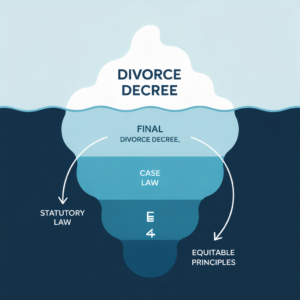
Think of divorce law as an iceberg. The surface, which is what most people see, is the final divorce decree: the document that says who gets what. What lies underneath the water line is the entire legal machinery that determined how those decisions were reached. And that underwater machinery, the discovery process, the financial disclosure rules, the valuation methodologies, the jurisdictional timing rules, the evidentiary standards, is where most people lose ground they never knew they were standing on.
Here is why this matters: divorce is not decided by fairness in the abstract. It is decided by facts presented within procedural frameworks. The person who presents the most complete, most legally organized picture of their financial life, their parenting capacity, and their legal standing is the person who gets the better outcome. Not always the most deserving person. Not always the one who has been wronged. The most prepared person.
Family law varies significantly by state, and that is precisely why so much confusion exists. What is standard practice in California may be entirely different from what applies in Texas or New York. When you read general divorce advice online, you are often reading information that applies to a composite legal landscape rather than to your specific jurisdiction. This creates dangerous blind spots.
The core legal framework most people need to understand is this: divorce is governed by a combination of statutory law (laws passed by your state legislature), case law (decisions made by judges that set precedent), and equitable principles (broad legal doctrines that allow courts to reach fair outcomes in complicated cases). Understanding that three-layer system is the first step to understanding why some divorces produce outcomes that seem shockingly unfair, and others do not.
The most common reason people are blindsided by these hidden laws is simple: they hired an attorney too late, asked too few questions too early, or assumed that because their spouse seemed cooperative, the legal process would be straightforward. Cooperation between spouses does not eliminate the legal complexity of divorce. It merely changes the tone of the conversation.
Let us get into the specifics.
For a comprehensive overview of how U.S. family law courts operate and the principles that guide judicial decision-making, the Cornell Law School Legal Information Institute’s complete guide to family law is one of the most authoritative free resources available.
9 Hidden Divorce Laws Most People Don’t Know Until They Lose Everything
Hidden Law #1: The Date of Separation Is a Legal Event, Not Just an Emotional One, and Getting It Wrong Can Cost You Thousands
Most people assume that the “date of separation” simply means the day one spouse moved out of the marital home, or the day someone said the words out loud. That assumption is understandable. It is also legally consequential in ways that shock many clients when they first learn the truth.
In most U.S. jurisdictions, the date of separation is a formal legal marker that determines the cutoff point for what counts as marital property, which is property subject to division, versus separate property, which belongs to one spouse alone. Everything earned, accumulated, or accrued after the legal date of separation may be treated differently from everything that existed before it. Your paycheck, your employer’s contribution to your 401(k), even the appreciation in value of an asset you already owned, can all be affected by which side of that date they fall on.
Here is where it gets complicated: different states define the date of separation differently. In California, for example, courts have historically required that a spouse must have both subjectively intended to end the marriage and taken some objective action consistent with that intent. Simply moving to a separate bedroom is not sufficient in many jurisdictions. In other states, such as those that follow a strict physical separation rule, the date one spouse physically leaves the marital home may carry more weight. Some states define separation based on the filing date of the divorce petition itself, which is a completely different standard again.
What this means practically is that if you and your spouse have been living in the same house for financial reasons while considering divorce, sometimes called “nesting” or “in-home separation,” the legal clock may not have started ticking when you think it did. And if one spouse has been earning significant income, contributing to retirement accounts, or paying down a mortgage during that ambiguous period, the question of which date applies becomes a financial dispute with real dollar consequences.
Clients frequently tell me, as I’ve seen with many clients, that they assumed the date they stopped sharing a bedroom was their separation date, only to discover months later that their spouse’s attorney was arguing for a different date entirely, one that conveniently captured an additional six months of retirement contributions or a significant stock vesting event on their side of the ledger.
Your action step: Document your date of separation with objective evidence. Emails, text messages, or a letter sent to your spouse clearly stating your intent to separate carry legal weight. Do not leave this to interpretation if you can help it. Speak with a family law attorney about how your specific state defines separation and get that date locked in writing.
Legal consensus holds that in community property states, including Arizona, California, Idaho, Louisiana, Nevada, New Mexico, Texas, Washington, and Wisconsin, the date of separation is particularly critical because it defines the boundary between community property, which is divided equally, and separate property, which is not. In equitable distribution states, which make up the majority of the country, the date of separation affects how the marital estate is characterized, though courts have more discretion in how they ultimately divide it.
One more dimension most people miss: the date of separation can also affect spousal support calculations, dependency status for tax purposes, and even health insurance eligibility. It is not merely a sentimental milestone. It is a legal event with financial consequences in multiple directions simultaneously.
If your separation has been ambiguous, gradual, or contested, get clarity on this issue before anything else moves forward. The rest of your case may depend on it more than any other single fact.
Hidden Law #2: Retirement Accounts Are Marital Property, and Without a QDRO, You May Never Actually Receive Your Share
Here is one of the most common and most devastating surprises in divorce law. A couple reaches a settlement. The agreement specifies that one spouse receives fifty percent of the other spouse’s pension or 401(k). Everyone signs. The divorce is finalized. And then, sometimes months or even years later, the spouse who was supposed to receive their share of the retirement account tries to access it, and finds out it was never actually transferred.
Why? Because transferring retirement account funds in a divorce requires a specific legal document that is separate from your divorce decree. That document is called a Qualified Domestic Relations Order, or QDRO (pronounced “quadro”). A QDRO is a specialized court order that instructs a retirement plan administrator to divide the account and pay a portion directly to the non-employee spouse, legally called the “alternate payee.” Without it, the retirement account stays exactly where it is, in the name of the account holder, regardless of what your divorce decree says.
This matters for three reasons that most people never anticipate.
First, QDROs are plan-specific. They must be drafted to comply with the specific rules of the retirement plan in question, whether it is a 401(k), a pension, a 403(b), a 457 plan, or a government plan such as FERS for federal employees. A generic QDRO template that works for one plan may be rejected by another. Each plan has its own approval process, its own required language, and its own timeline. Getting it wrong means starting over, sometimes at significant cost.
Second, QDROs take time. The average QDRO takes anywhere from 60 to 180 days to process after it is drafted, submitted to the plan administrator for pre-approval, signed by the judge, and then resubmitted for final approval. During that window, if the account holder dies, retires, or the plan changes its terms, your rights to that money may be affected in ways that your divorce decree cannot fully protect you from.
Third, and most critically, many people finalize their divorce without ever addressing the QDRO, either because their attorney forgot, because they used a DIY divorce kit that did not include it, or because they assumed the divorce decree itself was sufficient to transfer the funds. Courts have consistently found that a divorce decree alone does not transfer retirement account funds. Only a properly executed QDRO, approved by the plan, can do that.
If you have a retirement account in your settlement, or you are supposed to receive a share of your spouse’s retirement account, do not close out your divorce without also having a completed or at least in-progress QDRO. Confirm with your attorney exactly who is responsible for drafting it, which party pays for it (this is negotiable), and what the plan’s pre-approval process looks like.
For defined benefit pension plans, the valuation methodology becomes an additional layer of complexity. The present value of a pension depends on actuarial assumptions, including the employee spouse’s age, expected retirement age, and the plan’s payment formula. Courts have applied different standards for how to value pensions, and whether to divide the stream of future payments or offset it with a present-day asset of equivalent value. Your attorney should be fluent in both approaches and advise you on which one is more advantageous given your specific circumstances.
Legal consensus holds that military retirement accounts, federal civilian pensions, and railroad retirement benefits are each governed by their own specific statutes and require specific order types rather than a standard QDRO. If your spouse is or was in the military, the document required is a Military Retired Pay Division Order, and it must comply with the Uniformed Services Former Spouses’ Protection Act (USFSPA). Getting the wrong document type drafted is a costly mistake that takes significant time to correct.
Do not assume your divorce is truly finished until every retirement account addressed in your settlement has a finalized, plan-approved division order in place.
Hidden Law #3: Dissipation of Marital Assets Is a Legal Claim, Not Just an Accusation, and It Can Fundamentally Shift the Division of Your Estate
If your spouse spent marital money on an affair, on gambling, on excessive gifts to a new partner, on substance abuse, or simply on a sustained pattern of reckless financial behavior during the separation period, that is not just a moral grievance. In many jurisdictions, it is a legal claim called dissipation of marital assets, and it can directly affect how the marital estate is divided.
Dissipation, in family law, refers to one spouse’s intentional waste or misuse of marital assets for a purpose unrelated to the marriage, typically occurring after the marriage has begun to break down. The legal mechanism is straightforward: when a court finds that dissipation occurred, it may add the wasted amount back into the marital estate for purposes of division, which is called “charging” the dissipating spouse, effectively reducing their share of remaining assets to compensate the other spouse for the loss.
The challenge, and this is where most people stumble, is that dissipation claims require evidence. A suspicion that your spouse spent money irresponsibly is not sufficient. Courts look for documented financial irregularities, bank statements showing unusual withdrawals, credit card statements reflecting unexplained expenditures, or evidence of asset transfers to third parties. Courts have consistently found that the burden of proving dissipation lies with the spouse making the claim, and that the alleged dissipation must have occurred during or after the breakdown of the marriage, not simply during a period of financial stress earlier in the marriage.
Timing matters enormously here. Most jurisdictions require that the dissipation occur after some defined point of marital breakdown, often after the date of separation but sometimes earlier if the marriage was clearly failing. Wasteful spending that occurred years ago during a functional marriage is unlikely to qualify as dissipation under most state standards, even if it was financially harmful.
What most people do not know is that dissipation claims are not limited to obvious misconduct. They can include a spouse who liquidated a retirement account and spent the proceeds without consent, a spouse who transferred real property to a family member for below-market value, or a spouse who allowed an insurance policy to lapse, eliminating an asset that should have been part of the marital estate. Courts have also recognized the concept of constructive dissipation, where a spouse’s deliberate inaction causes an asset to lose value, such as allowing a rental property to deteriorate or failing to make required insurance payments.
To pursue a dissipation claim, you will need to act during the discovery phase of your divorce. Discovery is the legal process by which both parties are required to disclose financial information, including bank records, credit card statements, investment account records, and tax returns. You are entitled to request this information from your spouse, and if they are uncooperative, your attorney can issue a subpoena, which is a legal order compelling a third party such as a bank to provide records directly to the court.
The window for raising dissipation claims is not unlimited. In most jurisdictions, you must raise the claim during the divorce proceedings, not afterward. If you discover evidence of dissipation after your divorce is finalized, your options become significantly more limited and more expensive. Document your concerns early, gather financial records as thoroughly as you can before any accounts are closed or records are destroyed, and bring the issue to your attorney’s attention as soon as it arises.
Legal consensus holds that courts assess dissipation claims on a case-by-case basis, using factors including the nature of the expenditure, the timing relative to marital breakdown, whether the other spouse had knowledge of or consented to the spending, and the overall financial picture of the marital estate. The bigger the marital estate, the more significant the dissipation claim can be in shifting the ultimate distribution.
One area where dissipation claims are frequently missed is in the context of business expenses. If a spouse runs a business through which they have been personally charging expenses, such as meals, travel, or personal gifts classified as business deductions, those expenditures may constitute a form of dissipation that requires forensic accounting to uncover. If you suspect this, ask your attorney about engaging a certified divorce financial analyst (CDFA) or forensic accountant to review the business records.
Hidden Law #4: Fault Still Matters in Some States, and Even in No-Fault States, Conduct Can Affect Alimony and Asset Division
This is one of the most commonly misunderstood areas of divorce law, and one of the most consequential.
When no-fault divorce became available across all fifty states, many people drew the reasonable but incorrect conclusion that marital misconduct, including infidelity, abuse, or abandonment, no longer had any legal relevance in divorce proceedings. That conclusion is wrong in many jurisdictions, and in some states, it is dramatically wrong.
Here is the distinction that matters: no-fault divorce means that you do not need to prove fault in order to obtain a divorce. It does not mean that fault is irrelevant to how the divorce is resolved. These are two separate legal questions, and conflating them is a mistake that costs people real money.
In many states, including those with otherwise modern no-fault divorce statutes, fault-based conduct remains a factor in alimony determinations. This means that if your spouse had an extramarital affair, a judge in certain jurisdictions may consider that conduct when deciding whether to award spousal support, how much to award, or for how long. Virginia, North Carolina, South Carolina, and several other states have particularly robust provisions for considering marital misconduct in alimony decisions. In some of these states, a spouse who committed adultery may be completely barred from receiving alimony, even if they would otherwise qualify for it based on financial need.
Similarly, some states permit courts to consider marital misconduct when dividing the marital estate under equitable distribution principles. While courts in these jurisdictions are not supposed to punish a spouse financially for bad behavior, judges have discretion in how they apply equitable principles, and documented misconduct can and does influence judicial outcomes in practice.
The critical word here is documented. Alleging that your spouse was unfaithful is not the same as proving it in a way that satisfies the evidentiary standards of your jurisdiction. Courts require competent evidence, which may include communication records, financial records showing expenditures on a third party, witness testimony, or other documented proof. Simply telling your attorney that the affair happened is not sufficient if you cannot substantiate it with evidence the court will accept.
Conversely, if you are the spouse whose conduct may be at issue, it is equally important to understand this principle. If you engaged in misconduct during the marriage and you live in a state where that conduct is legally relevant to alimony or asset division, your attorney needs to know before your case begins. Concealing legally relevant facts from your own attorney is one of the most damaging mistakes a divorce litigant can make, because it prevents your attorney from building a strategy that accounts for how that information will surface.
There is also a nuanced middle ground worth knowing about. Even in states where fault does not directly affect asset division, a pattern of financial abuse, economic control, or documented domestic violence may be considered as part of the court’s equitable analysis. Courts have discretion to consider the circumstances of each case, and a pattern of one spouse controlling all financial decisions while keeping the other spouse financially dependent can be characterized in ways that affect the outcome of both support and asset division arguments.
Legal consensus holds that even in “pure” no-fault states such as California and Wisconsin, conduct that involves financial harm to the marital estate, such as hiding assets, forging signatures, or committing financial fraud, is treated as a separate legal matter that courts can and do address within the divorce proceedings.
Know your state’s specific provisions. This is not an area where general advice serves you well. A family law attorney in your jurisdiction can tell you within the first consultation whether and how fault or conduct will be relevant to your specific case.
Hidden Law #5: You Can Waive Your Right to Future Spousal Support Without Realizing It
Spousal support, also called alimony or spousal maintenance depending on your state, is one of the most emotionally and financially significant issues in a divorce. It is also one of the areas where people make silent, binding legal waivers without ever understanding that is what they are doing.
Here is how it happens.
In mediated divorces and collaborative divorces, both of which are voluntary processes where couples negotiate their own settlement with the help of a neutral third party or cooperating attorneys, the issue of spousal support is often raised and then set aside quickly. One spouse might say, “I don’t want alimony, I just want to be done.” The other spouse might agree, eager to move forward. The mediator or the attorneys draft a settlement agreement that includes a provision stating that both parties waive any right to spousal support, both now and in the future.
That waiver is legally binding in most jurisdictions. Once it is signed and incorporated into a final divorce decree, you cannot go back and ask for spousal support, even if your financial circumstances change dramatically. If you later lose your job, become ill, or discover that the divorce settlement left you in a financially vulnerable position you did not anticipate, you will have no recourse on the spousal support issue in most states. The waiver holds.
The legal doctrine at work here is called res judicata, which is a Latin legal term meaning “a matter already judged.” When a divorce decree is entered and becomes final, the issues resolved within it are generally not subject to relitigation. You can modify some aspects of a divorce decree after the fact, particularly child support and child custody, which courts retain jurisdiction over because the child’s needs evolve. But in most states, a spousal support waiver signed as part of a final settlement is permanent and irrevocable.
What makes this particularly dangerous is the emotional context in which these waivers are often signed. Many people in the early stages of divorce are desperate to be finished. The litigation is exhausting, the conflict is painful, and the idea of just drawing a line under the whole thing is genuinely appealing. An offer to “keep it simple” and waive support on both sides can feel like the mature, reasonable, forward-looking choice in the moment. It can also be a significant financial mistake with decades-long consequences.
Before waiving spousal support, there are several questions you must be able to answer honestly. First, have you been out of the workforce, or significantly underemployed, because of the marriage? If you sacrificed career advancement to raise children, support your spouse’s career, or manage the household, that sacrifice has economic value that may be compensable through spousal support. Courts in most jurisdictions recognize what is called “imputed income” when calculating support obligations, meaning they can assign you an income level based on your education, skills, and the local job market even if you are not currently earning at that level. But that calculation only matters if you actually seek support rather than waiving it.
Second, do you have a complete picture of your spouse’s financial situation? Signing a support waiver based on incomplete financial information, perhaps before discovery is finished or before a forensic accountant has reviewed business records, is particularly risky. If it later emerges that your spouse was hiding income or assets at the time of settlement, your legal options to reopen the decree are narrow and depend heavily on state law and the specific facts of the concealment.
Third, are you signing the waiver as part of a larger negotiated settlement, or are you doing so in isolation? A spousal support waiver that is offset by a larger share of assets may make economic sense. A standalone waiver made under emotional pressure, or to “just get it over with,” is worth scrutinizing very carefully.
Legal consensus holds that in states with mandatory financial disclosure requirements, such as California, Florida, and New York, a spousal support waiver made based on materially false financial disclosures may be subject to a motion to set aside the judgment, which is a formal legal request to reopen the settled issue. However, these motions face high legal hurdles and are rarely successful unless there is clear and convincing evidence of fraud or misrepresentation in the disclosure process.
Consider all the dimensions of your financial future before waiving support. Five years from now, your financial needs, your health, your career, and the job market may all look very different from how they look today. Spousal support is one of the few financial tools in family law specifically designed to account for that kind of long-term economic vulnerability.
Hidden Law #6: Your Spouse’s Separate Property Can Become Marital Property, and Vice Versa, Through a Legal Process Called Transmutation
This is a legal concept that surprises almost everyone who hears it for the first time, and it operates silently in marriages for years before anyone realizes it has occurred.
Transmutation is the legal process by which the character of property changes from separate to marital, or from marital to separate, based on the conduct of one or both spouses during the marriage. It is not a deliberate legal transaction in most cases. It happens gradually, through the ordinary financial decisions couples make together, and it can dramatically affect who owns what when a divorce occurs.
Here is a common example. Your spouse owned a house before the marriage. That house is separate property, meaning it belongs to them alone. But during the marriage, the mortgage payments were made from a joint bank account funded by both of your incomes. Over the years, marital funds paid down the principal, the equity increased, and perhaps you used a shared savings account to fund a major renovation. At the time of divorce, that house is no longer purely separate property in most jurisdictions. The marital contributions to its equity have created what is called a “marital interest” in the property, even though one spouse’s name is on the deed.
The reverse can also happen. A couple might own a house together as marital property, and then one spouse uses a large inheritance (separate property) to pay off the mortgage. If that transaction is not carefully documented and structured to preserve the separate character of the inheritance, some jurisdictions may find that the inheritance funds were “commingled” with marital property and lost their separate character in the process.
Commingling is the legal term for the mixing of separate and marital funds in a way that makes it impossible to trace which dollars are which. When courts cannot trace the separate property contribution with sufficient specificity, they may treat the entire asset as marital property subject to division. This is known as the “source of funds” rule in many states, and it places the burden on the spouse claiming separate property to prove, through documentary evidence, exactly where the money came from and how it was applied.
The area where transmutation most commonly blindsides people is in the context of inheritance and gifts. Many people believe, reasonably but incorrectly, that an inheritance they received during the marriage is automatically protected as their own separate property. In most states, that is initially true: a gift or inheritance received by one spouse is separate property. However, if you deposit that inheritance into a joint account, use it to purchase jointly-titled property, or allow it to become intermingled with marital funds over time, you may have inadvertently transmuted it into marital property.
Some states also recognize written transmutation agreements, which are formal documents in which both spouses agree to change the character of a specific asset from separate to marital or from marital to separate. California, for example, requires that transmutation of real property be in writing and signed by the spouse whose interest is adversely affected. Verbal agreements between spouses to transmute property are generally not enforceable in California, though they may carry some weight in other jurisdictions.
Business ownership is another area where transmutation creates significant complexity. If a spouse owned a business before the marriage, that business may be their separate property. But if the other spouse worked in the business, contributed skills or labor, or if marital funds were used to capitalize or grow the business during the marriage, the business may have acquired a marital component that is subject to division. Untangling the separate and marital portions of a business requires a formal business valuation and often a forensic accountant who can trace the financial history of the entity.
Legal consensus holds that the party claiming an asset is separate property bears the burden of proving its separate character with sufficient tracing evidence. In the absence of clear documentation, courts in many states apply a presumption that property accumulated during the marriage is marital property. This presumption is rebuttable, meaning you can overcome it with evidence, but doing so requires careful financial record-keeping from the beginning of the marriage, not just from the time you begin contemplating divorce.
If you received significant inheritances, gifts, or brought substantial assets into your marriage, document the separate origin of those assets now. Bank records, gift letters, trust documents, and property deeds are all relevant. Even if you have been married for many years, a forensic accountant may be able to trace the origin of funds if adequate records exist.
Hidden Law #7: Children’s Preferences in Custody Decisions Are Legally Weighted, But Not in the Way Most Parents Think
Few issues in divorce law are more emotionally charged than child custody, and few areas carry more common misconceptions about how courts actually make these decisions.
The most widespread myth is a specific version of this: “Once my child turns 12 (or 13, or 14), they get to choose which parent they live with.” Variations of this belief circulate widely among parents going through custody disputes, and it is not accurate in any U.S. jurisdiction, though it is based on a real legal principle that is far more nuanced than the myth suggests.
The actual legal standard is this: in virtually every state, family courts are required to make custody decisions based on “the best interests of the child.” That standard is not a single definition. It is a multi-factor test that different states define differently, but which generally includes factors such as each parent’s ability to provide a stable home environment, the quality of the parent-child relationship, the child’s adjustment to their school and community, each parent’s mental and physical health, any history of domestic violence or substance abuse, and, critically, the child’s own reasonable preference, taking into account the child’s age and maturity.
That last factor is where the myth comes from. Courts do consider the preference of a child who is of sufficient age and maturity to express a considered opinion. But “sufficient age and maturity” is a judgment call, not a bright-line rule. A twelve-year-old’s preference carries some weight in most jurisdictions. A seven-year-old’s preference carries considerably less. And in every case, the preference is one factor among many, not a deciding factor in isolation.
What many parents do not know is how courts evaluate the authenticity of a child’s expressed preference. Judges and custody evaluators are experienced at identifying when a child’s stated preference reflects their genuine feelings versus when it reflects parental coaching, pressure, or the child’s desire to avoid conflict with the more emotionally volatile parent. A child who expresses a preference that appears to have been coached or pressured may actually harm the case of the parent they are nominally supporting, because it raises concerns about that parent’s willingness to foster the child’s relationship with both parents, a factor courts weigh heavily.
Courts also consider what is called the “friendly parent” doctrine, which is the principle that courts prefer to award greater custody to the parent who is more likely to support the child’s ongoing relationship with the other parent. A parent who badmouths the other parent, attempts to limit contact, or engages in behavior that alienates the child from the other parent is at a legal disadvantage, regardless of how much the child appears to prefer living with them.
Parental alienation, while not a formally recognized diagnosis in all jurisdictions, is a pattern of behavior that courts increasingly take seriously. It refers to one parent’s systematic undermining of the child’s relationship with the other parent through denigration, interference with contact, or encouraging the child to reject the other parent. Courts have consistently found that documented parental alienation behavior is a significant negative factor in custody determinations, and in severe cases, it can result in a modification of custody to the previously disfavored parent.
Custody evaluation is a formal legal process in which a mental health professional, typically a licensed psychologist or social worker, is appointed by the court to conduct a comprehensive assessment of both parents and the child. The evaluator interviews all parties, observes parent-child interactions, reviews relevant records, and submits a written report with recommendations to the court. While the judge is not bound by the evaluator’s recommendations, courts give them significant weight, and in many cases the evaluator’s report effectively determines the outcome.
If you are facing a contested custody matter, the custody evaluation report may be the most important document in your case. Understanding how evaluators assess the factors in your jurisdiction, and how to present yourself authentically and effectively in that process, is something your attorney should prepare you for well in advance.
Legal consensus holds that courts in most jurisdictions strongly favor arrangements that allow children to maintain meaningful relationships with both parents, and that a parent who attempts to limit or eliminate the other parent’s access without a legitimate safety justification is typically viewed unfavorably. The legal presumption in favor of shared parenting has grown stronger in most states over the past decade, and in some states it is now codified as a starting point from which the court may deviate only for cause.
The American Bar Association offers a thorough overview of child custody standards and best interests considerations in its complete guide to family law and custody, which is a valuable reference for parents navigating this process.
If your child is expressing a strong preference about where they want to live, speak with your attorney about the most appropriate and legally sound way to bring that preference to the court’s attention, whether through direct testimony, a guardian ad litem (a court-appointed attorney representing only the child’s interests), or a formal custody evaluation.
Hidden Law #8: Hiding Assets Is Not Just Unethical, It Is Perjury, and Courts Have Specific Legal Tools to Uncover It
The financial disclosure process in divorce is not optional. It is not a suggestion. And it is not something courts take lightly when one party attempts to manipulate it.
In every U.S. divorce proceeding, both parties are required to complete a financial disclosure, which is a sworn statement listing all assets, liabilities, income, and expenses. The exact form varies by state, but the legal obligation is universal: you are signing a document under oath, and every material misrepresentation on it constitutes perjury, a criminal offense, in addition to being grounds for the court to sanction the offending party financially within the civil divorce proceedings.
Despite this, asset concealment in divorce is remarkably common. A 2012 survey conducted by the National Endowment for Financial Education found that a significant portion of adults in combined households admitted to financial deception of some kind toward their partner. In divorce proceedings, that deception can take many forms, from straightforward omissions of bank accounts or retirement accounts, to more sophisticated schemes involving business income underreporting, deferred compensation arrangements, or transfers to third parties.
Here is what most people do not know: courts have legal tools specifically designed to uncover hidden assets, and an experienced family law attorney who suspects concealment can deploy them aggressively.
The most powerful of these tools is formal discovery. Discovery in a divorce case includes interrogatories (written questions the other party must answer under oath), requests for production of documents (formal demands for financial records including bank statements, tax returns, investment account statements, and business financial records), requests for admissions (statements of fact the other party must either admit or deny), and depositions (sworn in-person testimony taken before a court reporter that can later be used at trial). These tools are not limited to what your spouse chooses to share. They extend to third parties: banks, employers, investment firms, and government agencies can all be subpoenaed to produce records.
Forensic accountants are the specialists who analyze those records once obtained. They are trained to identify the specific red flags of income or asset concealment, including unexplained deposits, transfers to family members or business entities, unusual patterns of cash withdrawals, discrepancies between lifestyle and reported income, and artificially reduced business profits. Courts have consistently found that forensic accounting evidence is admissible and highly persuasive, particularly in cases involving self-employed spouses or closely-held business owners.
There is also a legal tool called a constructive trust, which is an equitable remedy courts can impose when one spouse has transferred marital assets to a third party in an attempt to place them beyond the reach of the divorce proceeding. A court can declare that the third party holds those assets “in trust” for the other spouse’s benefit and order their return. This remedy is particularly relevant in cases where a spouse has transferred property to a new romantic partner, a family member, or a business entity they control.
What happens when hidden assets are discovered mid-proceeding, or even after a divorce is finalized? The consequences can be substantial. Within the proceedings, a judge who finds that one party concealed assets may impose sanctions including attorney’s fee awards, adverse inference instructions to the jury, or an unequal division of assets that penalizes the offending party. Courts have consistently found that financial fraud in divorce proceedings is taken seriously at the judicial level, and some judges will award the entire concealed asset to the innocent spouse as a penalty.
If concealment is discovered after the divorce is final, the innocent spouse may file a motion to set aside the judgment based on fraud, if they can show the other party made a material misrepresentation or omission in their financial disclosure. The timeframe for such motions varies by state, but most have a limitation period, and the burden of proof is on the party seeking to reopen the case.
Legal consensus holds that self-employed individuals, business owners, and those with complex investment portfolios present the highest risk of undisclosed assets in divorce proceedings, and that these cases warrant enhanced scrutiny of financial records from an early stage. If your spouse is self-employed, owns a business, or has income streams outside of a regular paycheck, the question of whether you have complete financial information is not academic. It is the foundation of your entire case.
Trust your instincts about your financial picture. If your marital lifestyle does not match the financial disclosures your spouse has made, that discrepancy is worth investigating with a forensic accountant or a certified divorce financial analyst before you sign anything.
Hidden Law #9: Temporary Orders Set the Default, and What You Agree to “Just for Now” Can Become Permanent
This is perhaps the most counterintuitive of all the hidden laws in this article, and it may be the one that catches the most people completely off guard.
When a divorce is filed and the parties have not yet reached a final settlement, the court frequently issues temporary orders to govern the situation while the divorce is pending. These orders may address temporary child custody and parenting time schedules, temporary spousal support or child support, who remains in the marital home during the proceedings, who pays which bills, and how marital assets are managed during the pendency of the case.
Temporary orders are presented to the parties, and often to the courts, as exactly that: temporary. They are designed to maintain stability while the longer process of litigation or negotiation proceeds. And yet, in practice, temporary arrangements have a powerful tendency to solidify into permanent ones.
Here is why this happens. Human behavior, including judicial behavior, is influenced by precedent and stability. A parenting schedule that has been in place for eight months by the time a final custody hearing occurs is no longer a hypothetical arrangement. It is a living, functioning reality that both the children and the parents have adapted to. A judge looking at that arrangement, particularly if it appears to be working reasonably well, has a strong practical incentive not to disrupt it without good cause. Family courts operate under the principle that stability is in children’s best interests, and a working status quo is a form of stability.
The same dynamic applies to financial arrangements. If one spouse has been occupying the marital home, paying the mortgage, and covering certain household expenses for the duration of the divorce proceedings, that arrangement creates its own inertia. The person who has been out of the home may find that courts are reluctant to disrupt the housing stability of any children in the home, even if the final property division would ideally produce a different result.
What this means practically is that you must treat temporary orders with the same seriousness as permanent ones. The parenting schedule you agree to “just to get through the holidays” may be the schedule a judge looks to when setting permanent custody terms eight months later. The financial arrangement that felt manageable during negotiations may lock in support amounts or asset control patterns that persist into the final decree.
There is also a specific phenomenon worth naming: the temporary custody arrangement and the “primary parent” determination. In many cases, the parent who becomes the primary residential parent during the temporary order phase of the divorce, meaning the parent with the majority of parenting time during the pendency of the case, is significantly more likely to be designated the primary parent in the final order. Courts are reluctant to destabilize a child’s life by drastically changing a parenting arrangement that appears to be functioning.
This means that if you care about shared parenting, or about being a meaningful presence in your children’s daily lives, the time to advocate for that is at the temporary order stage, not just at the final hearing. If you agree to a limited parenting schedule on a temporary basis without protecting your right to expand it, you may find yourself fighting uphill at the final stage to recover ground you voluntarily ceded.
On the financial side, be cautious about temporary stipulations regarding who has access to which bank accounts, who is responsible for which debts, and which spouse bears the costs of the marital home. These arrangements affect your financial position during a period when significant decisions are also being made, and they can create financial dependencies or advantages that influence the final settlement negotiations.
Legal consensus holds that parties should treat the negotiation of temporary orders as a strategic legal exercise, not a good-faith interim measure. This is not a suggestion to be adversarial. It is a recognition that in family law, as in many areas of the law, the best way to reach a fair final outcome is to be thoughtful and legally informed at every stage of the process, including the earliest ones.
Speak with your attorney about the specific language of any temporary order before you sign it. Ask specifically whether any of the provisions could be used as a baseline or precedent in final order negotiations. And if the temporary order is being presented to you without sufficient time to review it with counsel, request a brief continuance to do so properly. A few days of delay is a small price to pay to avoid a temporary arrangement that becomes a permanent one by default.
Content Image Suggestion #2
Image concept: A clean, organized infographic titled “9 Hidden Divorce Laws at a Glance” with each law summarized in one sentence alongside a simple icon. The design should be professional and calm, using navy, white, and soft gold color palette consistent with a legal authority brand. The visual should reinforce clarity and organization rather than fear or urgency.
Alt text: “Infographic summarizing 9 hidden divorce laws every person should know before proceeding with divorce”
The Legal Insight Paragraph
In my 19 years of family law practice, what I’ve seen most often is not ruthlessness or bad faith. What I’ve seen most often is good people making reasonable decisions with incomplete information, and then paying for that incompleteness for years. The clients who sit across from me and say “I just want this to be over” are often the same people who return two or three years later asking if there is anything that can be done now that they have signed a settlement they no longer fully understand. And sometimes there is. But sometimes the legal window has closed, the waiver is binding, the QDRO was never filed, the temporary custody arrangement became permanent, and the options that existed before are simply no longer available. That is the reality of family law: it rewards preparation, and it penalizes the assumption that good intentions are a substitute for good information. The single most effective thing you can do for yourself right now is to treat every decision in this process as if it is permanent, because in many cases it is. Not because the legal system is cruel, but because it is designed to produce finality. And finality, once achieved, is very difficult to undo.
When to Consult a Specialist
These are not generic warnings. These are specific legal triggers that require specific professional responses within specific timeframes.
If you receive a complaint for divorce or a summons from your spouse’s attorney, you have a legally imposed response deadline, typically 20 to 30 days depending on your jurisdiction, to file a formal response. If you miss that deadline, your spouse may be able to seek a default judgment against you, which means the court could grant their requested terms without your input. Contact a family law litigation attorney within five days of being served. Do not wait until you feel “ready.”
If your spouse has filed for a temporary restraining order (TRO) or an emergency protective order (EPO), these orders can go into effect immediately and may affect your access to your children, your home, and your shared financial accounts within hours. Contact a family law attorney immediately, the same day if possible. Emergency TROs are often granted ex parte, meaning without your presence or your ability to contest them initially, and a prompt legal response is essential to protecting your rights at the follow-up hearing, which is typically scheduled within two to three weeks.
If you suspect your spouse is hiding assets or has recently transferred property, closed bank accounts, or made unusual financial transactions, contact a family law attorney who regularly works with forensic accountants within the first 30 days of your divorce filing. Early financial investigation preserves evidence and may allow your attorney to seek a court order freezing assets before they are dissipated further.
If your divorce settlement includes a pension, 401(k), or other employer-sponsored retirement plan, contact a QDRO specialist attorney immediately after your divorce decree is finalized. Do not wait until you approach retirement. Retirement plans can change, account holders can die, and plans can merge or dissolve. The sooner your QDRO is filed and approved, the sooner your legal interest in those funds is protected.
If you have been the victim of domestic violence or economic abuse during the marriage, contact both a family law attorney and a domestic violence legal advocate in your area before you file for divorce or respond to your spouse’s filing. In legal proceedings involving domestic violence, standard mediation is often inappropriate and may not be legally required. A family law attorney with domestic violence experience can help you access protective orders, safety planning resources, and legal strategies that account for the power imbalance in the relationship.
If you are considering signing a settlement agreement without having completed formal discovery, stop. Contact your family law attorney, or obtain a second opinion from another family law attorney, before signing anything that contains a spousal support waiver, a property division agreement, or a child custody arrangement. Signing a settlement before your financial picture is complete is one of the most common and most consequential mistakes in divorce law.
If your divorce involves a business owned by one or both spouses, real property with complex title history, or significant assets held in trusts, retain a certified divorce financial analyst (CDFA) or forensic accountant in addition to your family law attorney. Business valuation and complex asset tracing require specialized expertise that most family law attorneys do not have and do not claim to have.
If your divorce involves a child with special needs, a child who has expressed a strong preference about custody, or a child whose other parent is alleging parental alienation, contact your family law attorney about the possibility of requesting the appointment of a guardian ad litem, which is a court-appointed attorney who represents only your child’s interests, and a custody evaluator who has specific experience with special needs children or complex parenting situations.
If you have signed a final divorce decree and subsequently discovered that your spouse failed to disclose significant assets in their financial disclosure, contact a family law appellate attorney or post-decree modification specialist within the limitation period applicable in your state, which may be as short as one year from the entry of the decree. Evidence of fraud or misrepresentation in financial disclosures may support a motion to set aside the judgment, but these motions are time-sensitive and legally demanding.
Empowering Close / Call to Action
You came to this article looking for clarity, and I hope that is what you found.
The legal system that governs your divorce was not designed to be confusing. But it was not designed for people without legal training either, and the gap between what most people assume is happening in their divorce and what is actually happening legally is where the majority of costly mistakes are made.
The single most important thing you can take from everything in this article is this: in divorce law, timing and information are everything. The decisions you make in the first 90 days of your divorce process often have consequences that extend for years. The arrangements you agree to “temporarily” have a way of becoming permanent. The financial disclosures you accept without scrutiny may be incomplete in ways you cannot see without the right professional help.
You are not powerless in this process. You are not at the mercy of a system that has already decided your outcome. Every single one of the nine legal principles in this article represents an area where a well-informed person, working with skilled legal counsel, can protect their interests and reach a fairer outcome.
Knowledge is not just power in family law. It is protection.
Or share this article with someone you know who is navigating a separation right now. The most valuable thing you can do for someone in the middle of a divorce is give them the information they did not know they needed.
Legal Disclaimer
This article is for informational purposes only and does not constitute legal advice. Laws vary by state and jurisdiction. Always consult a licensed family law attorney before making any decisions about your divorce, separation, or custody matter.
Published by Attorney Sarah Mitchell | divorceprolaw.com | Family Law | Divorce Process & Legal Strategy
Last reviewed for legal accuracy: 2025