9 Silent Signs Your Marriage Is Failing (And How to Fix It Fast)
The Night You Started Googling at 2 A.M.
You didn’t end up on this page by accident.
Maybe you’ve been lying awake for weeks, staring at the ceiling while your spouse sleeps beside you, feeling more alone than you’ve ever felt in your life. Maybe dinner conversations have quietly shrunk to logistics, “who picks up the kids,” “did you pay the electric bill,” and not much else. Maybe you caught yourself reflexively smiling at a text from a friend and then felt a pang of guilt, because you realized you hadn’t smiled that way around your partner in months.
Or maybe it’s more concrete than that. Maybe you’ve started quietly calculating what your finances would look like on your own. Maybe you’ve Googled “how does divorce work in my state” and then immediately closed the tab, as if closing the browser could close the thought.
Whatever brought you here, here’s what I want you to know: the fact that you’re asking these questions doesn’t mean your marriage is over. But it does mean something important is trying to get your attention. And in my 19 years of family law practice, I’ve learned that the people who recognize the warning signs early, and take them seriously, are the same people who either save their marriages or navigate their separations with clarity and dignity instead of chaos and regret.
This article is for you. Not because I want to scare you. Because I want to help you see clearly.
What “A Failing Marriage” Actually Means, Legally and Emotionally
Here’s where most marriage advice gets it wrong.
Popular media tends to treat a “failing marriage” as a dramatic event, a discovered affair, a screaming fight, a served divorce petition. But the truth, the one I see play out repeatedly in mediation rooms and courtrooms, is that marital breakdown is almost always a slow and quiet process. It rarely announces itself. It accumulates.
In family law, the concept most relevant here is the legal ground for divorce known as “irreconcilable differences,” which is the basis for a no-fault divorce. No-fault divorce, now available in all 50 states, allows either spouse to end a marriage without proving wrongdoing by the other party. The legal standard simply requires that the marriage has broken down to a point where reconciliation is not reasonably possible. What that means practically is that courts do not require you to prove abuse, infidelity, or abandonment. The internal erosion of the marriage, the quiet distance, the emotional withdrawal, the loss of partnership, is legally sufficient.
Think of it this way: a failing marriage is like a slow gas leak in a house. The house is still standing. Nothing looks obviously wrong from the outside. But the air inside has been quietly changing for months, maybe years, and one day a small spark, a conversation, a disclosure, a document served at the door, ignites everything.
Recognizing the signs of that slow leak is not pessimism. It is self-awareness. And self-awareness gives you options.
Featured Snippet Target: A failing marriage is rarely defined by one dramatic event. It is typically characterized by a gradual erosion of emotional connection, communication, and mutual respect, patterns that courts recognize under the legal standard of “irreconcilable differences” in no-fault divorce proceedings. Identifying these patterns early gives you time to seek counseling, mediation, or informed legal guidance before crisis forces your hand.
For a thorough grounding in how no-fault divorce works across U.S. jurisdictions, the Cornell Law School Legal Information Institute’s complete guide to family law offers an excellent foundation.
The 9 Silent Signs Your Marriage Is Failing (And What to Do About Each One)
Sign 1: You’ve Stopped Fighting, But Not Because You’ve Solved Anything
Most people assume that the absence of conflict means a marriage is healthy. In my experience, and in the research that family therapists and mediators consistently cite, the opposite is often true. When couples stop arguing, it sometimes means they’ve reached a resolution. But more often, it means one or both partners have emotionally disengaged to the point where they no longer believe the fight is worth having.
Psychologist John Gottman, whose research on marital stability is widely cited in both therapeutic and legal contexts, identifies what he calls “stonewalling” as one of the four most reliable predictors of divorce. Stonewalling is when a partner emotionally withdraws from interaction entirely, stops responding, stops engaging, stops showing up to conflict because showing up feels pointless.
From a legal and practical standpoint, this matters because emotional withdrawal almost always predates physical separation. It is the internal divorce that happens before anyone files paperwork.
What you can do: Don’t confuse quiet for peace. If arguments have stopped but underlying issues haven’t been addressed, that silence is a symptom, not a resolution. A licensed marriage and family therapist, specifically one trained in Emotionally Focused Therapy or Gottman Method couples counseling, can help you distinguish between healthy de-escalation and dangerous disengagement. If you’re already in this pattern, early intervention is your most powerful tool. Six months of consistent couples therapy has produced measurably better outcomes than waiting until separation feels inevitable.
Also understand this: if your marriage does eventually move toward divorce, a history of attempted reconciliation through therapy is not legally irrelevant. In contested divorce proceedings, particularly those involving child custody, courts look favorably on parents who demonstrated a genuine effort to maintain family stability before separation. A documented history of counseling can speak to your character and your commitment to your children’s wellbeing.
The silence in your house right now is not neutral. It is data. Take it seriously.
Sign 2: Physical Intimacy Has Disappeared, and Neither of You Is Talking About It
Let’s be direct about this, because too many people feel too much shame to say it out loud: the absence of physical intimacy in a marriage is one of the clearest and most consistent early signals of marital breakdown. Not because sex is the most important part of a marriage, but because its disappearance almost always reflects a deeper disconnection that has been building for some time.
Clinical research consistently shows that couples who experience a significant and sustained decline in physical intimacy, without open acknowledgment or intervention, report higher levels of emotional loneliness, resentment, and ultimately separation intent. The physical distance is rarely the root cause. It is the symptom of emotional distance, unresolved conflict, accumulated grievances, or unspoken needs that have never found a safe channel for expression.
From a legal standpoint, this becomes particularly relevant in states that still recognize fault-based divorce grounds. A small number of states allow “constructive desertion” as a divorce ground, which can include the sustained, unilateral withdrawal of marital relations without consent or justification. Most divorce cases, however, proceed on no-fault grounds, and physical intimacy is not directly litigated. But as I’ll explain shortly, the emotional pattern that drives physical disconnection has direct consequences for how couples communicate during divorce proceedings, how cooperative or adversarial they become, and how contested custody arrangements tend to be.
What you can do: The single most important step here is to name it. Not accusatorially, but honestly. If your partner has withdrawn physically and you haven’t spoken about it directly, the conversation itself, however uncomfortable, is where recovery begins. If you have tried to raise it and been met with deflection, minimization, or anger, that response pattern is as telling as the intimacy gap itself.
Consider sex therapy, which is a specialized clinical discipline, distinct from general marriage counseling, that addresses intimacy issues with evidence-based, structured interventions. A certified sex therapist can work with both partners to identify whether the disconnection is physical, psychological, relational, or some combination. Many couples report that addressing this specific issue in a professional setting allowed them to have conversations they had been unable to have on their own for years.
If your marriage has reached a point where physical separation is being considered, document your attempts at reconciliation, including couples counseling or therapy referrals. This is not about building a legal case. It is about protecting yourself from a false narrative later, one where your efforts to save the marriage are not acknowledged or credited.
Sign 3: You’re Living as Roommates, Not Partners
This is one of the most commonly reported experiences among clients who come to me after years of marital unhappiness, and it is one of the most underestimated signs that a marriage is genuinely failing.
The “roommate marriage,” as therapists sometimes call it, looks functional from the outside. The household runs. Bills get paid. Kids get to school. Social obligations get met. But inside the home, the couple has quietly organized their lives around parallel tracks rather than a shared journey. Meals are eaten at different times or in different rooms. Evenings are spent in separate spaces. Weekends involve separate activities. And the emotional language of partnership, the small kindnesses, the inside jokes, the genuine curiosity about each other’s day, has faded so quietly that neither partner can quite pinpoint when it disappeared.
What makes this sign so dangerous is precisely its normalcy. Because nothing dramatic has happened, because there is no crisis to point to, many couples convince themselves that this is just what long marriages look like. That the intensity of early partnership fades for everyone. That this is sustainable.
It is not. And the research on marital longevity confirms this consistently.
The legal dimension you may not have considered: In divorce proceedings, the “date of separation” is a legally significant milestone. In many states, including California, the date of separation can affect how marital assets are classified, whether income earned after that date is considered community or separate property, and how spousal support calculations are framed. Courts in some jurisdictions have found that couples living under the same roof, but operating as effectively separate households, may qualify as legally separated even without a formal filing.
This matters because if you and your spouse are already living as roommates, you may already be closer to legal separation than you realize, and how that separation is ultimately framed and dated can have direct financial consequences. If you suspect this applies to your situation, a family law attorney in your state can help you understand how your jurisdiction defines the date of separation and what documentation, such as separate finances, separate social calendars, and separate sleeping arrangements, might be relevant.
What you can do: Start by being honest with yourself about whether you are describing a temporary rough patch or a sustained pattern. Rough patches, even long ones, can be addressed with intention and effort. Sustained patterns require deeper intervention. A couples retreat, an intensive weekend therapy program, or a structured “relationship audit” with a licensed therapist can help you and your spouse assess honestly whether reconnection is something both of you want, and are willing to work for.
If reconnection is not something both partners want, then knowing that clearly and early is also valuable. It allows you to move toward separation with intention rather than drift into it resentfully.
Sign 4: Financial Secrets Have Started Appearing
Money, as every family law attorney will tell you, is one of the most reliable early warning systems for marital trouble. Not because financial stress alone destroys marriages, though it certainly creates pressure, but because financial secrecy specifically signals a breakdown in trust and partnership that is very difficult to recover from.
Financial secrets in a marriage take many forms. A hidden credit card opened in one spouse’s name. A bank account that the other spouse doesn’t know about. Undisclosed debt accumulated without discussion. Cash withdrawals that don’t correspond to any known household expense. A paycheck that seems smaller than it should be. Gifts or transfers to third parties that aren’t explained. Business revenue that seems to evaporate before it reaches the household.
These patterns matter for two distinct reasons.
The first is relational: financial secrecy is almost always accompanied by, or a symptom of, a deeper breach of trust in the marriage. People hide money from their spouses when they are planning for a future that doesn’t include that spouse. When they are funding an outside relationship. When they are ashamed of behavior they know their partner would not accept. When they have already emotionally exited the marriage and are quietly preparing for a new life. The money is the symptom. The disconnection is the disease.
The second reason is legal, and it is critical.
The legal dimension: In divorce proceedings, full financial disclosure is mandatory. Both parties are required to provide a complete accounting of their assets, debts, income, and financial activity during the marriage. This process, called “discovery” in litigation or “financial disclosure” in mediated divorces, is governed by court rules and enforceable by contempt proceedings. When one spouse has been hiding financial activity during the marriage, that history of concealment becomes legally relevant in asset division proceedings.
Courts in equitable distribution states, which include the majority of U.S. jurisdictions, divide marital assets based on what is “fair,” not necessarily equal. Judges have discretion to consider a spouse’s financial misconduct, including dissipation of assets (the deliberate waste or hiding of marital funds), when determining how property is divided. In community property states, including California, Arizona, and Texas, marital assets are presumptively divided equally, but hidden assets can be subject to sanctions and can alter how the court treats the concealing spouse’s share.
If you have discovered financial irregularities in your marriage, whether you are hoping to save the marriage or beginning to consider separation, you need clarity on your financial picture before anything else.
What you can do: Start by gathering documentation. Bank statements, credit card statements, tax returns for the past three to five years, mortgage documents, investment account statements, retirement account balances, and business financial records if applicable. You are entitled to access all of these documents during your marriage. Make copies. Store them somewhere your spouse cannot access, whether digitally in a secure cloud account or physically at a trusted family member’s home or a safe deposit box opened in your name alone.
If you suspect significant financial concealment, a forensic accountant, a financial professional trained to identify hidden assets and financial manipulation, can be an invaluable resource. They are often retained in divorce proceedings but can also be consulted before a formal filing to help you understand what you’re dealing with.
Sign 5: One or Both of You Has Emotionally Checked Out
There is a clinical term for this: “emotional flooding.” It describes the state in which a person becomes so overwhelmed by negative emotions associated with a relationship, whether anger, sadness, contempt, or despair, that they have effectively shut down their emotional response to that relationship entirely. They are not angry anymore. They are not sad. They feel, in their own words, nothing.
When a spouse tells a therapist, or a divorce attorney, “I just don’t feel anything anymore,” that is almost always a sign that emotional withdrawal has completed. And completed emotional withdrawal is, in the landscape of marital crisis, one of the most sobering signals there is.
John Gottman’s research, again relevant here, identifies what he calls “the Four Horsemen” of marital apocalypse: contempt, criticism, defensiveness, and stonewalling. Contempt, which includes eye-rolling, dismissiveness, mockery, and a fundamental disrespect for a partner’s worth as a person, is identified as the single strongest predictor of divorce. When contempt has taken root in a marriage, it is not impossible to address, but it requires intensive, sustained, committed therapeutic work from both partners.
Emotional checkout is the stage that often follows contempt. It is the resignation that follows the resentment.
The sign you might be missing: Emotional disconnection doesn’t always look like coldness. Sometimes it looks like excessive politeness. Couples who have emotionally checked out are sometimes remarkably civil to each other, especially in public, precisely because they have stopped caring enough to be angry. If you find yourself being perfectly pleasant to your spouse while feeling absolutely nothing, that numbness is worth paying serious attention to.
What you can do: Be honest with your therapist, or with yourself, about whether you have reached this stage. The distinction between “we’re going through a rough patch” and “I have emotionally exited this marriage” is not a small one. It affects what kind of help you need and what realistic outcomes are available to you.
If you believe your spouse has emotionally checked out and you want to save the marriage, understand that you cannot single-handedly re-engage a withdrawn partner. You can create conditions for reconnection, through changed behavior, therapeutic invitation, and demonstrated commitment to growth, but you cannot force it. Your therapist can help you evaluate whether your partner’s withdrawal is responsive to intervention or has progressed to a point of genuine resolution.
Sign 6: Your Children Are Showing Behavioral Changes
Children are remarkable barometers of family stress. They may not have the language to describe what is happening in your home, but their behavior almost always reflects it. Changes in school performance, sleep disruption, increased anxiety, regression to younger behaviors in young children, withdrawal from friends, or suddenly explosive emotional reactions in previously calm children: these are the signals children send when the emotional climate of their home has shifted significantly.
This sign belongs on this list not only because it reflects what is happening in your marriage, but because of its direct legal significance.
The legal dimension: In any divorce or custody proceeding involving children, the central legal standard applied by family courts is the “best interests of the child.” This standard is not a vague sentiment. It is a specific legal framework that courts apply using a set of enumerated factors, which vary somewhat by state but typically include the child’s emotional and developmental needs, the stability of each parent’s home environment, the child’s existing relationships with each parent, the ability of each parent to support the child’s relationship with the other parent, and any history of domestic conflict or instability.
If your children are already showing behavioral signs of marital stress, that reality will be relevant to a court’s assessment of their needs and of the parenting arrangements that will best serve those needs. This is not to alarm you, but to underscore why addressing your children’s wellbeing, through their own therapist or school counselor, is important both for their sake and for your legal positioning should divorce become a reality.
Courts have consistently found that parents who proactively address their children’s emotional needs during marital difficulty, who involve child therapists, communicate with schools, and maintain stability and routine, are demonstrating exactly the kind of parenting competency that informs custody determinations.
What you can do: If you have noticed behavioral changes in your children, consult with their pediatrician or a child therapist as soon as possible. A licensed child therapist, particularly one trained in play therapy for younger children or trauma-informed adolescent counseling, can assess your child’s emotional state and provide the support they need regardless of what happens in your marriage.
Keep records. Document the behavioral changes you’ve observed, when they started, how they manifest, and what interventions you’ve put in place. If your marriage does move toward divorce and custody becomes a contested issue, this documentation demonstrates your attentiveness and responsiveness as a parent.
Equally important: do not, under any circumstances, involve your children in adult marital conflict. Do not discuss the details of marital problems with them. Do not ask them to carry messages between parents. Do not position them as confidants or allies. Courts view parental alienation, the deliberate or negligent undermining of a child’s relationship with the other parent, extremely seriously, and even well-intentioned behavior can cross this line if children are exposed to adult conflict.
Sign 7: You’ve Started Imagining Life Without Your Spouse, and It Doesn’t Scare You
There’s a specific moment that many of my clients describe, sometimes with guilt, sometimes with relief, sometimes with both at once. It’s the moment they realized they were imagining their future, a vacation they wanted to take, a home they wanted to live in, a version of daily life they were looking forward to, and their spouse wasn’t in the picture.
Not as a fleeting fantasy. As a realistic vision.
This shift in orientation is one of the most psychologically significant signs that a marriage is in serious trouble. Marriage researchers describe this as the loss of “positive sentiment override,” the fundamental orientation of goodwill and generosity toward a partner that allows couples to weather difficulty and interpret ambiguous actions charitably. When that goodwill erodes completely, the future begins to reorganize itself around a different kind of life.
This sign is particularly significant because it is typically not reversible through surface-level interventions. Date nights and weekend trips rarely fix this. What restores positive sentiment override, when it is restorable, is deep, sustained relational work that addresses the specific injuries and disappointments that eroded it in the first place. This is precisely what intensive couples therapy is designed to do.
The sign you might not be examining honestly: Notice whether the imagined future without your spouse feels frightening or peaceful. Fear, even if accompanied by sadness, often signals that attachment to the marriage remains and that there is relational material worth working with. Peacefulness, the specific quiet relief of imagining a life that is simply yours, more often signals that the emotional separation has already occurred.
Neither response is a verdict. But both are data. And data deserves honest engagement.
What you can do: If you’ve reached this stage, the most important thing you can do is not act impulsively in either direction. Don’t file for divorce in an emotional moment. But equally, don’t suppress this awareness and pretend it isn’t happening.
Seek individual therapy in addition to any couples work you’re doing. This sign, specifically, is one that benefits from private reflection with a skilled therapist who can help you untangle what you’re feeling, what you want, and what is driving your sense of the future. Understanding yourself clearly at this stage will help you make decisions that you can stand behind with integrity, whether those decisions lead toward reconciliation or separation.
If separation is where you are heading, consulting with a family law attorney at this stage, before any formal action is taken, gives you important information. You can understand your financial rights, your parenting rights, and your options without committing to any course of action. That knowledge protects you regardless of what you ultimately decide.
Sign 8: Contempt Has Replaced Conflict
Earlier in this article, I mentioned John Gottman’s identification of contempt as the single strongest predictor of divorce among the “Four Horsemen” of marital breakdown. Here, I want to go deeper, because contempt is often misidentified and therefore missed.
Contempt doesn’t always look like cruelty. It doesn’t require screaming or name-calling, though it certainly can include those things. More often, contempt in long-term marriages looks like a subtle but pervasive dismissiveness. It’s the eye-roll when your spouse shares an opinion. It’s the slightly exasperated sigh when they ask a question you consider obvious. It’s the quiet condescension in how you talk about them to friends. It’s the way you’ve stopped taking their perspective seriously in disagreements. It’s a foundational stance of superiority that has replaced the foundational stance of respect that a partnership requires.
What makes contempt particularly damaging, both relationally and legally, is its effect on conflict resolution. Couples who operate from contempt cannot have productive conflict because one party has already decided that the other’s perspective is not worth genuine consideration. Every disagreement becomes a performance rather than an exchange. And over time, the contempt becomes self-sustaining, because dismissing a partner’s humanity makes it progressively harder to remember why you once valued them.
The legal dimension you need to understand: In cases where marriages have deteriorated to the point of contempt-driven communication, the divorce process itself tends to become more adversarial and more expensive. Attorneys can spot this pattern early in mediation sessions: clients who are incapable of hearing their spouse’s perspective without visible disdain are clients who are unlikely to reach negotiated settlements and more likely to require full litigation. The emotional cost of contempt translates directly into the financial cost of contested divorce proceedings.
Uncontested or mediated divorces, where both parties negotiate in good faith, are significantly less expensive, faster, and less emotionally damaging to children and to the parties themselves than fully contested, litigated divorces. Addressing contempt, through therapy before separation or through structured mediation with a skilled mediator, is not only relationally valuable. It is financially strategic.
What you can do: If you recognize contempt in your marriage, whether directed at you or coming from you, name it specifically in a therapeutic context. Not accusatorially, but descriptively. “I’ve noticed that when you share an opinion, I sometimes dismiss it before really considering it, and I think that’s a problem” is a very different conversation-opener than “You treat me with contempt.” The first invites reflection. The second triggers defensiveness.
If you are on the receiving end of contempt and your spouse is unwilling to address it therapeutically, that refusal is itself significant information. A partner who acknowledges that their contempt is damaging and is willing to work on it in good faith is a fundamentally different situation from a partner who denies the pattern or dismisses your experience of it. That distinction will matter both in your personal decision-making and, if you proceed toward divorce, in the negotiation process that follows.
Sign 9: You’re Reading This Article Alone, at Night, and Haven’t Told Your Spouse
This is the sign that rarely appears on anyone else’s list. But in my experience, it is one of the most telling.
The moment a person begins privately researching the state of their marriage, looking up warning signs, reading about divorce processes, calculating what separation would look like financially, is the moment when their internal conversation has outpaced their marital one. They know something is seriously wrong. But they are not yet ready, or not yet safe, or not yet certain enough, to have that conversation with their partner.
This gap, between what you know privately and what you’ve been willing to say aloud, is where marriages most often reach the point of no return. Not because the gap itself is irreversible, but because it tends to widen, quietly and steadily, until the distance between what you feel and what you say is so vast that the conversation becomes impossible.
There are situations, importantly, where this gap exists for very good reasons. If you are in a marriage where expressing concern or dissatisfaction has historically been met with anger, criticism, or worse, reading alone and in private is not a failure of courage. It is a reasonable response to an unsafe dynamic. If this describes your situation, the appropriate next step is not a marital conversation. It is a confidential consultation with a therapist or a family law attorney.
The legal dimension: If your marriage involves any element of domestic violence, emotional abuse, coercive control, financial control, or any pattern of behavior that makes you feel unsafe, your legal rights and your strategic options are materially different from a marriage characterized by mutual unhappiness. Domestic violence, including psychological and financial abuse, affects protective orders, custody determinations, and asset division in ways that a standard divorce framework does not account for.
The National Domestic Violence Hotline at 1-800-799-7233 provides confidential support 24 hours a day, seven days a week, and can connect you with local legal resources. You should also know that many family law attorneys offer confidential consultations, and anything you share with a licensed attorney is protected by attorney-client privilege.
What you can do: Say it out loud. To a therapist. To a trusted friend. To your attorney. To yourself, honestly, in a journal. The act of voicing what you know privately is not disloyalty to your marriage. It is honesty with yourself. And your clarity, your willingness to face what is real, is ultimately the thing that will allow you to make decisions you can live with.
Whether those decisions lead toward recovery or separation, that honesty is where every good outcome begins.
How to Fix These Problems Fast: A Legal and Practical Framework
Before I go further, let me be direct about something.
“Fix it fast” is a useful framing for action, but it can also be misleading if it creates the expectation that serious marital problems have quick solutions. They almost never do. What you can do fast, and what makes a genuine difference in outcomes, is move from paralysis to purposeful action. That shift, from knowing something is wrong to doing something intentional about it, is where recovery becomes possible.
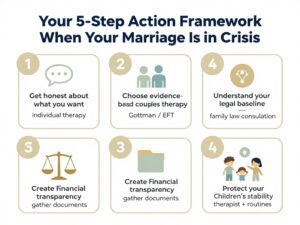
Here is a practical, legally grounded framework for acting with intention when you recognize the signs described above.
Step 1: Get Honest About What You Actually Want
Before any external intervention, before couples therapy, before legal consultation, before difficult conversations with your spouse, you need to get clear on what you actually want.
This sounds simple. It is not.
Most people who are unhappy in their marriages are not actually sure whether they want to save the marriage or end it. They want the pain to stop. They want to feel seen and valued. They want their partner to change, or to understand the impact of their behavior, or to show up differently. They want their family to stay intact. They want to feel like themselves again. They want relief.
These are valid desires. But they are not the same as a clear answer to the question: “Do I want to stay married to this person and build a different kind of relationship with them, or has this relationship run its course?”
Getting clear on that answer, honestly, without judgment, without rushing toward either outcome because it feels more comfortable or more heroic, is the foundational work. A skilled individual therapist is your best resource here. Not a couples therapist, not yet. A therapist working with you alone, confidentially, to help you understand your own experience of this marriage and your own vision for your future.
That clarity will determine everything else. The intervention you need if you want to stay is entirely different from the preparation you need if you are moving toward separation.
Step 2: Choose Couples Therapy Strategically
If you want to work on the marriage, therapy is not optional. Insight without intervention produces very little change in established relational patterns.
But choosing the right therapeutic approach matters enormously. Not all couples therapy is the same. Couples therapists vary significantly in training, approach, and effectiveness for different presenting problems.
The two approaches with the strongest evidence base for marital intervention are:
Gottman Method Couples Therapy, developed from decades of marital research, focuses on building friendship and intimacy, managing conflict constructively, and creating shared meaning. It is particularly effective for couples dealing with communication breakdown, contempt patterns, and emotional disconnection.
Emotionally Focused Therapy (EFT), developed by Dr. Sue Johnson, focuses on the emotional attachment patterns underlying conflict, helping couples identify the deeper vulnerabilities and fears driving their surface-level arguments. It is particularly effective for couples dealing with emotional withdrawal, intimacy breakdown, and recurring conflict cycles.
Both approaches have significant peer-reviewed research supporting their effectiveness. Both require a trained, certified therapist to deliver properly. When you are selecting a couples therapist, ask specifically about their training in these models and their experience with the specific issues your marriage is facing.
Commit to a meaningful trial period, typically a minimum of twelve to sixteen sessions, before making any major decisions. Change in deeply entrenched relational patterns takes time, and premature assessment of therapy’s effectiveness is one of the most common reasons couples abandon the process before it has had a real chance to work.
Step 3: Understand Your Legal Baseline, Even If You Hope to Avoid It
One of the most important things I tell clients who are trying to save their marriages is this: understanding your legal rights does not mean you are committed to using them.
A family law consultation at this stage, before any filing, before any formal separation, is not an act of aggression or disloyalty toward your marriage. It is an act of self-awareness. It gives you information you need to make clear decisions. It removes the fear of the unknown that often prevents people from thinking clearly about their situation.
In a confidential initial consultation with a family law attorney, you can learn:
How your state handles asset division and what “marital property” includes under your jurisdiction’s laws.
How spousal support, also called alimony, is calculated in your state and what factors affect eligibility.
What your parenting rights are if you and your spouse separate, and how custody determinations are made in your jurisdiction.
What the process and timeline of divorce looks like in your specific county and court.
What documents you should be gathering and securing regardless of what you decide.
This knowledge does not commit you to anything. But it removes the fear that can make people stay in unhappy marriages out of terror of the unknown, or make people stay in conflict-avoidance mode until the situation becomes much more complicated and expensive to resolve.
Knowledge is not the same as a decision. But it is the foundation for making a good one.
Step 4: Create Financial Transparency, Immediately
Whether you are working toward reconciliation or quietly preparing for the possibility of separation, financial transparency is non-negotiable.
If you don’t know what you own, what you owe, what your household income and expenses are, and what your individual financial footprint looks like, you are operating without essential information. That lack of clarity leaves you vulnerable regardless of what direction your marriage takes.
Gather the following documents and understand their contents:
All joint and individual bank account statements for the past three to five years. All credit card statements. Federal and state tax returns for the past three to five years. Mortgage documents and current account balance. Investment and retirement account statements, including 401(k), IRA, and any pension information. Life insurance policies and current cash values. Any business ownership documents, partnership agreements, or shareholder records. Vehicle titles and loan balances. Any significant personal property, jewelry, art, or collections of value.
Store digital copies in a password-protected account that only you can access. Store physical copies in a location your spouse cannot access.
This is not about building a case against your spouse. It is about ensuring that you have the information you need to make informed decisions and, if necessary, to participate meaningfully in financial disclosure during divorce proceedings.
Step 5: Protect Your Children’s Stability, No Matter What
Whatever happens in your marriage, your children’s wellbeing is the throughline that should guide every decision you make from this point forward.
This means maintaining their routines as consistently as possible, regardless of the tension in the household. It means shielding them from adult conflict while acknowledging honestly and age-appropriately that the family is going through a difficult time. It means ensuring they have access to therapeutic support, whether through a school counselor, a child therapist, or a pediatrician who can assess their emotional health.
It also means being thoughtful about what you model. Children learn how to navigate conflict, disappointment, and change by watching the adults in their lives. How you handle this period, with integrity, with self-awareness, with genuine concern for their wellbeing, is a form of parenting that will shape them in ways that extend far beyond this specific crisis.
From a legal standpoint, courts making custody determinations look specifically at how each parent has behaved during the period of marital breakdown. Parents who have prioritized their children’s stability and maintained cooperative co-parenting behavior, even in difficult circumstances, consistently receive more favorable judicial consideration than parents who have allowed marital conflict to bleed into their parenting behavior.
Your children don’t need perfect parents. They need present, honest, stable ones.
The Legal Insight Paragraph
In my 19 years of family law practice, what I’ve seen most often is that the people who come to me most prepared, most clear-headed, and most able to navigate the legal process with their dignity and their family relationships intact, are rarely the people who acted fastest. They are the people who acted most honestly. The clients who spent six months in individual therapy before making any decisions. The clients who gathered their financial documents quietly and methodically before ever mentioning separation. The clients who, when they finally made the call to consult an attorney, came in knowing what they had, knowing what they wanted for their children, and knowing what kind of post-divorce relationship with their co-parent they were committed to building. What most people don’t realize is that the decisions you make in the months before divorce paperwork is filed have more impact on your final settlement than almost anything that happens after filing. The degree to which you are informed, organized, and emotionally clear when that process begins directly determines how cooperative or how adversarial it becomes, and how much it costs you financially and emotionally. The silent signs of a failing marriage are not just relationship warnings. They are your window for preparation. And preparation, more than anything else I’ve seen in two decades of this work, is what determines outcomes.
When to Consult a Specialist
The following situations require specific professional intervention, not simply general reflection or couples therapy. Each represents a legal or clinical threshold where specialized expertise is necessary to protect your rights and your family’s wellbeing.
If you discover that your spouse has opened undisclosed financial accounts, made unexplained asset transfers, or removed significant funds from joint accounts, consult a family law attorney and a forensic accountant within 30 days. Unexplained financial activity during a troubled marriage can constitute dissipation of marital assets, which is legally actionable in divorce proceedings. Delay allows further concealment and complicates your ability to establish the accurate financial picture a court requires.
If your spouse has served you with divorce papers, filed a separation petition, or submitted any court filing, you have an extremely limited timeframe to respond, typically 20 to 30 days depending on your jurisdiction, before a default judgment may be entered against you. Contact a family law attorney immediately upon receiving any court document. A default judgment can result in a settlement imposed by the court without your meaningful participation.
If your marriage involves any history of domestic violence, coercive control, financial abuse, or threats of any kind, contact a domestic violence attorney or a family law attorney with specific domestic violence experience before taking any other action. These circumstances affect your right to protective orders, your custody positioning, and your safety during the separation process in ways that require specialized legal strategy.
If your household includes a business, significant investment assets, retirement accounts with substantial balances, real property in multiple states, or complex financial instruments, consult a family law attorney and a certified divorce financial analyst (CDFA) before agreeing to any settlement terms. Complex asset division requires expert analysis that goes beyond what either spouse or a general practice attorney can reliably provide.
If you are witnessing behavioral changes in your children that suggest emotional distress, including regression, anxiety, withdrawal, or academic decline, consult a licensed child psychologist or child and adolescent therapist within two weeks. Early therapeutic intervention is demonstrably more effective than delayed intervention, and a therapist’s documented assessment of your child’s needs can be valuable in subsequent custody proceedings.
If you have been the primary financial provider and your spouse is threatening to relocate with your children, contact a family law attorney immediately. Parental relocation, particularly across state lines, triggers specific legal procedures and filing requirements that vary by state but that generally require court approval or the other parent’s written consent. If a relocation is imminent, emergency motions for custody orders may be available and necessary.
If your divorce involves significant spousal support considerations and either party has complex income structures, including self-employment, bonus structures, stock compensation, or business income, consult a family law attorney with specific experience in high-income divorce and consider retaining a vocational expert or financial expert to assist in establishing income for support calculation purposes.
The Path Forward: What You Do Next Matters More Than You Think
You started this article looking for signs. Some of them, I imagine, landed with uncomfortable recognition. That recognition is not a failure. It is the beginning of clarity.
Here is the most important legal and practical takeaway from everything I’ve shared with you: the decisions made in the quiet period, before the crisis point, before the paperwork, before the attorneys and the court dates and the formal separation, are the most consequential decisions of this entire process. The person who understands their financial situation, who has gotten therapeutic support, who knows their legal baseline, and who has been honest with themselves about what is happening in their marriage, is the person who navigates what comes next with the most options and the most control.
You have not lost any options yet. If anything, reading this article means you are still in the window where options exist.
Here is your next step: schedule one appointment this week. It might be with a couples therapist. It might be with an individual therapist. It might be a confidential consultation with a family law attorney in your state. It might be with a financial advisor to get clarity on your financial picture. One appointment. One step toward clarity. That is the only commitment I’m asking you to make today.
As I’ve seen with many clients, the act of making that appointment, moving from paralysis to purposeful action, is itself the turning point. Everything becomes slightly more navigable once you’ve taken the first step from knowing something is wrong to doing something about it.
Share this article with someone who is quietly going through something similar. They may not be ready to say it out loud yet. But seeing themselves reflected in these signs, and knowing that options exist and that clarity is possible, might be exactly what they need.
Drop a comment below: Which of these nine signs resonated most with you? Your experience might be exactly what another reader needs to hear.
A Final Word on Getting Expert Family Law Support
For those who are ready to understand the formal legal process, the American Bar Association’s family law resources provide authoritative guidance on finding qualified family law attorneys in your jurisdiction, understanding the divorce process, and knowing what questions to ask before retaining counsel.
You deserve to make decisions based on clear information, not fear or confusion. That is precisely what qualified legal and therapeutic support exists to provide.
Legal Disclaimer
This article is for informational purposes only and does not constitute legal advice. Laws vary by state and jurisdiction. Always consult a licensed family law attorney before making any decisions about your divorce, separation, or custody matter.
Article written by Attorney Sarah Mitchell, family law attorney with 19 years of litigation and mediation experience. Published exclusively on divorceprolaw.com.